The camping skills that matter most for children are the ones that keep them safe and make them useful at camp: staying put if lost, helping choose and set up a campsite, packing their own bag, reading a simple map, cooking and fire safety with an adult, and leaving nature as they found it. Children learn these best in small steps, with real jobs, long before the first night under canvas. This guide shows what to teach at each age, where each skill tends to go wrong, and how Singapore’s heat, storms and wildlife change the lessons.
Key Takeaways
- Preparation and staying put matter more than dramatic survival tricks, because they make a dangerous situation unlikely to start.
- Every skill can be split by age: little ones gather, carry and fill, older children plan, cook and navigate.
- In Singapore, weather checks, sun protection and wildlife manners are camping skills too, not extras.
- Practice at home first (a backyard or living-room tent, a packing checklist, a treasure-hunt map) so the real trip is a repeat, not a first.
- Guided programs with trained facilitators let children practise these skills with peers, which is often easier than learning them from a parent.
Table of Contents
- Which Camping Skills Matter Most
- Staying Put: The First Safety Skill
- Choosing a Campsite and Pitching a Tent
- Packing and Camp Chores
- Maps, Compasses and Knots
- Camp Cooking and Fire Safety
- Weather, Heat and Wildlife in Singapore
- Leave No Trace and Respect for Nature
- How to Teach It: Build Up in Stages
- Where Resilience Fits In
- Our Perspective
- Turning Practice Into a Program
- FAQ
- Sources
Which Camping Skills Matter Most
Parents often start with fire-building and knots because they look like “real” camping. Experts put the order differently. Green Child Magazine’s Linda McGurk argues that preparation matters more than dramatic survival skills, because good preparation reduces the chance a child ever needs them. She also notes that shelter is a top priority in survival situations, because exposure to the elements is the greatest danger to a lost child.
A practical order for families:
- Staying safe: stay put if lost, know the ground rules, carry a whistle.
- Campsite and shelter: choosing ground, pitching and packing away a tent.
- Packing and chores: carrying their own kit and doing a fair share.
- Finding the way: simple maps, landmarks, later a compass.
- Food and fire: cooking, kitchen rules, fire safety.
- Weather and wildlife: reading conditions and respecting animals.
- Leave No Trace: rubbish, plants, rocks and toilet habits.
The table below gives a realistic starting point. Treat the ages as a guide, since children vary a lot.
| Skill | Ages 3 to 5 | Ages 6 to 9 | Ages 10 to 13 |
|---|---|---|---|
| Staying safe | Stay put, blow a whistle | Know the ground rules, buddy system | Plan a route and share it with an adult |
| Tent and campsite | Carry pegs, hold poles | Help pitch, roll out sleeping bag | Choose the spot, pitch and strike a tent |
| Packing | Pick a toy and a hat from a checklist | Pack own bag from a list | Plan the list for the whole trip |
| Navigation | Treasure hunt with landmark pictures | Simple sketch map | Map and compass basics |
| Cooking | Wash fruit, fill water bottles | Prepare simple food, wash up | Cook a meal with supervision |
| Nature | Wildlife dos and don’ts | Spot hazards, follow trail rules | Lead Leave No Trace habits |
Staying Put: The First Safety Skill
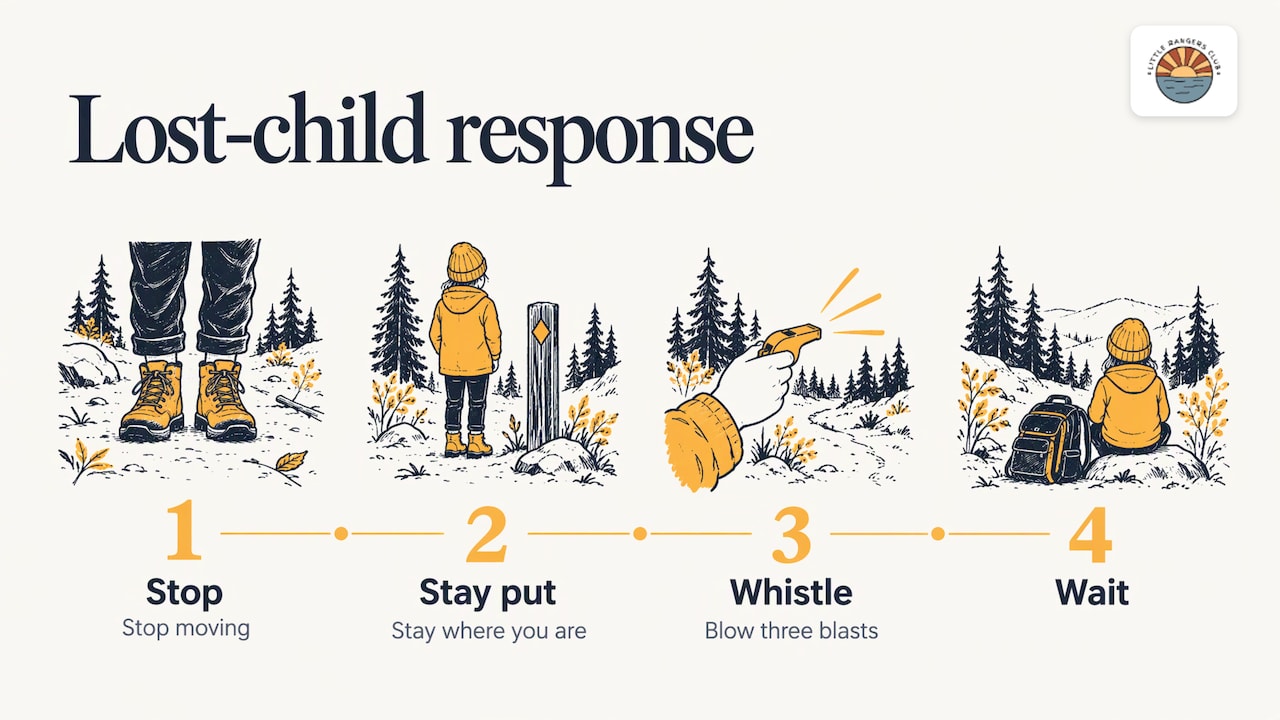
If your child learns only one thing, make it this. Orlando Science Center’s outdoor safety guidance names staying put when lost as the most important skill, since the farther a child wanders, the harder rescuers find them. Teach it as a game. Ask “what do you do if you can’t see me?” on every walk until the answer is automatic: stop, stay where you are, blow the whistle in three blasts, and wait.
A small explorer’s kit helps. The same guidance suggests sunscreen, bug spray, a whistle, a flashlight, a poncho, water, snacks, a laminated emergency contact card and basic first-aid items. In Singapore, add a small towel and a spare dry shirt for sudden rain.
Where it goes wrong: children whisper the rule at home and forget it when excited. Repeat it at the start of every outing, and practise the whistle so it is not a surprise sound in the field.
Choosing a Campsite and Pitching a Tent
Pitching a tent looks simple until pegs bend, poles go in the wrong sleeves and the wind picks up. Break it into jobs a child can own.
Choosing the spot. Cadets in Singapore’s St John’s CCC/203 camping badge learn to judge ground condition and drainage, shelter from wind and weather, distance to water and environmental hazards, then sketch a campsite layout. That is a good checklist for any child aged about nine and up: look up for dead branches, look down for ant trails and puddles, and look around for slopes.
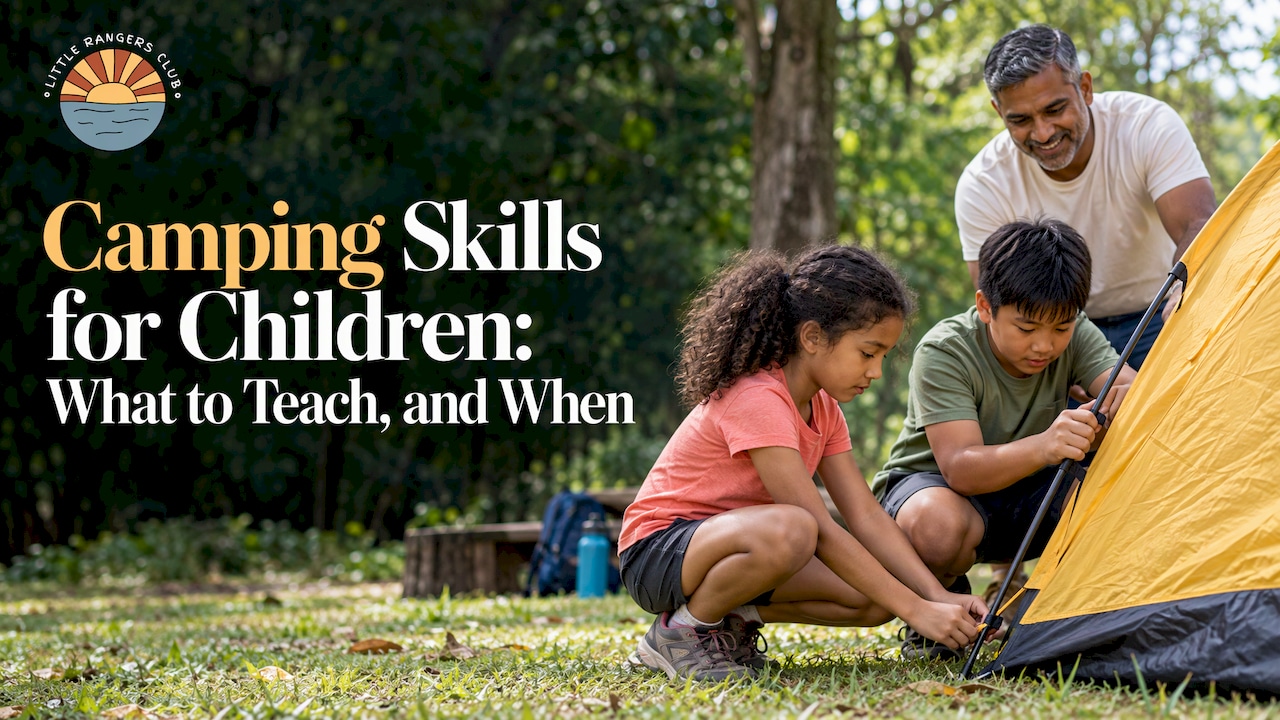
Pitching and striking. The same badge has cadets pitch and strike a tent with supervision, using pegs, poles and guy lines correctly. Younger children can hold the poles, hammer pegs with a soft mallet and pull guy lines tight. Girl Guides Singapore’s beginner camper requirements go further: know how to pitch, air and clean a tent, and strike and pack it up afterwards. The packing-away step is the one families skip, and it is where tents get damp, mouldy and ruined in our humid climate.
Practice first. REI suggests pitching the tent at home first so children feel comfortable in a new sleeping space. A tent in the living room for one afternoon removes most of the fear of the first night.
Packing and Camp Chores
Letting children pack is a skill lesson disguised as a chore. The US National Park Service recommends involving children in packing by asking questions such as what clothes they will need when it is hot by day and cold at night, and packing in layers. In Singapore, the version is: what do you wear when it is hot, when it rains, and when the tent is damp at dawn?
Try this routine:
- Write a checklist together with pictures for non-readers.
- Lay everything out on the floor.
- Let the child pack their own bag, then check it together.
- Have them carry it around the block to learn what “too heavy” feels like.
Girl Guides Singapore expects beginners to pack all their belongings into a backpack, including a personal meal bag without disposable utensils. That is a good standard to borrow.
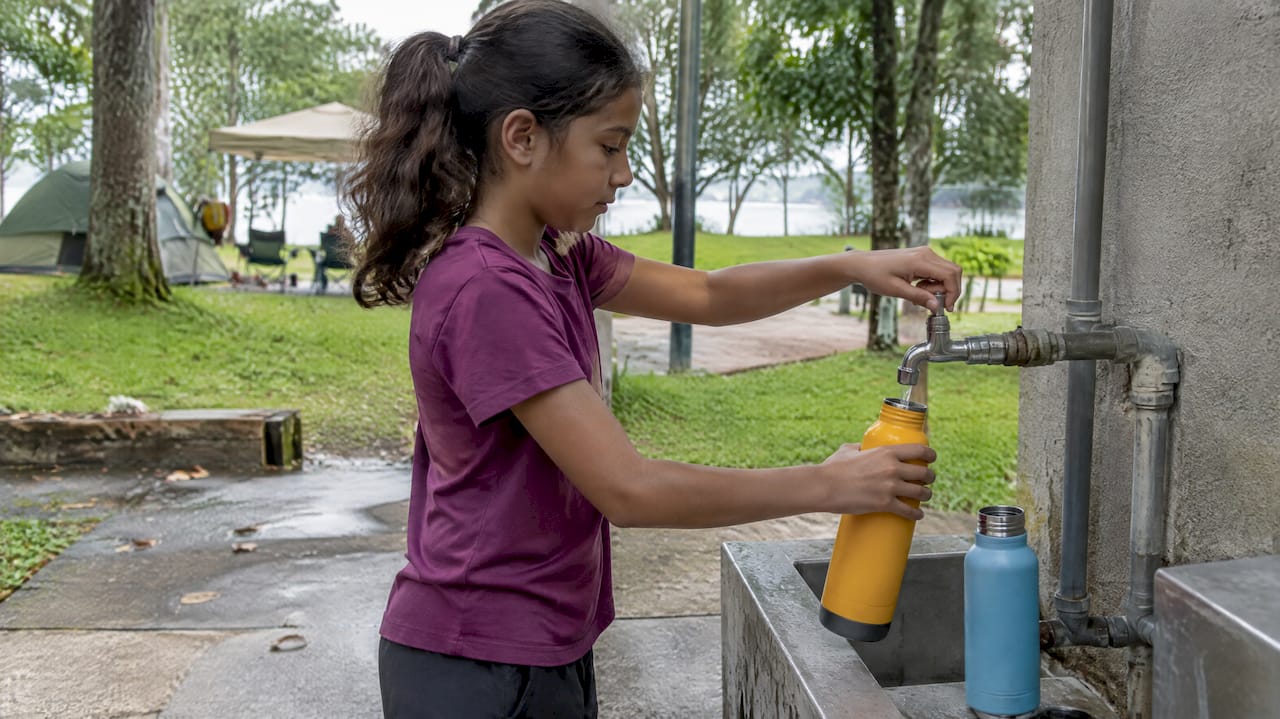
On chores, the Park Service suggests little ones gather kindling or fill water bottles, while older children prepare food, wash dishes or set up their own tents. REI makes the same point: involving children is the aim, even when you could finish faster alone. The extra five minutes is the lesson.
Maps, Compasses and Knots
Navigation grows from play. Green Child Magazine recommends treasure hunts with simple landmark maps for younger children and topographical map and compass orienteering for older ones. A park near home works well: draw a map with the playground, the big tree and the bridge, hide a small prize, and let your child lead you.
For older children, add a compass one step at a time: find north, line up a landmark, walk twenty steps, check. Singapore’s trails are well marked, so practise on a short loop where you can see them.
Knots are the other classic. Two or three are enough at the start: a stopper knot, a square knot to join ropes and a simple hitch to tie a tarp. Singapore’s wildlife attractions now teach this to children too; The Straits Times reported that Mandai’s ZooSchool programme would teach knot-tying, map reading and first aid to build resilience and critical thinking. That shows how mainstream these skills have become in local child education.
Camp Cooking and Fire Safety
Cooking is where confidence shows up fastest. OSU Extension lists outdoor cooking as a way to teach food preparation, recipe following and fire management, plus basic science such as heat and measuring. It also notes that leaders need first aid and food-safety knowledge, a reminder that this area needs an adult in charge.
A simple split:
- Ages 3 to 5: washing fruit, tearing lettuce, carrying plates. Stay well back from any flame.
- Ages 6 to 9: mixing, spreading, measuring and clearing up, with an adult handling the stove.
- Ages 10 to 13: following a recipe and cooking on a camp stove with an adult beside them.
On knives, Green Child Magazine says knife skills can be taught safely early with a child-specific knife that has a rounded tip and finger guards. For water, it suggests treating purification practice as a game and collecting from moving sources such as streams, not stagnant water.
The pre-school camp featured by The Straits Times shows good kitchen discipline. The six-year-olds followed rules of no running, no jumping and no playing with knives or fire, and recipes were test-cooked in school before the camp. Copy that: rehearse the menu at home first.
Fire itself should always be adult-led for children in this age range. Teach the respect rules (a clear circle, water nearby, never leave it unattended) before any hands-on practice, and be aware that open fires are not allowed in most Singapore campsites, so a camp stove is the more realistic skill here.
Weather, Heat and Wildlife in Singapore
This is the part generic camping guides miss. Our weather turns fast, and our wildlife is on the doorstep.
Weather. NParks’ Kids For Nature guide tells teachers to check the weather before outdoor lessons on the NEA website (weather.gov.sg) or the Lightning Advisory number 6282 6821, and to avoid bringing children outdoors in heavy rain or when there is lightning risk. Children aged eight and up can learn to do this check themselves, and to know what the plan is when a storm closes in.
Ground rules. The same guide briefs students to stay together, respect plants and animals, keep food in bags and stay on the trail. It also advises checking for red ants near trees, and having a first-aid kit with children’s medical conditions noted.
Sun. Orlando Science Center points out that UVA rays reach through clouds, so sun protection counts on overcast days too. Hats, sunscreen and water breaks are a daily habit, not a beach-only one.
Wildlife. NParks’ responsible human-wildlife encounters resource, aimed at ages 4 to 6, teaches which wildlife children may meet in Singapore, where it lives, and how to behave around it in green spaces. The simple rule to teach: look, don’t touch, don’t feed, step back and tell an adult. NParks’ guide for teachers adds the same instruction for any potentially dangerous animal: move away and inform an adult.
Leave No Trace and Respect for Nature
REI advises teaching children to respect wildlife, dispose of rubbish properly, leave rocks and plants where they found them, and follow proper toilet practices in unimproved areas. Scouting America’s Outdoor Adventurer adventure turns this into activity: children work out what to bring on an overnight campout, set up the campsite kitchen and eating area before their own tent, explain how to keep food safe, and discuss how they followed Leave No Trace.
A nice habit for any age: do a “last look” circle before leaving, where each child finds three pieces of rubbish that are not theirs. NParks frames this as part of its Singapore Green Plan 2030 City in Nature vision, saying children should learn to co-exist with wildlife from a young age.
How to Teach It: Build Up in Stages
The best evidence that preparation beats improvisation comes from a local pre-school. The Straits Times described 33 six-year-olds who took a three-day, two-night camp on St John’s Island in 2023. Seven months earlier they had built up cycling endurance to 5km. They then worked with teachers on the menu, packing list, timetable and duty roster, and learned camping safety and environmental awareness. Their teacher’s view was that age-appropriate new experiences help children learn self-care and independence.
You can use the same arc at home:
- Month 1: Short park walks, the whistle rule, a packing checklist.
- Month 2: Backyard or living-room tent, a map treasure hunt, simple chores.
- Month 3: A day trip with a packed lunch the child prepared, plus a weather check.
- Month 4: A first overnight with an adult, with children running the routine.
Schools and providers use the same idea. UWCSEA describes how the camp craft strand of its expedition skills is developed through age-appropriate activities in each grade from Kindergarten to Grade 11. And for any organised outdoor program, Singapore’s SS 710:2024 code of practice for outdoor adventure education sets minimum requirements for planning and delivery, covering provider accountability, supervisor competence and risk management. It is a useful reference point when you compare programs.
For more on what to teach at each age, see our guide to outdoor survival skills for kids. For what to ask about supervision, read child safety at outdoor camps.
Where Resilience Fits In
Skills are only half of camping. The other half is how a child handles a wet shoe, a failed fire-lighting attempt or a tent that collapses. Tasks with small, safe setbacks build that. Let your child struggle for a minute before you step in, and praise the second attempt. If you want ideas that build the same habit without a campsite, try these resilience-building activities for kids.
Our Perspective
Parents often tell us they want their child to “be more independent outdoors”. In our experience of the topic, independence is not one big skill. It is a pile of small ones: carrying your own bag, asking for help early, working with a buddy, and keeping going when it rains.
That is why we put so much weight on teamwork, resilience and problem-solving alongside the practical skills. Our programs for children aged 3 to 13 blend indoor and outdoor learning, from adventure activities and nature exploration to outdoor survival training, and they are run by facilitators who care about safety and quality instruction.
A child who practises with peers and a trained facilitator tends to try things they would not try in front of a parent. Parents then pick up the routine at home, in the park or on the family’s first camp. We think that combination, fun first and learning built in, is the most reliable way to build confidence.
Joshua
Turning Practice Into a Program
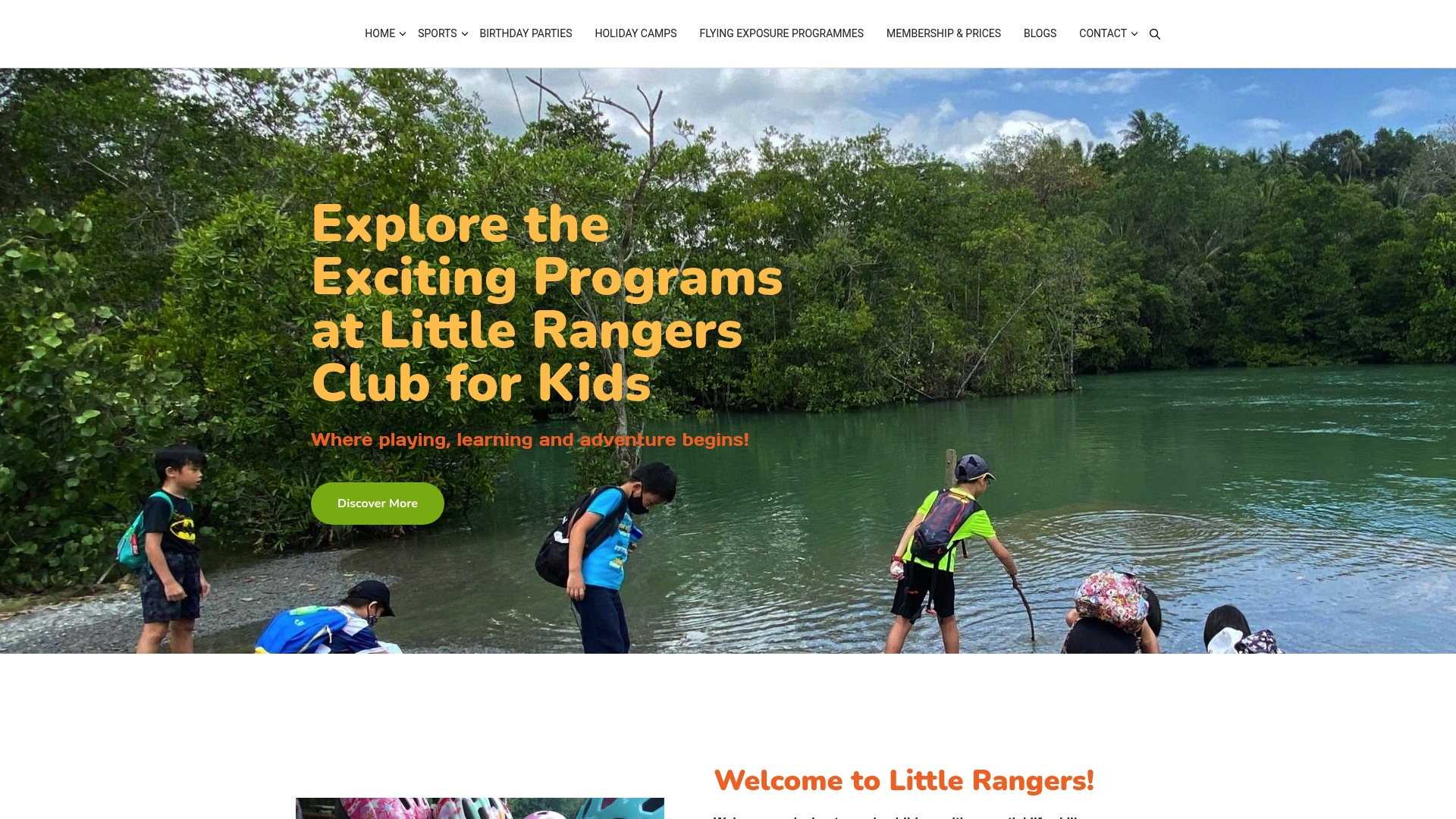
If you would like your child to practise these skills with trained facilitators and other children, our Little Rangers Holiday Camps bring together adventure, outdoor learning and life skills for children aged 3 to 13. For a regular rhythm during term time, the 10 Sessions Weekly Class Package is $280 one-off. Schools and kindergartens planning year-end or field activities can start from our school programs and partnerships page.
If you are comparing options, our guides to outdoor adventure camps in Singapore and outdoor activities for kids are good next reads.
FAQ
At what age can children start learning camping skills?
From about three. Young children can carry pegs, fill water bottles, follow a treasure-hunt map and learn to stay put and use a whistle. Skills such as pitching a tent, camp cooking and compass work fit better from about six to ten, with an adult close by.
What are the most important camping skills for a first trip?
Staying put if lost, packing their own bag, helping set up the tent and following ground rules come first. Add weather awareness and sun protection for Singapore. Cooking and navigation can grow on later trips.
How do I teach camping skills if we have never camped?
Start at home. Pitch a tent in the living room, pack a bag from a checklist, make a landmark map of your neighborhood park and cook a simple meal together. A short guided program also lets children try these skills with trained facilitators and other children.
Are there Singapore-specific things to teach?
Yes. Teach children to check the weather and the lightning advisory, to stay out of the open in storms, to watch for red ants near trees, and to keep a respectful distance from wildlife. NParks publishes guidance that covers these points for school groups.
Sources
- Camping and Campcraft CCC/203, St John Singapore
- Girl Guides Singapore outdoor guidelines
- Camping with Kids, U.S. National Park Service
- Tips for Camping with Kids, REI
- Survival Skills for Kids, Green Child Magazine
- Outdoor Cooking, OSU Extension Service
- Kids For Nature Programme guide, NParks
- Responsible human-wildlife encounters, NParks
- Outdoor Adventurer, Scouting America
- Pre-school without walls, The Straits Times
- New ZooSchool for children, The Straits Times
- Foundation skills in outdoor education, UWCSEA
- SS 710:2024 code of practice for outdoor adventure education