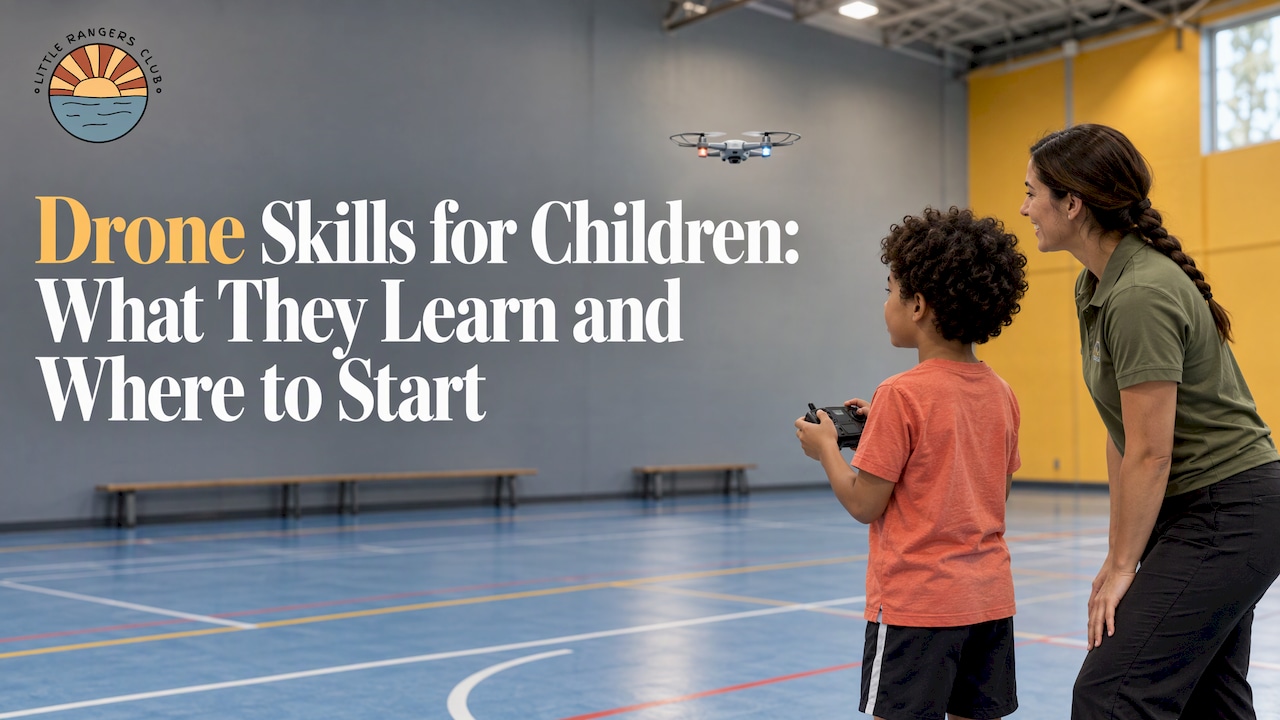
Children who fly drones practise hand-eye coordination, spatial thinking, sequencing and calm problem-solving, and they can start from about age 6 with a guided session. In Singapore, the safest and fastest route is a supervised course where the aircraft, the space and the rules are already sorted. Our Basic Build & Fly Course ($60 per person) has children assemble a drone and then fly it under a facilitator’s eye.
Key Takeaways
- Drone flying trains spatial visualization and sequencing. A small six-week study of third graders found significant gains in both.
- Singapore sets no age limit for recreational flying of a drone up to 1.5kg, but CAAS recommends adult supervision for under-16s.
- A child under 16 cannot register a drone. A parent or other eligible adult must, for any drone above 250g.
- Building a drone first, then flying it, gives a child the most to learn: mechanics, controls and judgment together.
- A guided session indoors or at an approved venue removes the biggest practical problem: finding a legal place to fly.
Table of Contents
- What drone skills do children actually learn?
- From flying to building to programming: the usual path
- Drones in Singapore’s schools and national programmes
- How old should a child be?
- Singapore’s rules every parent should know
- Where can a child legally practise?
- A checklist for parents and schools
- What a first session with us looks like
- Making drone skills stick between sessions
- Our perspective
- Book a first drone session
- FAQ
- Sources
What drone skills do children actually learn?
A drone is a flying lesson in cause and effect. Push the stick, and the aircraft answers a moment later. A child learns to read that delay, correct it, and plan the next move. Four skills show up again and again.
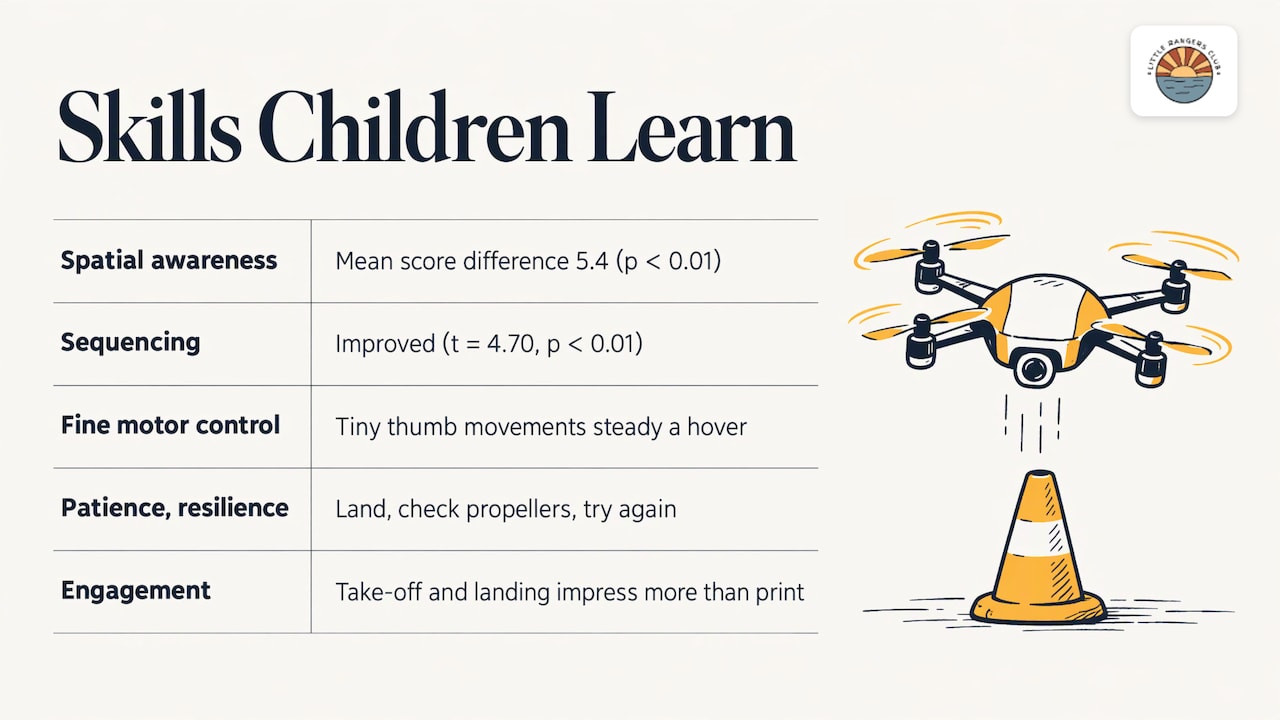
Spatial awareness. A drone moves in three dimensions, and the child watches it from the outside while thinking of it from the inside: which way is it facing, how far above the cone is it? In a six-week after-school drone programming study of 10 third graders in Taiwan, spatial visualization scores rose significantly (mean difference 5.4, p < 0.01). The author argues that flying lets students physically experience 3D sensations of their surroundings.
Sequencing and planning. The same study found a significant improvement in sequencing (t = 4.70, p < 0.01). Sequencing means putting steps in the right order: take off, climb, turn, hold, land. It is the same habit that later helps with maths working and with code. The study is small, so treat it as a promising signal and not a guarantee.
Fine motor control and hand-eye coordination. Holding a hover or flying a gentle circuit asks for tiny, steady thumb movements. Young pilots usually overcorrect at first, then learn to be smooth.
Patience and resilience. Crashes happen, especially in the first session. A child who lands a bumped drone, checks the propellers and tries again is practising exactly the persistence we want children to carry into everything else.
There is a fifth benefit that is easy to miss: engagement. The authors of a Springer chapter on teaching STEM with drones note that a beginner is more likely to be impressed when a drone takes off and lands than when they only see a printed line on a screen. Children who say they dislike “coding” or “science” often change their minds when the result moves through the air.
From flying to building to programming: the usual path
Drone activity for children tends to progress through three layers. A child does not need to complete one before enjoying the next, but the order is a useful guide.
Stage 1: Basic flying
Children learn the controls, the safe launch and landing routine, and how to hold a steady hover. They then fly a simple circuit around markers. This stage is about confidence and control, and it suits ages 6 and up in a supervised session.
Stage 2: Building
Assembling a drone teaches children what each part does: frame, motors, propellers, battery, flight controller. The Springer chapter lists mechanical design, electricity and electronics, and motion and kinematics among the STEM topics teachable with drones. A child who has built the aircraft understands why it tilts, why a bent propeller matters, and why the battery limits flight time.
Stage 3: Programming
Older children can move on to commanding the drone with code. The same chapter suggests block-based tools such as Scratch for younger students, then code-based languages such as Python as they progress. Singapore’s older students already do this at scale: in the 2025 National Youth Tech Championship, more than 320 students from 67 secondary schools spent six weeks programming AI-enabled drones to fly an obstacle course on their own. Edgefield Secondary School’s applied learning programme has students program and deploy drones to survey 8,000 square metres in 8 minutes in a simulated earthquake search.
The point for parents: the skills a 7-year-old picks up on a basic build-and-fly morning are the foundation of what these teenagers do.
Drones in Singapore’s schools and national programmes
Drone flying is not a fringe hobby here. The NCC Quadcopter Drone Programme, described by then-Minister for Education Chan Chun Sing on 9 September 2021, teaches cadets the principles of flight and how to use drones to solve problems in civilian and military settings. Students who arrive at secondary school having already built and flown a drone start with an obvious advantage over classmates seeing the controls for the first time.
How old should a child be?
There is no single magic age, but there are clear practical markers.
- Ages 3 to 5: too young for controlled flying. Aviation themed play, paper planes and watching a demonstration are better fits.
- Ages 6 to 8: ready for guided build-and-fly sessions, if they can follow a short instruction sequence and sit with a task for around an hour.
- Ages 9 to 13: ready for longer builds, circuit flying, simple challenges and, later, block-based programming.
Our build-and-fly courses are listed for children from 6 years up, and a facilitator adjusts how much help each child gets. If your child is also curious about aircraft more broadly, our young aviators programmes and flight simulator experiences sit alongside the drone work and teach cockpit thinking in a different way.
Singapore’s rules every parent should know
Drone flying is regulated here, and the rules change what a family can do at home. Here is what the Civil Aviation Authority of Singapore (CAAS) says.
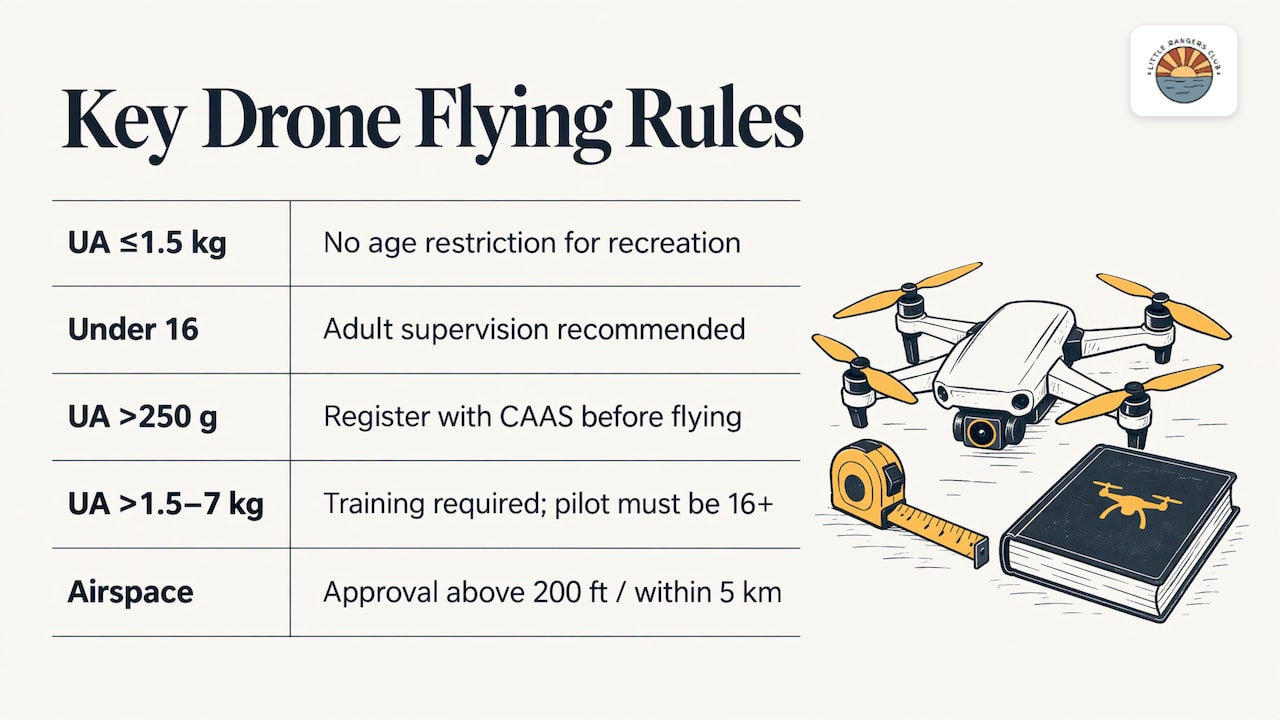
Age and supervision. CAAS states there are no age restrictions for recreational flying of an unmanned aircraft (UA) not exceeding 1.5kg, but it recommends adult supervision for operators below 16. For a UA above 1.5kg and up to 7kg, an operator below 16 must be supervised by someone who has met the corresponding pilot competency requirements.
Registration. Any UA with a total weight above 250 grams must be registered with CAAS before it is flown, and operating an unregistered one has been an offence since 2 April 2020. A person below 16 cannot register a UA. A parent or legal guardian should register it, and the registered owner is responsible for what the UA does.
Training for heavier aircraft. Anyone flying a UA above 1.5kg and up to 7kg for recreation or education needs UA Basic Training, a one-time course of about two hours, and must be at least 16 at the point of flying. An exemption applies to indoor flying in a non-publicly accessible area with fewer than 50 people. Children’s beginner drones are typically far lighter than this, but check the weight on the box.
Height and distance. CAAS’s aeronautical information publication states that unmanned aircraft operations are not permitted above 200ft or within 5km of an aerodrome without the required approvals. Much of Singapore sits near an airport or military airfield, so this alone rules out many neighbourhoods.
Prohibited areas and penalties. Under the Air Navigation (Unmanned Aircraft) Regulations 2019, operating a UA outdoors in a prohibited area carries a fine of up to $50,000 or up to 2 years in prison for a first offence, and up to $100,000 or 5 years for later ones. The consequences are serious enough that a stray flight over the wrong area is not worth the risk. The risk is real: in one incident, drone sightings closed a Changi runway for 10 hours, delaying 37 flights.
Parks. NParks lists places where kites and drones cannot be flown, including Bukit Timah Nature Reserve, Changi Beach Park, Fort Canning Park, Jurong Lake Gardens, the Singapore Botanic Gardens and others. See NParks’ kite and drone flying page for the full list before you pack the car.
Where can a child legally practise?
This is the question that stops most families. A flat, a void deck and a neighbourhood park are all poor choices. CAAS maintains designated Unmanned Aircraft Flying Areas, with open-field sites at Pandan Reservoir and Dover. In 2026 it also began a trial of the first enclosed-facility flying areas, in repurposed courts at four SAFRA clubhouses, with drone gates and signage on the rules. Because trials change, check the CAAS announcement for the current status and conditions.
For a child who is just starting, a guided session solves the venue question, the registration question and the supervision question in one booking. That is the main reason we run drone sessions the way we do.
A checklist for parents and schools
Whatever route you choose, run through this before the first session:
- Check the weight. Under 250g needs no registration. Above 250g, an adult must register the aircraft.
- Check the place. Is it outside prohibited areas and the 5km aerodrome zone, or is it an approved indoor or designated space?
- Check supervision. Under-16s should have an adult beside them, and a trained facilitator is better still.
- Check the group size. One instructor to a small group gives each child real flight time.
- Check the build. Does the child assemble the aircraft, or only fly a ready-made one? The building is where much of the learning sits.
- Check what to wear. Closed shoes and comfortable, durable play clothes, such as these durable kids’ play outfits, keep a child focused on flying and not on scuffed knees.
Schools planning a drone activity for a whole level can use the same list, then add a head count, a rain plan and a clear role for each teacher.
What a first session with us looks like
Our drone offers form a ladder, so a child can step up without repeating what they know:
| Programme | Price | What it is |
|---|---|---|
| Basic Build & Fly Course | $60 per person | Build a drone, then fly it (listed as a 1.5-hour course for ages 6 and up) |
| Advance Build & Fly Course | $50 per person | A step up for children who have already built and flown |
| Hall-of-Fame Drone Fly Sessions | $16-25 per person | Flying sessions for returning pilots |
| Aviation Exposure School Programme | $105 per student | A programme for schools that brings aviation and flying activities to students |
For a first-timer, begin with the basic course. For a child who flies already and wants more air time, the Hall-of-Fame sessions are the lightest commitment. If your child loves aircraft in general, the 30-minute and 60-minute simulator experiences ($55 and $95 per person) let them practise cockpit controls, and the aviation activities for kids guide has ideas for home too.
Making drone skills stick between sessions
Learning sticks when a child gets to repeat and extend it. A few habits help.
- Talk through the flight. Ask your child to explain what they will do before takeoff: “climb, turn left at the cone, land.” This is sequencing practice in plain words.
- Give a small mission. “Fly the circuit without touching the markers” teaches more than free flying.
- Let them fix things. A child who replaces a bent propeller learns more about aircraft than one who is handed a repaired drone.
- Mix in movement. Balance, coordination and teamwork from sport carry over to calm, steady piloting. Our multi-sports programmes are designed to build those foundations.
- Keep sessions short. Twenty focused minutes of flying beats an hour of frustration.
Our perspective
We run drone sessions as part of a wider idea: children learn best when the activity is real, a little challenging and supervised by someone who knows the group.
A drone is a good example. It looks like a toy, yet it asks a child to plan, control their hands, and recover calmly when something goes wrong. That is why we pair building with flying. A child who has put the aircraft together understands it, and a child who understands it flies it with more care.
We also think the setting matters as much as the aircraft. In Singapore, the rules on registration, height, distance and prohibited areas are strict, and families should not have to decode them just so a seven-year-old can have a first go. A facilitated session removes that burden and lets the child focus on the flying and the fun.
Our club is built around adventure, safety and character development, and drones fit it well: teamwork when children share a build, resilience after a crash, and confidence when the drone finally holds a steady hover.
Joshua
Book a first drone session
If your child is 6 or older and curious about how drones work, our Basic Build & Fly Course is the simplest place to start: they build, they fly, and they go home knowing how it works. See the courses and current prices on our pricing page, or get in touch through our bookings page to ask about group sessions, birthday parties with a drone theme such as the Brick-A-Drone party ($750), or school programmes.
If you are planning for a school or kindergarten, our school programmes and partnerships page sets out the aviation exposure option.
FAQ
What age can a child start flying a drone?
CAAS sets no age restriction for recreational flying of a drone up to 1.5kg, and recommends adult supervision for anyone under 16. In practice, children from about 6 can manage a guided beginner session where they build and fly with a facilitator nearby.
Can my child register their own drone?
No. CAAS states that a person below 16 cannot register a UA, so a parent or other eligible adult must do it for any drone above 250g. The registered owner is responsible for the drone’s activities, so keep the registration details to hand.
Do children need a licence to fly a small drone?
Not for a lightweight recreational drone under 1.5kg. CAAS requires UA Basic Training for operators of drones above 1.5kg and up to 7kg, and the operator must be at least 16. Check the official CAAS page for the current requirements before buying any heavier aircraft.
Where can my child fly a drone in Singapore?
Not in prohibited areas, within 5km of an aerodrome without approval, or in parks such as the Botanic Gardens and Bukit Timah Nature Reserve. CAAS runs designated flying areas, and a supervised course is the easiest way to give a beginner a legal place to practise.
Does flying a drone really help with school subjects?
A small Taiwanese study of third graders found significant improvements in sequencing and spatial visualization after six weeks of drone programming. Those skills underpin maths, science and coding, though results vary by child.
Sources
- Smart Technology for Sustainable Curriculum: Using Drone to Support Young Students’ Learning (MDPI)
- Let’s Learn! An Initial Guide on Using Drones to Teach STEM for Children (Springer)
- Recorded Speech by Mr Chan Chun Sing (MinDef)
- AI drone, land rover robot from Ngee Ann Secondary (The Straits Times)
- Applied Learning Programme, Edgefield Secondary School
- CAAS: Are there any age restrictions for flying a UA?
- CAAS eSOMS UA portal FAQs
- CAAS: Unmanned aircraft basic training
- CAAS AIP Singapore, section ENR-5.5
- Air Navigation (Unmanned Aircraft) Regulations 2019, Singapore Statutes Online
- NParks: Kite flying
- 37 flights delayed after drone sightings force Changi Airport to close runway
- CAAS and SAFRA Trial Unmanned Aircraft Flying Areas at Four SAFRA Clubhouses