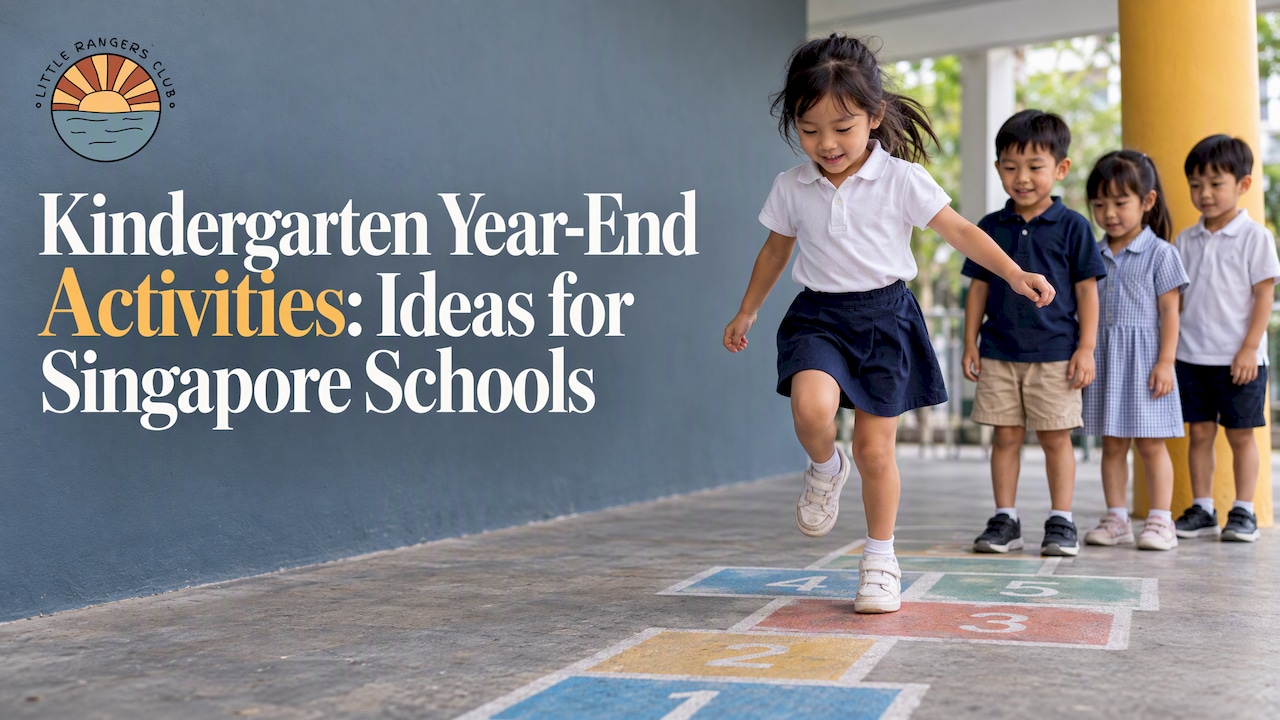
The best kindergarten year-end event mixes three things: a moment of reflection, active play and a way to include families. In Singapore, add a plan for heat and sudden rain. Children aged 4 to 6 remember what they did with their bodies and their friends. A concert, a movement morning and a short certificate moment will beat a long programme that asks them to sit still.
This guide is for kindergarten principals, teachers and PTAs planning a December-term or end-of-year celebration. It covers what to run, how long to run it, what to prepare, and how to keep it safe outdoors.
Key Takeaways
- Combine one reflective activity (a show, memory book or project showcase), one active block and one family moment. Keep each short.
- Singapore’s guidelines recommend a lot of daily movement for ages 3 to 6, so a year-end event is a good place to add active play rather than cut it.
- Open-ended equipment such as hoops, beanbags and cones is cheap, easy to set up and works for mixed abilities.
- Always have a wet-weather plan and a lightning rule for outdoor blocks.
- If you want an outside facilitator, book early and ask for a plan for your age group, your space and your headcount.
Table of Contents
- Start with the shape of the day
- Reflective activities that children enjoy
- Active games and outdoor activities
- Involve families and recognize progress
- Materials, preparation and timing
- Safety and weather planning
- Our perspective: why year-end is the best time for adventure
- Bringing in an outside facilitator
- What Little Rangers offers kindergartens
- A sample 2-hour run sheet
- Common mistakes to avoid
- FAQ
- Sources
Start with the shape of the day
Before picking games, decide what the event is for. Most kindergartens want three outcomes: children feel proud of the year, parents see progress, and teachers are not exhausted by the planning.
A simple three-part shape handles all three:
- Look back (20 to 30 minutes): children share something they made or learned.
- Move together (30 to 45 minutes): games, circuits or an outdoor adventure.
- Celebrate (20 to 30 minutes): certificates, a song, a simple treat and photos with families.
That gives roughly 90 minutes to two hours, which suits the attention span of a K1 or K2 group. If you invite parents, put the family moment at the end so children have already burned off energy and are ready to sit and receive a certificate.
Reflective activities that children enjoy
Reflection does not have to mean a worksheet. Young children reflect best when they make, perform or show something.
Create a class production
A Senior Kindergarten at an international school in Singapore staged a musical in which students wrote original songs, designed costumes, developed characters, choreographed dances and illustrated a picture book. You do not need that scale. A scaled-down version works in any classroom: each child picks a favorite moment from the year, draws it, and the class turns the drawings into a simple story with actions and a chorus.
Run a project showcase
MOE Kindergartens use a Weeks of Wonder project at the end of each term, where children work together to explore and share discoveries about topics they are curious about. You can borrow the idea for year-end: let small groups present what they found out, whether it is insects in the school garden, how a boat floats or what a pilot does. Parents walk around as a mini exhibition rather than sitting through presentations.
Make memory books and murals
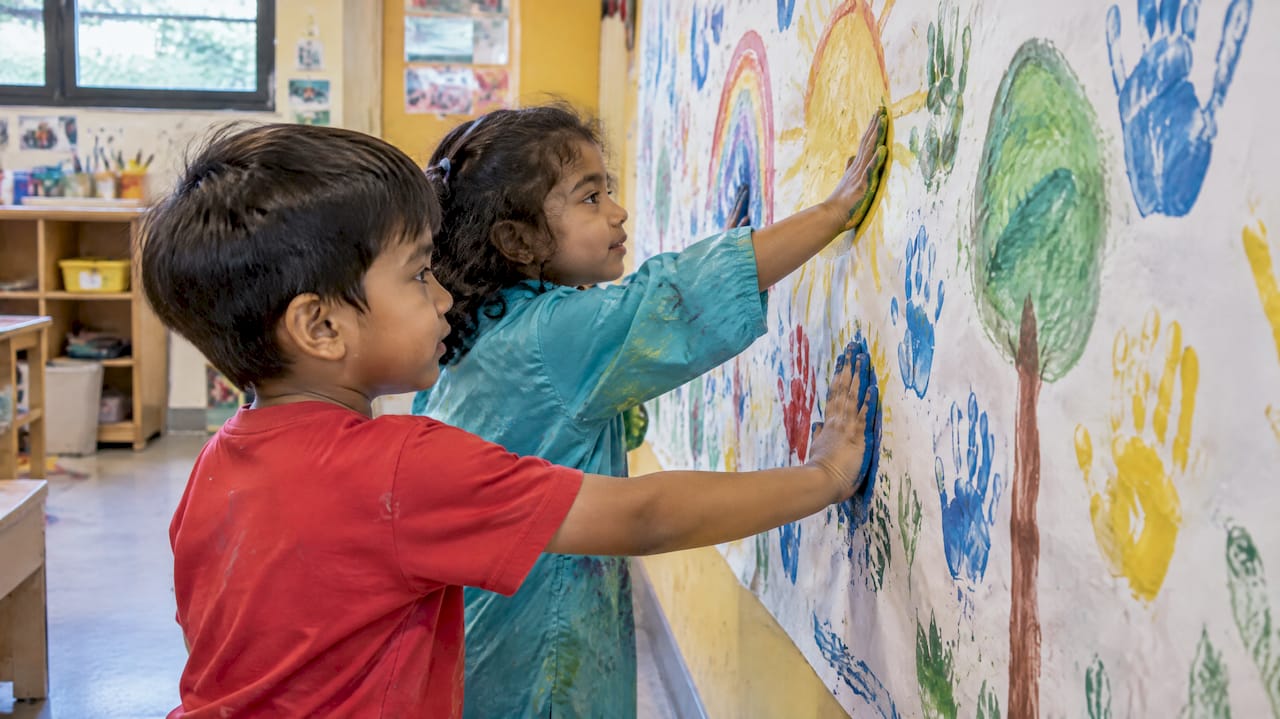
A memory book (one page per term, a drawing, a dictated sentence and a photo) is low cost and gives every family something to keep. A class mural works the same way for the whole group: each child adds a handprint and a drawing of a favorite activity.
Keep screens purposeful
A slideshow of the year’s photos is popular with parents, and it is fine as a short moment. ECDA’s guidance says screens in preschool should complement hands-on learning, not entertain or fill time. Keep the slideshow to a few minutes at the family moment and fill the rest of the day with doing.
Active games and outdoor activities
This is where most kindergarten teachers want fresh ideas. The good news is that the best activities use simple movements children are already developing.
The ActiveSG Circle preschool guide suggests playground games such as tag and hopscotch, plus running, jumping, hopping, throwing, catching and balancing. Build your event around those movements.
Why movement belongs in the plan
Singapore’s Physical Activity Guidelines recommend at least 180 minutes of varied physical activity a day for ages 1 to 6, with at least 60 minutes of moderate to vigorous activity for ages 3 to 6. A 45-minute active block at your event is a meaningful contribution to that day’s total.
Game ideas by skill
| Activity | Skill practiced | Materials | Space |
|---|---|---|---|
| Colour-hoop hop | Jumping, balance, colour recognition | Hoops | Covered court or hall |
| Beanbag target toss | Throwing, aim | Beanbags, buckets | Any open area |
| Cone obstacle trail | Running, weaving, hopping | Cones, ropes | Playground or hall |
| Freeze tag with animal moves | Running, listening, body control | None | Field or hall |
| Team treasure hunt | Teamwork, observation | Picture clues | School compound |
| Parachute play | Cooperation, coordination | Parachute or large sheet | Hall |
Let children shape the games
ActiveSG Circle notes that children tend to be more active when they lead their own play, and suggests letting them invent games and set the rules to build confidence. A nice year-end twist: each class table designs one rule or one obstacle, and the whole group tries them all. It also lowers your planning load.
Give it a theme
Themes turn a set of stations into an adventure. Popular ones include “Mission Rangers” (children collect stamps for completing challenges), “Around the World” (each station is a country with its own movement) and “Pilots and Explorers” (children carry out missions with maps and paper airplanes). We have more game ideas in our guide to outdoor games that inspire adventure.
Involve families and recognize progress
A family element is what makes the day feel like an event. Keep it short and personal.
One Singapore school’s kindergarten graduation, for example, included certificates, a concert by the graduating K2 class and classroom parties. That is a good template: a formal moment, a performance, then informal time.
Ideas that keep recognition meaningful for every child:
- Strength certificates: instead of “best” awards, name something each child did well, such as “the kindest friend”, “the bravest climber” or “the best question-asker”.
- Parent-child challenge: one short game where families work together, such as a relay with a beanbag.
- Letter to next year: older children dictate a tip for new K1 children. Teachers post them on the wall.
- Photo moment: a simple backdrop and a class group photo for every family.
For schools with large cohorts, stagger parent arrival by class, or hold separate sessions for K1 and K2, so the space does not become crowded.
Materials, preparation and timing
Most year-end events succeed or fail on preparation, not ideas. Work backwards from the day.
A simple preparation timeline
- 6 to 8 weeks before: choose the format, confirm the venue and a wet-weather space, and decide whether to bring in an outside facilitator.
- 4 weeks before: send parents a notice with dates, dress code (covered shoes, hats, water bottles) and any consent forms.
- 2 weeks before: finalize stations, assign teacher roles, and prepare certificates and memory books.
- The week of: check equipment, brief all staff and helpers, and confirm weather plans.
Equipment that works
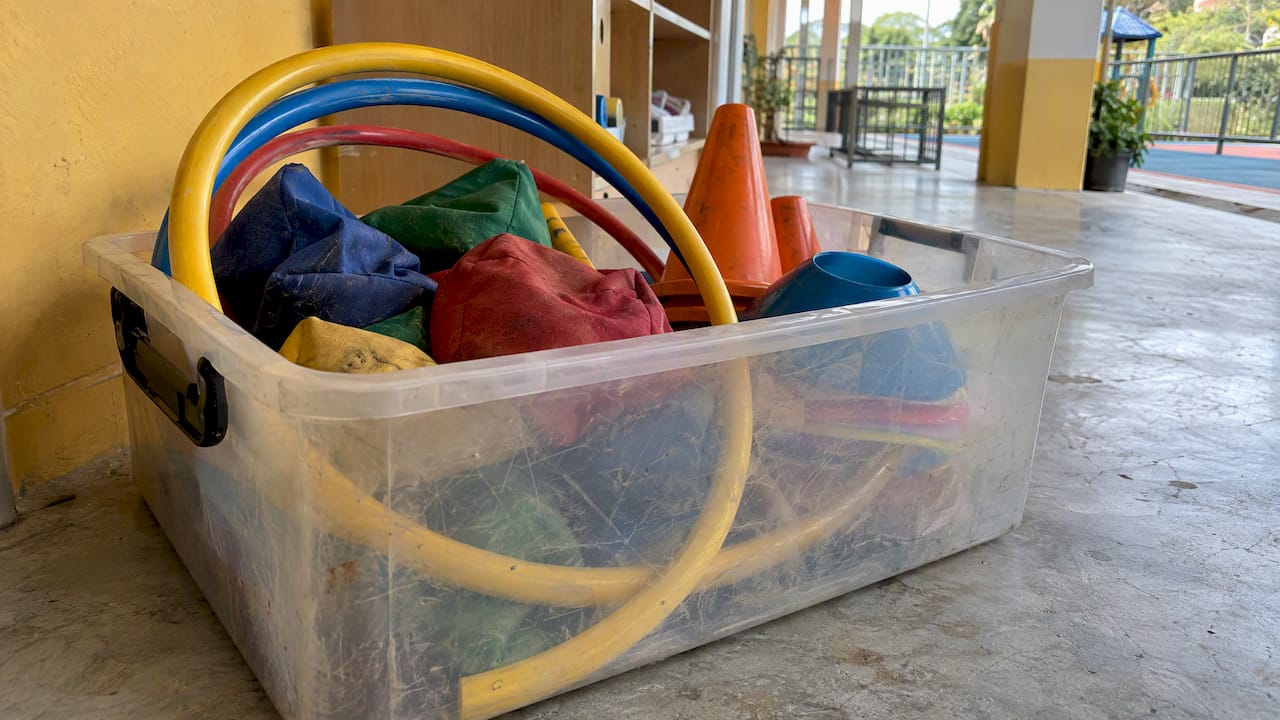
ECDA’s outdoor learning guide encourages open-ended resources such as hula hoops, beanbags and cones, because they are easy to set up and pack away and let children invent their own challenges. This kit fits in one storage bin, which is useful if your outdoor space is shared with other classes.
Timing in Singapore’s climate
Schedule active blocks in the cooler part of the morning. Plan shaded or covered stations, water breaks every 15 minutes or so, and a quieter activity (stories, art) in the middle of the day.
Safety and weather planning
ECDA expects preschools to have safe practices and furnishings in place and advises asking whether equipment, materials, spaces and surroundings are safe and developmentally appropriate. For a year-end event, that translates into a short checklist.
- Space: walk the area beforehand. Look for wet patches, loose items, sharp edges and gaps in fencing.
- Ratios: keep adult-to-child ratios at least as generous as your normal day, and add parent volunteers as helpers, not as supervisors.
- Equipment: check for cracks, and keep sizes suitable for 4 to 6 year olds.
- Hydration and shade: water bottles for every child, hats, shaded rest points.
- Allergies and medical needs: collect them in advance and carry the list and any medication.
- Wet-weather plan: pick an indoor hall or corridor circuit and decide in advance who calls the switch.
A lightning rule
Singapore’s afternoon storms are fast. PUB’s trainer guide for a school learning trail at MacRitchie asks groups to check the weather forecast and lightning status one to two hours before, and not to start during heavy rain or uncleared Category 1 lightning. That guide is written for one site, but the habit transfers: set a go or no-go time and stick to it. For any off-campus trip, follow MOE and ECDA requirements and your own centre’s risk assessment process.
Our perspective: why year-end is the best time for adventure
Over the years we have watched what happens when a group of 4 to 6 year olds is given a mission instead of a schedule. They stop performing for the teacher and start working with each other.
That is why we believe a year-end event should feel like an adventure, not a farewell assembly. Teamwork, resilience and problem-solving are not abstract ideas for this age. They show up when a group has to carry a ball across a course together, or work out how to cross an obstacle after one attempt fails.
We design our programs around that idea: fun and learning intertwined, with experienced facilitators who read the group and adjust on the spot. For kindergartens, this means the teachers can enjoy the day with their children rather than run it. We also think outdoor and active experiences deserve a place in the school year, which is why we wrote about outdoor learning and sports in preschools.
Our advice to any kindergarten: keep it simple, keep it moving, and let every child leave feeling they were part of something.
Joshua
Bringing in an outside facilitator
Many kindergartens run their own year-end day, and many bring in a partner for the active block so teachers can focus on observing and celebrating. Both are valid. Consider an external facilitator if you want:
- a themed activity your team has no equipment or training for,
- a big cohort split into rotating stations with trained leaders,
- a fresh experience children will talk about for weeks.
When you speak to any provider, ask for a written plan covering the age group, the number of children, the venue, the wet-weather option, the facilitator-to-child ratio and the equipment safety checks. You can also read our comparison of nature-based and indoor enrichment to decide which format suits your children.
What Little Rangers offers kindergartens
Little Rangers Club runs indoor and outdoor learning programs for children aged 3 to 13, built around adventure, teamwork and problem-solving. For schools, we offer our Aviation Exposure School Programme at $105 per student, and we work with schools on outdoor and adventure activities for year-end events. Details and enquiries are on our school programs and partnerships page.
If you are planning a year-end day for your kindergarten, tell us your cohort size, your space and your preferred date, and we will suggest a format. You can start from our homepage or look at our weekly class packages if parents ask what to do after the event. Younger children can also start with our guide to sports for 3-year-olds.
A sample 2-hour run sheet
Use this as a starting point and adjust to your venue.
| Time | Activity | Notes |
|---|---|---|
| 0:00 to 0:15 | Welcome circle and class song | Children sit by class; teachers introduce the theme |
| 0:15 to 0:35 | Project showcase or memory-book sharing | Small groups, parents walk around |
| 0:35 to 0:45 | Water break and snack | Shaded area |
| 0:45 to 1:30 | Active stations (rotate every 10 to 12 minutes) | Hoops, beanbags, obstacle trail, treasure hunt |
| 1:30 to 1:45 | Quiet activity | Story or drawing; lets heart rates settle |
| 1:45 to 2:00 | Certificates, group photo, goodbye | Families gather |
If the weather turns, shift the stations into the hall and shorten each rotation to 8 minutes.
Common mistakes to avoid
- Too many speeches. Four-year-olds lose focus after a few minutes of listening. Keep talking short and performances shorter.
- Competition for its own sake. Cooperative games keep every child involved and avoid tears.
- No rest moments. Alternate high-energy and calm blocks.
- No plan B. Decide your wet-weather and heat plan early, and tell parents.
- Overlooking children who hold back. Offer a role such as scorekeeper, leader or helper, so shy children can participate at their own pace.
FAQ
What are good year-end activities for kindergarten in Singapore?
A mix of a creative showcase, an active games block and a short family celebration works best. Examples include a class musical or mural, an obstacle trail with hoops and cones, and strength certificates for each child. Plan for heat and rain by choosing shaded or indoor options.
How long should a kindergarten year-end event be?
About 90 minutes to two hours suits most K1 and K2 groups. Split it into short blocks of 10 to 20 minutes with a water break and a calm activity in the middle. Longer events tend to tire both children and parents.
How do we include parents without overcrowding the space?
Stagger arrivals by class or hold separate K1 and K2 sessions. Put the family moment, such as certificates or a short performance, at the end and use a simple parent-child game as an activity. Parents can also help as volunteers at stations.
Do we need an outside provider for the event?
No, a school team can run a good event with simple equipment. An outside facilitator helps when you want a themed or specialist activity, or when the cohort is large. Ask for a written plan that covers safety checks, ratios and a wet-weather option.
What should we do if it rains or there is lightning?
Move the active block indoors to a hall or covered area and shorten each rotation. Decide on a go or no-go time in advance and check the forecast and lightning status beforehand. Do not start or continue outdoor play during heavy rain or active lightning.
Sources
- Going full circle at this year’s Senior Kindergarten musical
- MOE Kindergarten curriculum and programmes
- ECDA Beanstalk: Use Screen Time Wisely
- ActiveSG Circle: Integrated Movement Approach
- HealthHub: Toddlers and Physical Activity
- ActiveSG Circle: 5 Ways Your Kids Can Get Creative with Active Play
- Overseas Family School: Past Events
- ECDA Beanstalk: Choosing a Preschool
- PUB ABC Waters MacRitchie Reservoir Trainer’s Guide