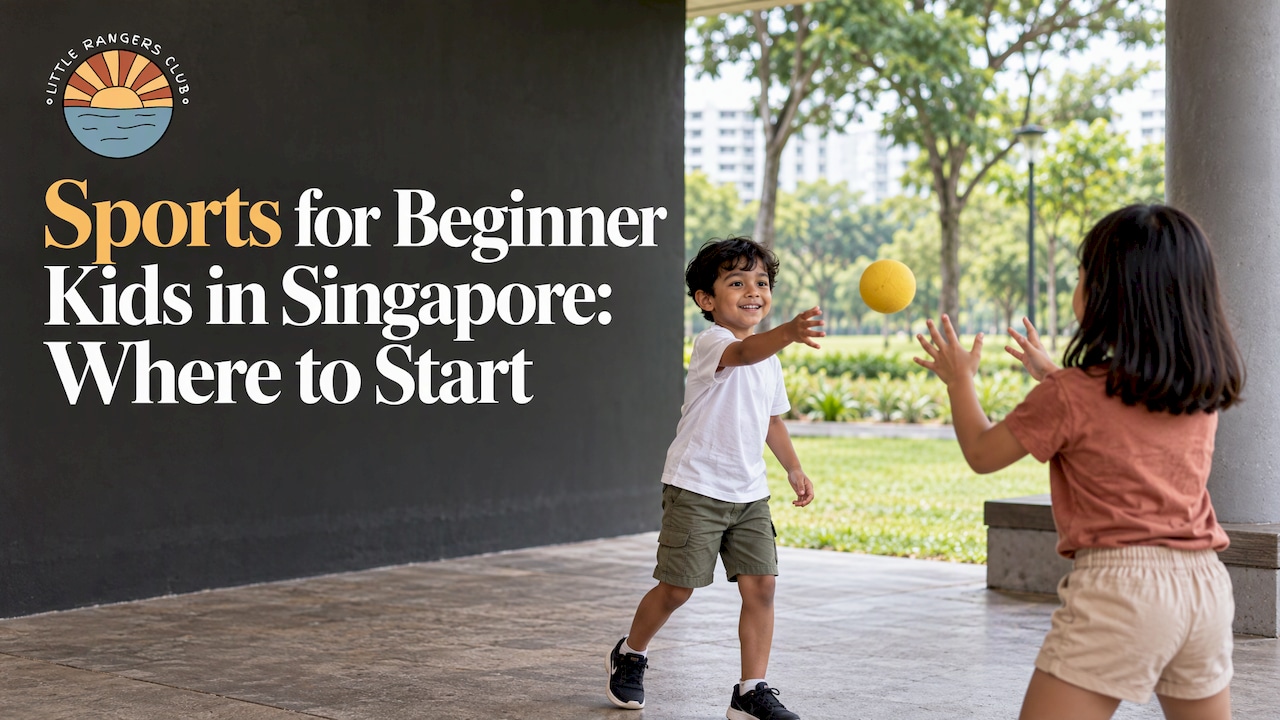
The best first sport for a child is the one that lets them move in many ways, with a coach who keeps it fun. For most beginners in Singapore, that means a multi-sports class rather than one sport chosen too early. At Little Rangers Club we run weekly multi-sports classes for children aged 3 to 13, and the reasoning below is why we think that format suits beginners.
Key Takeaways
- Preschoolers aged 3 to 6 do best with fun, relatively unstructured play that builds basic movement skills, according to Sport Singapore’s age guide.
- Variety beats early specialising: try ball games, swimming, dance, gymnastics and cycling, and move on if a child is not interested.
- Match the level to the child. A programme that is too advanced or too strenuous can make a child lose interest.
- Look for a coach who is NROC-certified and Safe Sport-trained, and who puts development before winning.
- Preschools can bring outdoor adventure to the classroom year through year-end activities and school programmes.
Table of Contents
- What “beginner” means at different ages
- Good first sports and activities in Singapore
- How to choose: a simple five-step routine
- What children gain beyond fitness
- Safety checks before the first class
- For preschools: outdoor adventure that fits the year
- Other ways to start
- Our perspective
- Start with a weekly class
- FAQ
- Sources
What “beginner” means at different ages
A beginner is not only a young child. A nine-year-old who has never joined a team is a beginner too. But age sets what the body and mind are ready for.
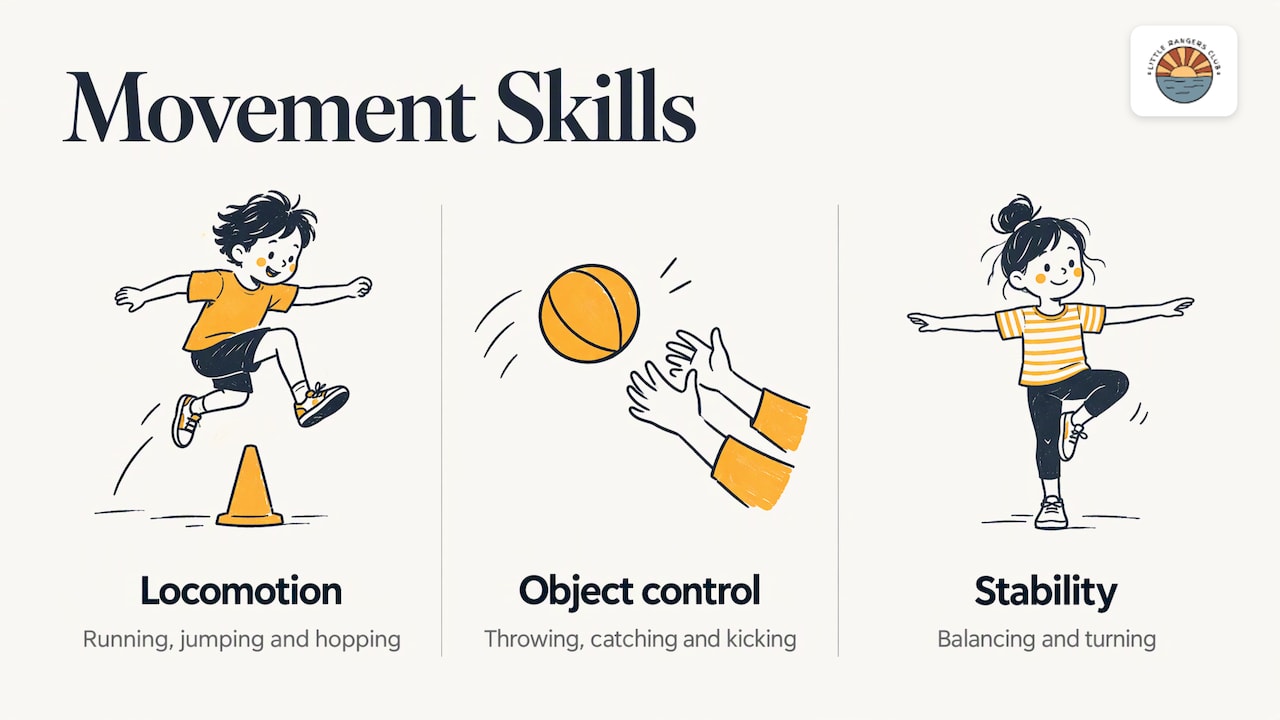
The Health Promotion Board explains that children aged 3 to 6 are still developing locomotion, object-control and stability skills. Locomotion means running, jumping and hopping. Object control means throwing, catching and kicking. Stability means balancing and turning. They are also learning to follow rules and take turns.
Sport Singapore’s guide for this age group points to fun, relatively unstructured play over complex organised sport. It lists ball games, dancing, gymnastics, karate, bicycle riding and swimming as suitable options.
For lower-primary children, organised group activities start to matter more. HealthHub notes that they can build teamwork and help children handle winning and losing. That is the age when a class with clear games, small teams and a friendly coach pays off.
If your child is 3, our guide to sports for 3-year-olds in Singapore goes into more detail.
Good first sports and activities in Singapore
The 2023 Singapore physical-activity guideline annex encourages varied movement indoors and outdoors. It lists tag and catching games, ball games, scooters, bicycles, roller skating, nature walks, hikes, sand play and wading for preschoolers.
Here is how those translate into choices for a beginner:
| Activity | Good for | What a beginner gains |
|---|---|---|
| Tag and catching games | Ages 3 and up | Running, dodging, reaction speed |
| Ball games | Ages 3 and up | Throwing, catching, kicking, turn-taking |
| Swimming and water play | Ages 3 and up | Confidence in water, whole-body coordination |
| Gymnastics and dance | Ages 3 and up | Balance, flexibility, body awareness |
| Cycling and scooting | Ages 3 and up | Balance and stability |
| Nature walks and outdoor exploration | All ages | Curiosity, stamina, environmental awareness |
Water is a natural starting point on an island. Our page on water sports for beginner kids in Singapore shows where to begin.
How to choose: a simple five-step routine
- Start with what your child already does. Watch what they do at the playground. Do they climb, chase, throw or balance? That tells you more than any list.
- Offer variety first. HealthHub suggests trying different preschool activities and moving on if a child is not interested. A multi-sports class does this inside one booking, so your child samples several skills without you signing up for each.
- Get the level right. Sport Singapore’s parents’ handbook warns that an overly advanced or strenuous programme can make a child lose interest. Beginner groups with children of a similar age help.
- Use interest tools as a conversation starter. The National Youth Sports Institute’s I LIKE tool, developed with Ghent University, helps children identify sports from movement patterns and interests. It does not predict who will excel, but it can suggest sports to try.
- Book a term, not a single trial. Children settle in over several weeks. Our 10 Sessions Weekly Class Package is $280, which gives a child time to get comfortable and show progress.
What children gain beyond fitness
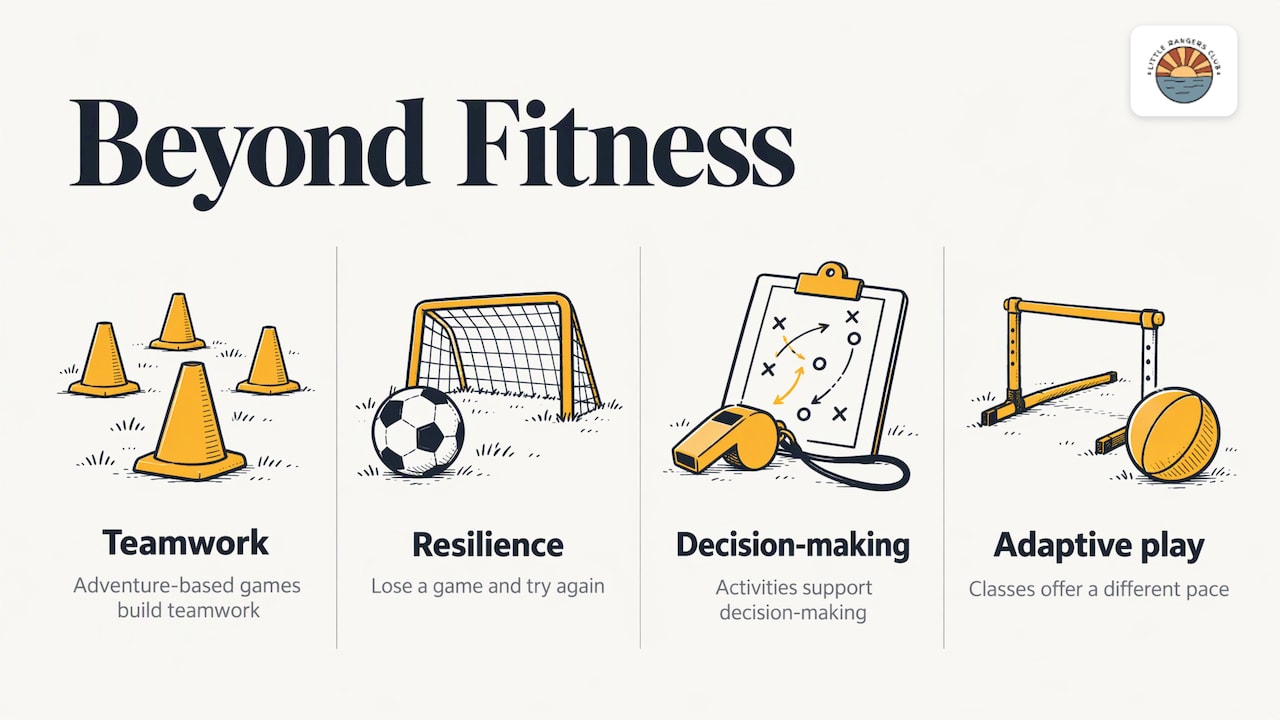
Sport Singapore’s handbook describes movement activities as supporting motor development, physical growth, socio-emotional development, confidence, creative thinking and decision-making. For a beginner, the social side is often the biggest early win: waiting for a turn, cheering a friend, losing a game and trying again.
This is the thinking behind our programmes. We build teamwork, resilience and problem-solving through adventure-based games. You can read more in our pieces on multi-sports programs and social development and building confidence and teamwork at a kids sports club.
If your child needs a different pace, our inclusive kids sports classes are built around adaptive play.
Safety checks before the first class
These are worth doing for any programme:
- The coach. Sport Singapore’s handbook advises looking for an NROC-certified, Safe Sport-trained coach who prioritises child development over winning. NROC is the National Registry of Coaches.
- Clothing and footwear. HealthHub advises suitable clothes and shoes, warm-ups and cool-downs, and adult supervision where needed.
- Health on the day. Keep a child home from exercise when they are unwell.
- Singapore weather. Bring water and choose shaded or indoor options at the hottest hours.
Safety and quality instruction are core to how we run our sessions, with experienced facilitators leading every class.
For preschools: outdoor adventure that fits the year
Preschool teachers face the same question as parents, at class scale: what suits a room of 3 to 6 year olds with different confidence levels? The answer is the same. Play-based, varied, outdoors where possible. The 2023 guideline annex says daily outdoor active play supports fundamental movement skills and exploration of the environment.
We work with kindergartens and schools on outdoor and adventure activities, including year-end events. Our article on why outdoor nature and sports programmes matter for preschools in Singapore sets out the case. For older students, our Aviation Exposure School Programme is $105 per student. Details are on the school programmes and partnerships page.
Other ways to start
Not every child begins on a field. Depending on the child, we also offer:
- Holiday camps for children who like full days of outdoor activity. See our holiday camps.
- Flight simulator and drone workshops. A 30-minute simulator experience is $55 per person, and a 60-minute one is $95. The Basic Build & Fly Course is $60 per person.
- Birthday parties with active games at home or a local venue. Combat Skirmish Laser Tag is $360 and BLOOP Bubble Games is $456. See all party packages.
- Exclusive Private Classes for one-to-one attention. See private classes.
Sport Singapore notes that most programmes on its school-holiday list are beginner-friendly for children with little or no experience. Ours are designed with the same idea: no prior skill needed.
Our perspective
We see beginners every term, and the pattern we care about is simple: a child who enjoys the first month stays active for years.
That is why we put variety and fun ahead of drills. A child who tries running games, team challenges, water, and outdoor exploration learns what they like, and learns that trying something new is safe.
Our weekly multi-sports classes are built for that. Children from 3 to 13 build teamwork, resilience and problem-solving through adventure, with experienced facilitators and a focus on safety. Parents tell us the biggest change is confidence, and you can read some of it in our class feedback.
If your child is reluctant, start with play and let the sport come later.
Joshua
Start with a weekly class
If you want one place to begin, our weekly multi-sports classes give a beginner a mix of games, skills and teamwork in a safe, friendly group. The 10 Sessions Weekly Class Package is $280. Browse the weekly multi-sports classes and pick the one near you.
If you want ideas for keeping a child moving between classes, see motivating kids to exercise.
FAQ
Which sport is easiest for a child to start with?
There is no single easiest sport. For ages 3 to 6, Sport Singapore lists ball games, dancing, gymnastics, karate, cycling and swimming as suitable. Games that combine running, throwing and catching are the most forgiving for beginners.
Should my child pick one sport early?
For preschoolers, trying a range is better. HealthHub recommends varied activities and moving on if a child loses interest. A multi-sports class lets a child try several in one programme.
How do I know a class is right for my child’s level?
Check that the class is pitched at beginners and groups children by age. Sport Singapore’s handbook says programmes that are too advanced or strenuous can cause a child to lose interest.
What should I look for in a coach?
Look for an NROC-certified, Safe Sport-trained coach who focuses on development rather than winning. You can ask about this when you enquire.
Sources
- Sport for Different Age Groups, ActiveSG
- Getting Fit Through Fun for kids, HealthHub
- ActiveSG Parents’ Handbook
- Sport Singapore Parents’ Handbook (2023)
- I LIKE, National Youth Sports Institute
- Annex 2, Singapore physical activity guideline (2023)
- ActiveSG School Holiday Programmes