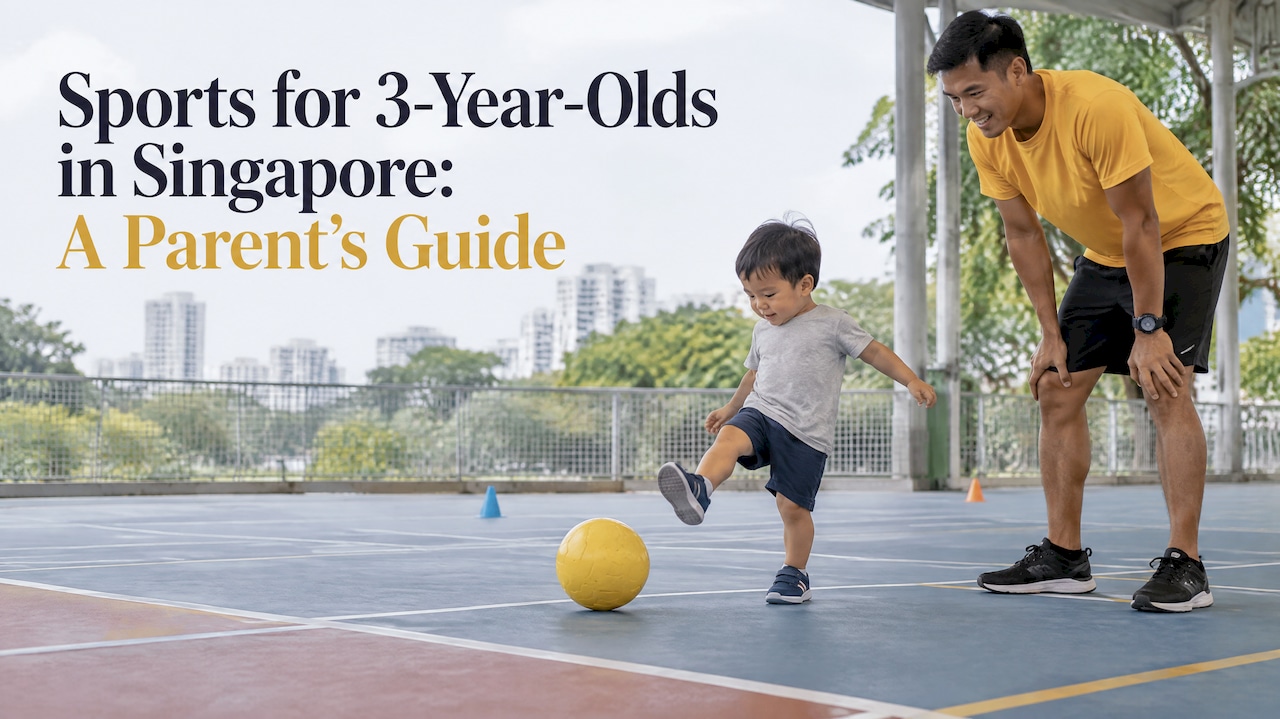
At three, the best sport is play with a purpose: running, jumping, throwing, kicking and balancing in short, fun, non-competitive sessions with an adult close by. Singapore’s health guidelines ask for plenty of daily movement at this age, and a good weekly class can supply a share of it. Below you will find what to look for, what to skip, how it changes at 4 and 5, and how to judge a class before you pay.
TL;DR
- Aim for at least 180 minutes of varied physical activity a day for ages 3 to under 7, with at least 60 minutes at moderate-to-vigorous intensity, according to Singapore’s 2022 guidelines.
- Choose non-competitive, play-based classes that practise running, jumping, catching, throwing, kicking and balance, not drills or matches.
- Watch a session first, talk to the coach, and look for children who are having fun.
- Use a weekly class alongside daily outdoor play, not instead of it.
- At 4 and 5, keep the same play-first approach and add variety, rather than specialising in one sport.
Table of Contents
- What counts as sport for a 3-year-old
- How much activity a preschooler needs
- What a good class for 3-year-olds looks like
- Safety basics before you sign up
- Sports activities that suit 3-year-olds
- How things change at 4 and 5
- Perspective: why we teach preschoolers through play and variety
- Our weekly multi-sports classes
- Why outdoor and nature-based play helps
- A sports birthday party for a preschooler
- Choosing between a class, a camp and play at home
- Questions to ask before you enrol
- FAQ
- Sources
What counts as sport for a 3-year-old
Forget leagues and rules. For a preschooler, sport means building the basic movements every later sport relies on. HealthHub’s Move With Fun and Grow resource describes fundamental movement skills in three groups:
- Locomotor skills: running, hopping, jumping, skipping.
- Object control skills: catching, throwing, kicking, striking.
- Stability skills: balancing, landing, twisting, stopping.
These develop through a wide variety of movements and games, and outdoor playground play counts too. A three-year-old kicking a soft ball at a wall, walking along a low beam or chasing bubbles is doing sport in the way that matters.
This matters because early movement skills tend to stick. The Singapore guidelines note that a strong foundation of movement competence in childhood is associated with lifelong participation in physical activity. They also cite a local study in which lower primary children did not show age-appropriate movement proficiency, which is why the guidelines stress activity from the preschool years (full guidelines, PDF).
How much activity a preschooler needs
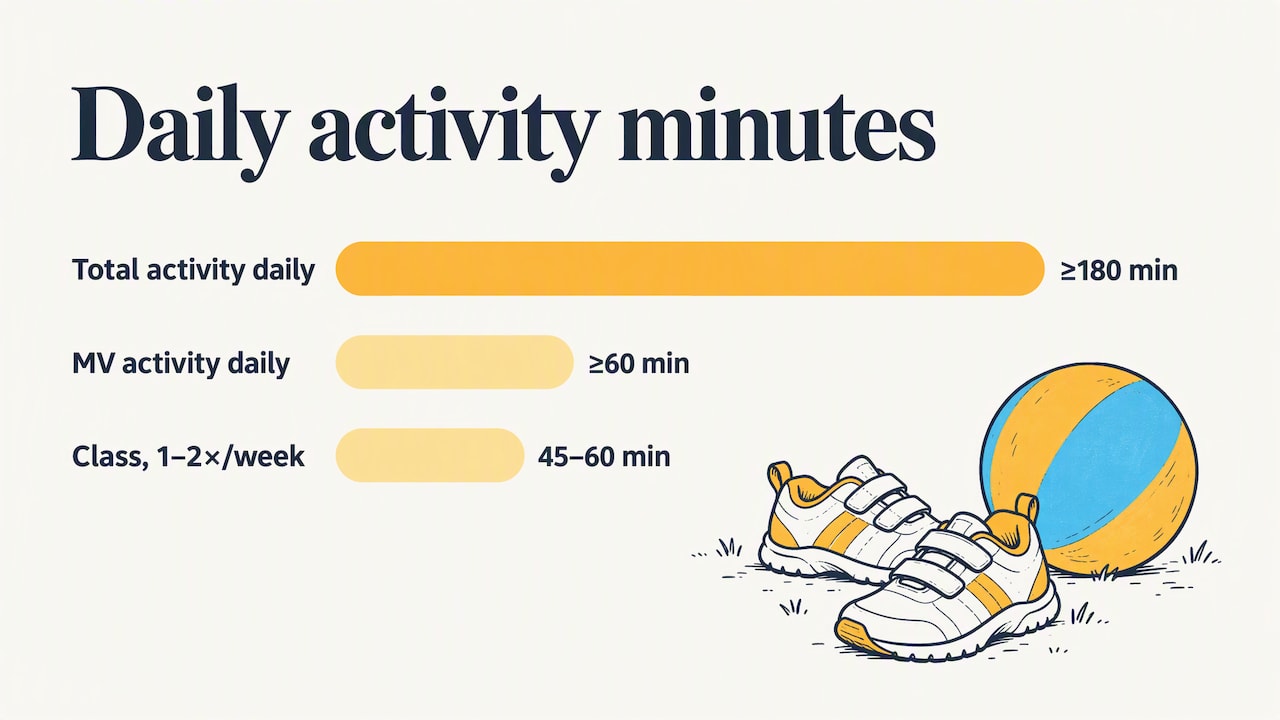
The Singapore Integrated 24-Hour Activity Guidelines for Early Childhood (2022) say children aged 3 to under 7 should accumulate at least 180 minutes of a variety of physical activities daily, including at least 60 minutes of moderate-to-vigorous activity (KKH announcement). The 180 minutes is spread through the day, not done in one block.
What does that look like in a real week? Here is one example of how the minutes can add up:
| Part of the day | Example | Counts toward |
|---|---|---|
| Morning | Walk to the playground, climbing and running | Total activity, some vigorous |
| Afternoon | Ball games or dancing at home | Total activity |
| Once or twice a week | A 45 to 60 minute multi-sports class | Moderate-to-vigorous activity |
| Evening | Family walk, scooter ride | Total activity |
This is an illustration, not a prescription. The point is that one class a week is a useful anchor, but it cannot carry the whole target. Daily free play does the rest.
Two other findings from the same guideline family are worth knowing. Recreational screen time for ages 3 to 6 should be under one hour a day, and the same Asia-Pacific consensus statement reports that outdoor play had a protective effect against incident myopia. Both are good reasons to move active time outdoors where you can.
What a good class for 3-year-olds looks like
Singapore’s Families for Life advises that younger children interested in organized sport should generally be offered non-competitive activities such as gymnastics, swimming or soccer. It also says that learning to play, be active and try hard matters more than perfect technique or winning and losing.
Turn that into a checklist you can use at the door:
- Games, not drills. Children should spend most of the session moving, not queuing or listening to long explanations.
- Variety. A mix of running, throwing, balancing and kicking beats an hour of one skill.
- No scoreboards. At three, nobody needs to win.
- Adjusted activities. The ActiveSG Circle GetActive@Home preschool pack advises modifying activities to the child’s age and level, so ask how the coach does this when a child is struggling or racing ahead.
- Safe space and equipment. Look at the floor, the surroundings and the gear. The same pack advises inspecting the activity area and equipment.
- Room for you. Caregivers are encouraged to take part in active play with preschoolers as role models, per the guidelines summary. Ask whether parents can join or watch.
Families for Life gives the simplest test of all: observe a programme, speak with the coach, and look for children who are having fun. If you see a row of bored three-year-olds waiting for a turn, keep looking.
Safety basics before you sign up
The Health Promotion Board’s Getting Fit Through Fun guidance covers the practical points parents in Singapore need. In short:
- Make sure an adult supervises whenever the child needs it.
- Dress your child in suitable clothes and shoes.
- Include a warm-up and a cool-down.
- Skip exercise when your child is unwell.
- Stop if your child feels dizzy, breathless or has pain, and see a doctor if it keeps happening.
- Avoid the hottest outdoor periods of the day.
- Use protective gear where the activity calls for it.
- Give water before, during and after activity.
In our climate the heat point deserves extra attention. Morning and late-afternoon sessions are easier on small children than midday, and a water bottle should be in the bag every time.
Sports activities that suit 3-year-olds
You do not need special equipment to start. These work at home, in a void deck playground or in a class:
- Ball play: rolling, kicking and throwing a soft ball into a basket or at a target.
- Obstacle courses: cushions to climb over, a rope on the floor to walk along, a table to crawl under.
- Animal movements: hopping like a frog, galloping like a horse, stretching like a giraffe. They build balance and body awareness.
- Swimming and water play: water confidence is a sensible goal at this age, with an adult within reach at all times.
- Dance and freeze games: music on, music off, and everyone stops. This trains stability and listening.
- Playground time: climbing, swinging and sliding develop strength and coordination.
To build confidence and social skills, choose group games that need turn-taking, such as passing a ball in a circle or a simple team treasure hunt. Join in yourself where you can.
How things change at 4 and 5
The checked guidance does not split recommendations by single year of age: the Singapore guidelines treat ages 3 to under 7 as one band, and Families for Life gives the same advice for younger children generally. That tells you something useful: the principles stay the same as your child grows. Keep activity varied, fun and non-competitive, and watch for readiness.
Families for Life says to sign your child up when they are ready. In practice, readiness shows in how your child behaves, not the birthday:
- They stay with a group and follow a simple instruction.
- They separate from you without distress.
- They ask to try a sport they have seen.
What tends to change at 4 and 5, in our experience running classes, is the length of games, the number of steps in each instruction and how well children cope with taking turns. A five-year-old can usually handle a longer obstacle course or a simple team relay. That is a reason to add variety, not to specialise early. A multi-sports format lets your child sample ball games, water activities and outdoor challenges before choosing what they love.
Perspective: why we teach preschoolers through play and variety
At Little Rangers Club we work with children aged 3 to 13, and our youngest rangers teach us the same lesson every week: they come back for the games, not the drills.
That is why our multi-sports classes are built around fun first. Teamwork, resilience and problem-solving show up naturally when a child works out how to cross a balance course or cooperates in a relay. We want a three-year-old to leave a session proud and eager for the next one.
We also believe in taking learning outdoors. Fresh air, open space and nature give children movement challenges that a small room cannot. Our facilitators adjust each activity to the child in front of them, so a shy beginner and a confident climber can share the same game.
If you are choosing a first class, watch one, talk to the coach and trust what you see in the children’s faces. We are happy for you to do exactly that with us.
Joshua
Our weekly multi-sports classes
If you want a regular, structured class, our multi-sports programs for children are designed for ages 3 to 13 and combine indoor and outdoor learning. Classes mix different sports and games so your child builds a broad base of skills and learns to cooperate with others. You can read what parents say about the effects in our feedback on children’s outdoor sports classes, and see how we run sessions at Bukit Batok CSC.
The 10 Sessions Weekly Class Package is $280. Details are on the club activities page. If your child needs more individual attention, we also offer exclusive private classes; contact us for details, as no price is published.
Want to see a class before you commit? Visit Little Rangers Club to ask about the current class schedule and which sessions suit your child’s age.
Why outdoor and nature-based play helps
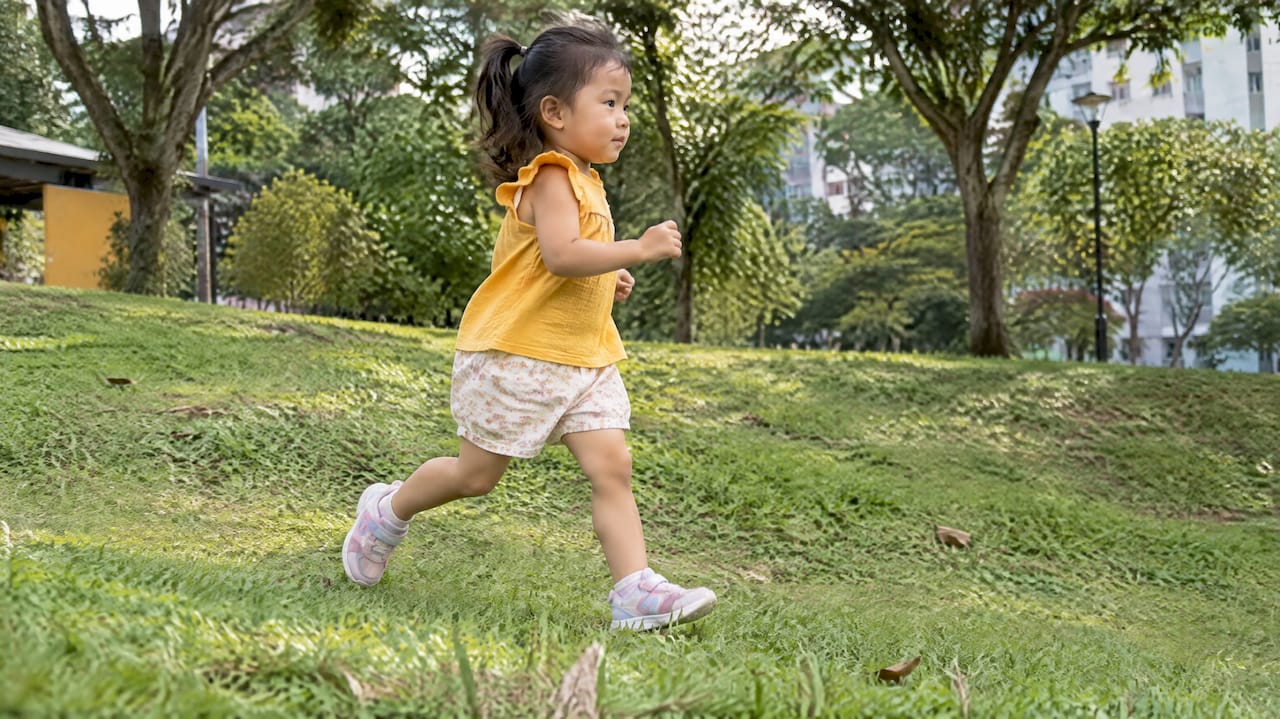
Young children get more from varied terrain and open space than from a single repeated activity. Beyond the myopia finding above, outdoor play is easier to make vigorous: running across grass is naturally more demanding than walking around a small room. If you are comparing formats, our guide to nature versus indoor enrichment sets out how to choose, and our piece on outdoor learning and sports in preschools explains why it matters at this age. For ideas to try this weekend, see outdoor activities for kids in Singapore and our list of outdoor games for children.
A sports birthday party for a preschooler
A sports birthday party works well because children burn energy and the host does not have to entertain them alone. We bring the party to your home or a nearby venue, with professional facilitation, so there is no travelling across the island with a group of small children.
Our published party packages include:
| Party | Price |
|---|---|
| Combat Skirmish Laser Tag Birthday Party | $360 |
| BLOOP Bubble Games Birthday Party | $456 |
| Water ZOVB and Water Tag Pool Party | $660 |
| Minute To Win It Birthday Party | $680 |
| Indoor Lego Bricks Masters Birthday Party | $680 |
| Laser Clay Shooting Birthday Party | $690 |
| Brick-A-Drone Kids Birthday Party | $750 |
| Amazing Race Party Edition | $780 |
| Sailing & Wing Foil Birthday Party | $950 |
Prices are as listed on our parties and events page. Tell us your child’s age and the guest list when you enquire, and we will help you match a theme to the group. For inspiration, read about how one child celebrated with sailing and laser tag, or our overview of birthday party programmes near home.
Choosing between a class, a camp and play at home
These three formats do different jobs:
- Weekly class: a routine, a coach and a group of peers. Good for building skills and confidence gradually.
- Holiday camp: a longer stretch of active days during school breaks. Check our holiday camps page for the current programme, as camp details change by season.
- Play at home or at the playground: the daily base that supplies most of the 180 minutes.
Most families do best combining all three: a weekly class for structure, a camp in the holidays, and daily outdoor play for the rest.
Questions to ask before you enrol
- How do you adapt activities for a three-year-old versus a five-year-old?
- Can I watch a session first?
- Are classes non-competitive and play-based?
- How are the equipment and the activity area checked?
- What is the plan for hot or rainy days?
- What should my child wear and bring?
A good provider answers these easily. If the answers are vague, treat that as information.
FAQ
What is the best sport for a 3-year-old?
There is no single best sport. Families for Life suggests non-competitive activities such as gymnastics, swimming or soccer for younger children. A multi-sports class that rotates through running, throwing, kicking and balance games gives your child the broadest start.
How long should a sports class for a 3-year-old be?
The guidelines set a daily target rather than a class length: at least 180 minutes of varied activity for ages 3 to under 7, including 60 minutes of moderate-to-vigorous activity. Ask the provider for the session length and judge by your child’s energy and enjoyment. Stop if your child feels dizzy, breathless or has pain.
Is my child ready for a class at 4 or 5?
Families for Life advises signing up when your child is ready. Signs include following simple instructions, being comfortable in a group and wanting to try. Watch a class first and look for children having fun.
Can a 3-year-old have a sports birthday party?
Yes, as long as the games suit the age and an adult supervises closely. Pick active, non-competitive games and keep the schedule short. We run mobile parties at home or a nearby venue, and you can see the packages on our parties and events page.
Sources
- Singapore Integrated 24-Hour Activity Guidelines for children under seven launched (KKH)
- Move With Fun and Grow (HealthHub)
- Singapore Integrated 24-Hour Activity Guidelines for Early Childhood, full document (KKH)
- Asia-Pacific consensus statement on integrated 24-hour activity guidelines
- Physical Activity for Younger Children (Families for Life)
- GetActive@Home Resource Pack, Preschool Edition (ActiveSG Circle)
- Getting Fit Through Fun for kids (HealthHub)
- Singapore Integrated 24-Hour Activity Guidelines summary (College of Paediatrics and Child Health)