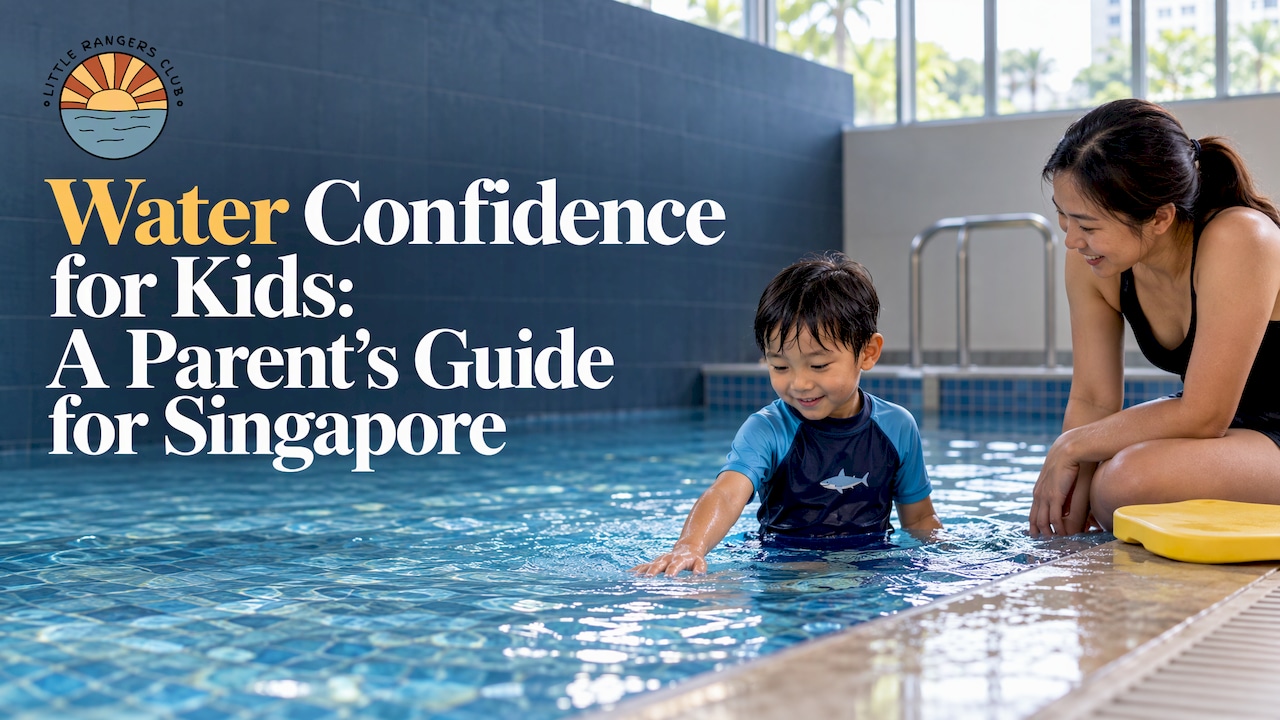
Water confidence is a child’s comfort in and around water: face wet, feet off the floor, calm when something splashes. You build it with small, playful, pressure-free steps, starting in the bath, moving to a shallow pool, and always staying within arm’s reach. This guide covers how to start at home, what to expect by age, how Singapore’s national programmes map the journey, and when to bring in a qualified instructor.
Key Takeaways
- Start small and make it fun: bath-time play, cups of water over the head and blowing bubbles come before any pool lesson.
- A fear ladder works: list water steps from least to most scary and let your child pick the next one.
- Singapore’s learn-to-swim framework begins at age 0 to 4 with parent-accompanied stages, so there is no need to wait for “school age”.
- Confidence never replaces supervision. Young children need an adult close by every time they are near water.
- Outdoor, game-based activities let children practise comfort with water in a relaxed setting, alongside formal lessons.
Table of Contents
- What water confidence really means
- Start at home: bath-time steps that work
- When your child is afraid of water
- What to expect by age
- How Singapore’s national frameworks map the journey
- Safety comes first: supervision and rules
- Beyond lessons: games that keep the water fun
- Our perspective
- Plan your child’s next step
- FAQ
- Sources
What water confidence really means
Water confidence is not the same as swimming. A child can be a keen splasher and still be unable to swim a length, and a child can have good strokes yet freeze when the water gets deep. Confidence is the foundation: it is what lets a child listen to an instructor, try a new skill and recover calmly when something goes wrong.
Singapore’s national programme uses the same idea. Stage 1 of SwimSafer is described by the official instructors’ manual as developing confidence and independence in the water, through forward and backward movement, safe entry and exit, and personal water safety. Confidence comes first, strokes second.
In practice, a water-confident child can usually:
- Enjoy having water on the face and head
- Blow bubbles and put the face in the water, with or without goggles
- Enter and exit the pool safely when an adult is present
- Move around in shallow water with support
- Follow simple instructions from a trusted adult
Start at home: bath-time steps that work
You do not need a pool to begin. Health guidance from Australia suggests parents can first introduce a baby to water in the bath, letting them float while held, keeping it fun, age-appropriate and supportive. That advice scales up neatly to toddlers and preschoolers.
- Make bath time playful. Cups, small toys and songs turn water into something familiar.
- Pour gently. If a child is anxious, a paediatrician at Cleveland Clinic suggests starting small by dripping water over the head with a cup or strainer, then encouraging bubble-blowing.
- Introduce goggles in the tub or shower. The same source recommends letting children get used to wearing goggles at home before the pool.
- Go to a shallow pool together. Stay in the water with your child and keep close physical contact.
- Repeat often and keep sessions short. Ten happy minutes beat forty tense ones.
Never leave a child alone in the bath or a paddling pool, even for a moment. Water confidence grows from calm repetition, not from being thrown in at the deep end.
When your child is afraid of water
Fear is common and often temporary. Some children take to water like little fish, while others need more encouragement, and the Cleveland Clinic specialist says that is perfectly fine.
Listen before you coax
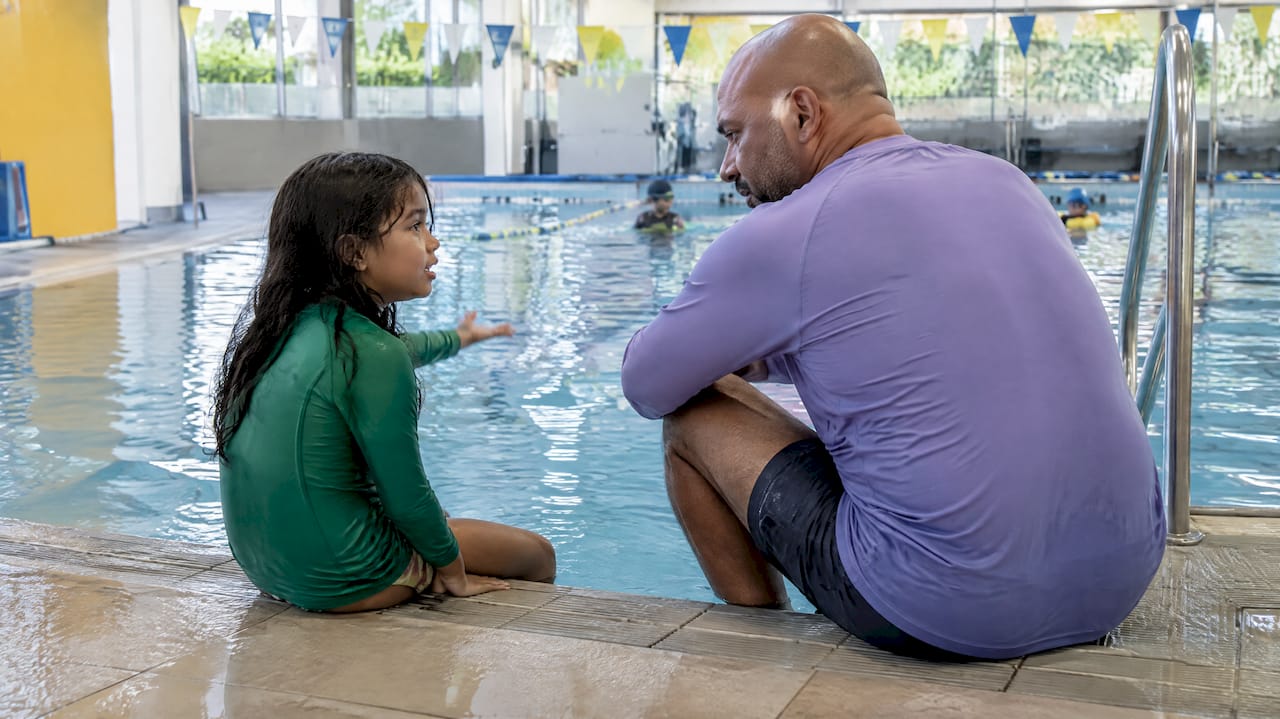
Psychologist Dr. Emily Edlynn says a child needs to feel understood before the fear can shift. In an interview with Parents, she suggests asking questions, reflecting back what the child says and finding the child’s own motivation. Try “What part feels scary, the splashing or the deep part?” rather than “There’s nothing to be afraid of.”
Build a fear ladder
The same source describes a “fear hierarchy”: you list steps related to the fear from least to most scary and invite the child to push a little past their comfort zone, which gives them a sense of control. A ladder for a three-year-old might look like this:
| Step | Activity | Done? |
|---|---|---|
| 1 | Sit at the pool edge with feet in the water | |
| 2 | Splash with hands while you hold them | |
| 3 | Walk in the shallow end holding your hands | |
| 4 | Blow bubbles with chin in the water | |
| 5 | Put the mouth and nose in, then the face | |
| 6 | Float on the back with your hands supporting |
Let your child decide when to move up. Celebrate a step even if it is small, and drop back down a rung on a tired or grumpy day without comment.
Watch your own reactions
Children read their parents. A tense face at the pool edge tells a child there is something to worry about. Stay relaxed, speak in a steady voice and keep praise specific: “You put your chin in, great job.”
When to pause or ask for help
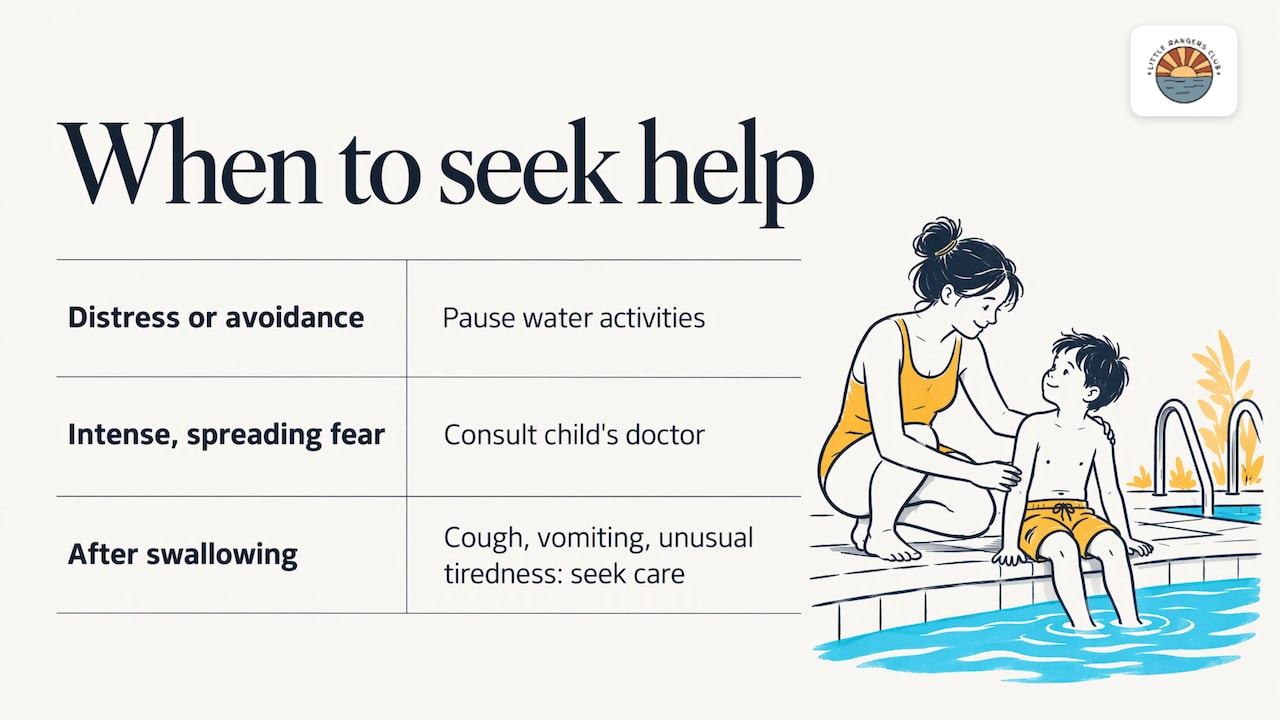
Pause water activities if your child is crying hard, panicking, gasping or refusing to go near any water despite weeks of gentle steps. Forcing the issue usually sets progress back. Speak to your child’s doctor if the fear is intense, spreads into daily life such as refusing a bath or shower, or comes with nightmares or distress. A qualified instructor who works with nervous beginners can then give structured, one-to-one support. If a child coughs persistently, vomits or seems unusually tired after swallowing water, seek medical attention promptly.
What to expect by age
There is no single right age. The Cleveland Clinic specialist notes there is no one “best” age for every child, though the American Academy of Pediatrics advises that most children should start learning to swim by around 4. Australian health guidance suggests waiting until a baby is around 6 months old before formal lessons, and says classes up to age 3 focus on comfort, age-appropriate safety skills and teaching parents about water safety.
| Age | Focus | What it looks like |
|---|---|---|
| 0 to 2 | Comfort and bonding | Bath play, supported floating, a parent always in the water |
| 3 to 4 | Face in the water, movement | Bubbles, kicking with support, short pool visits |
| 4 to 6 | Independent confidence | Group play without a parent in the water |
| 7 to 9 | Skills and stamina | Strokes, safe entry, longer swims |
| 10 to 13 | Water activities beyond the pool | Paddling, sailing and other water sports, with proper supervision |
The age bands above are a practical guide, not a test. A child who is nervous at five is not behind.
How Singapore’s national frameworks map the journey
Singapore has a clear path from toddler to confident swimmer, and knowing it helps you choose the right class.
SwimSingapore. Launched on 5 July 2025, this national learn-to-swim framework has six segments, according to Singapore Aquatics:
- SwimStart: six stages for ages 0 to 4, with a parent accompanying, building water confidence and parents’ skills in handling their children in water
- SwimFun: three stages for ages 4 to 6, focused on independent water confidence
- SwimSafer: six stages of national water safety
- SwimFurther, SwimBetter and SwimFaster: recreational, performance and competitive pathways
The Straits Times reports that SwimStart and SwimFun are offered through accredited swim schools and private instructors, with standardised assessments and prescribed safety guidelines, though the programme can vary by provider.
SwimSafer 2.0. Singapore’s national water safety programme was introduced in July 2010 and enhanced in 2018, with six progressive levels teaching swimming proficiency and water survival skills under Sport Singapore. The stages in short, per the instructors’ manual:
| Stage | Aim |
|---|---|
| Stage 1 | Confidence and independence in the water |
| Stage 2 | 25 metres of continuous swimming |
| Stage 3 | 50 metres |
| Bronze | 100 metres of varied strokes |
| Silver | 200 metres of varied strokes within a time frame |
| Gold | 400 metres of varied strokes, plus survival skills such as clothing flotation and the H.E.L.P. technique |
Most children meet SwimSafer through school. The Ministry of Education says all primary schools use the programme, typically enrolling the entire Primary 3 cohort during curriculum time, fully funded by MOE. Based on 2019 data in the same reply, an average of 83% of participants met Stage 1 requirements, 55% met Stage 2 and 39% met Stage 3. Pupils who do not pass Stage 1 can go through a remediation programme and be re-tested.
That Stage 1 figure is the argument for building comfort before Primary 3: a child who already enjoys the water arrives ready to learn.
Older children who swim often benefit from looking after their shoulders too, and this guide to preventing swimmer’s shoulder is worth a read once strokes get serious.
Safety comes first: supervision and rules
Confidence can make a child bolder than their skills justify, so safety habits need to grow alongside it.
- Stay within arm’s reach of any child under school age near water, including condo pools and paddling pools. In June 2026 a Singapore coroner ruled on the death of a three-year-old who fell into a condo pool in 2025 and stressed close supervision of young children around pools.
- Put the phone away. Supervision means watching, not being in the vicinity.
- Read the signs. Singapore’s Code of Practice for Water Safety at aquatic facilities, SS 700:2023, covers supervision requirements, safety advisory signs and drowning-prevention tips at facilities.
- Use age and swimming rules for activities. The Singapore Canoe Federation’s 2026 code says paddlers must have basic swimming skills and adequate water confidence. For double sit-on-top kayaks, children must be at least five, and those aged twelve and below must be accompanied by an adult at all times.
- Teach the pool rules early: walk, don’t run; enter only when an adult says so; never swim alone.
Beyond lessons: games that keep the water fun
Formal lessons teach technique, but plenty of confidence is built through play. Children who have fun around water ask to go back, and repetition is what makes the fear ladder work.
We design our programmes around that idea of fun intertwined with learning. For older children, our Water ZOVB and Water Tag Pool Party is a pool-based birthday format at $660, and our Sailing & Wing Foil Birthday Party at $950 introduces water sports for children who are already comfortable in the water. If your child is still working up to that, our weekly multi-sports classes build the teamwork, resilience and physical coordination that carry over to water activities. For the youngest, our guide to sports for 3-year-olds explains how to start active play early.
Our perspective
We see it every week: children who are brave in one setting hesitate in another. A child who happily climbs and runs at an outdoor session may still hold back at the pool edge. Confidence is a habit built through small wins, not a switch.
That is why we put so much weight on adventure-based learning. When children practise teamwork, resilience and problem-solving in games, they learn to try something new, cope with a wobble and try again. Those are the same muscles they need at the pool.
Our facilitators are there to keep sessions safe and to let each child progress at their own speed. We believe the best water-confident kids are the ones who were never pushed, only invited. For older children, a pool party or water-sports format can be a joyful way to put those skills to use with friends.
Joshua
Plan your child’s next step
If your child is ready for more active, game-based adventures, we run structured indoor and outdoor programmes for ages 3 to 13: weekly multi-sports classes, holiday camps, workshops and mobile birthday parties delivered at home or at a venue near you. Our 10 Sessions Weekly Class Package is $280.
See the weekly class package, browse our birthday party options including the water-based formats, or explore our holiday camps for school-break fun.
FAQ
At what age should my child start learning water skills?
There is no single perfect age. In Singapore, SwimStart covers ages 0 to 4 with a parent in the water, and the American Academy of Pediatrics advises most children to start learning to swim by about 4. A child who needs more time is not behind, so follow their comfort.
How do I help a child who cries at the pool?
Go back a step. Try cups of water over the head and bubble-blowing in the bath, then return to the shallow end with you holding them close. Build a fear ladder together and let your child choose each next step.
Is water confidence the same as being able to swim?
No. Confidence is comfort, calm and willingness to follow instructions in water. Swimming is a skill that builds on it, which is why SwimSafer Stage 1 targets confidence before distance goals begin at Stage 2.
When should I get professional help?
Seek help if your child panics, refuses all water for weeks or shows distress in daily routines like bathing. Speak to your child’s doctor first about the fear itself, then look for a qualified instructor experienced with anxious beginners.
Can my child join water activities if they are not a strong swimmer?
It depends on the activity and the age rules. Some, like paddling, require basic swimming skills and water confidence, and young children need an adult with them. Check the requirements with the organiser before booking.
Sources
- Babies and swimming, Pregnancy, Birth and Baby
- When Should My Child Learn How To Swim?, Cleveland Clinic
- How Do I Help My Kid Get Comfortable in the Water?, Parents
- SwimSafer 2.0 Instructors Manual, ActiveSG Circle
- SwimSafer, ActiveSG Circle
- SwimSafer 2.0 programme, MOE
- OCBC supports Singapore Aquatics, Singapore Aquatics
- New national swimming framework, The Straits Times
- Boy, 3, drowned in condo pool accident: Coroner, The Straits Times
- SS 700:2023 Code of Practice for Water Safety, Enterprise Singapore
- SCF Paddling Code of Practice 2026
- Preventing swimmer’s shoulder, Nowak Orthopedic Associates