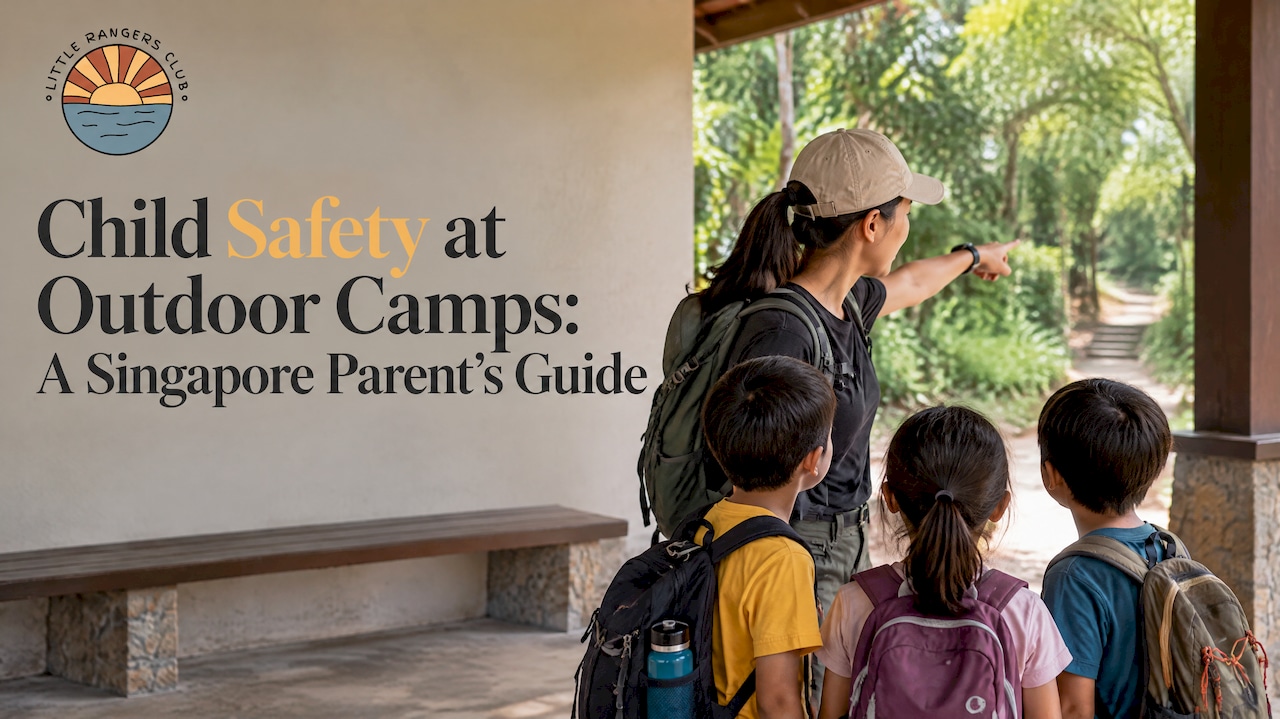
A safe outdoor camp in Singapore has certified staff, clear supervision, a plan for heat and storms, trained first aiders and a written emergency procedure that families can see. You can check all of that before you pay. This guide shows what to look for, which Singapore standards apply, and how to handle heat, lightning, water, allergies and communication with the camp.
Key Takeaways
- Singapore has no single licence for every children’s camp, so parents are expected to make reasonable checks themselves. A published code of practice, SS 710:2024, shows what good providers work towards.
- Ask about staff certifications, supervision ratios, first-aid training, the emergency plan and how incidents are reported to parents.
- Heat and lightning are the everyday Singapore risks. Look for a heat plan based on WBGT readings, scheduled water breaks and a rule for stopping when thunder is heard.
- Tell the camp about allergies, medication and medical conditions in writing, and agree who carries an adrenaline auto-injector if your child has one.
- Water, sailing and drone or laser activities need extra, activity-specific safety briefings. A good camp explains them without being asked.
Table of Contents
- Why parents need to check for themselves
- The pre-enrollment checklist
- Staff: qualifications, screening and supervision
- Heat: the everyday Singapore risk
- Lightning and storms
- Water, equipment and getting lost
- First aid, allergies and emergencies
- What to tell the camp, and what to expect back
- Our perspective
- If you are considering a Little Rangers camp
- FAQ
- Sources
Why parents need to check for themselves
Singapore does not run one regulatory regime that covers every place where children spend time. In September 2026, Senior Minister of State Goh Pei Ming said it is not practical to regulate every setting for children. He said the Children and Young Persons Act is the ultimate safety net, and that parents should exercise due diligence with reasonable checks on a provider and keep watching their child’s well-being.
That does not mean you are on your own. There are useful benchmarks:
- For schools: the Ministry of Education says schools carry out risk assessments for outdoor adventure learning activities. They look at facilities and equipment, the competence of personnel, safe conduct, participant readiness and the environment. External vendors must follow MOE safety guidelines, and all personnel must hold relevant certifications.
- For the industry: SS 710:2024 is the Singapore standard for outdoor adventure education. It is owned by Enterprise Singapore and co-convened by Outward Bound Singapore and the OLAE Association. It was published in 2025 and gives guidance in five areas, including risk and emergency management and participant information.
- In the text of the standard: it sets minimum requirements and best practices. These cover what providers are accountable for, the competence of programme supervisors and activity leaders, risk management systems, the readiness of locations and the adequacy of equipment.
The standard is a useful yardstick. If a camp talks about risk assessments, qualified leaders and emergency drills in the same terms, it is working the way the industry expects.
The pre-enrollment checklist
Paediatric and public-health bodies abroad give very similar lists. The American Academy of Pediatrics advises parents to ask about staff qualifications and child-to-staff ratios, how health care is delivered and whether staff are first-aid trained. It also covers arrangements with local hospitals and emergency services, swimming requirements and sunblock protocols.
Here is that advice turned into a checklist you can use in Singapore.
| Area | What to ask | What a good answer sounds like |
|---|---|---|
| Staff | Who leads each activity, and what certifications do they hold? | Named roles, current first-aid and activity-specific certificates |
| Ratios | How many children per adult, and does it change for water or climbing? | A clear number, lower for higher-risk activities |
| Medical | Who is first-aid trained, and where is the kit and AED? | Several trained staff on site, a stocked kit, a known route to the nearest hospital |
| Emergencies | What happens if a child is hurt or lost? | A written plan, with 995 as the first call for serious cases |
| Weather | What do you do in heat, rain or thunder? | Defined triggers for breaks, moving indoors or stopping |
| Water | How are swimmers and non-swimmers handled? | Swim checks, lifejackets, close supervision |
| Communication | How will I hear about incidents? | Same-day contact for anything beyond a minor scrape |
If you want to see how organizers structure a multi-day camp so that supervision and breaks are built into each day, a basketball camp plan shows one example of day-by-day scheduling.
Maryland’s health department adds a few more questions: whether the camp is licensed where licensing applies, who the director is and whether a doctor or nurse is on call at all times. Licensing rules differ by country, so in Singapore the equivalents are certifications, standards such as SS 710 and a written safety plan.
ChildCare.gov also suggests asking for a copy of the program’s policies, including safety and emergency planning. Camps that run well usually have these documents ready and are glad to share them.
Staff: qualifications, screening and supervision
People make a camp safe, so start there.
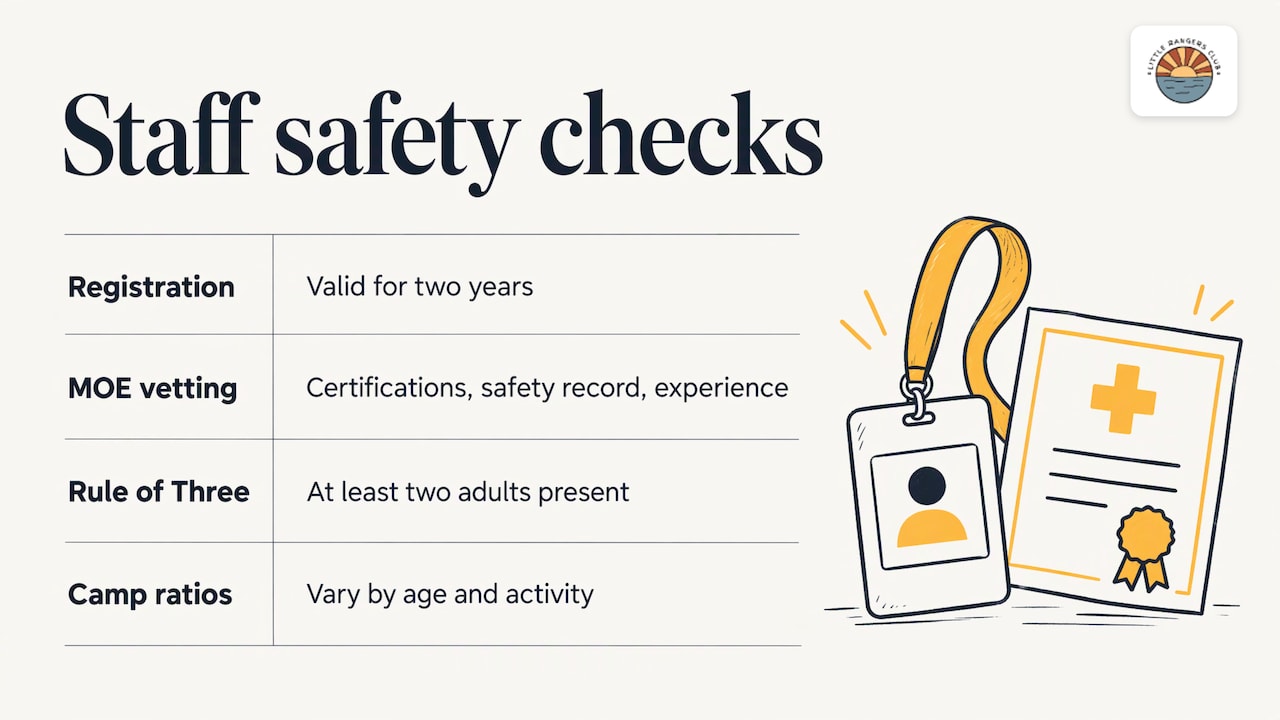
Certifications. For work with schools, MOE requires instructors to register before providing services. Registration lasts two years. Suitability is assessed on certifications, safety record, experience and, where applicable, registration with a professional body. MOE also says it can de-register instructors who compromise student safety and may hold back new contracts from vendors under investigation. A camp that works with schools has therefore been through a vetting process. Many parents find it reassuring to ask whether the camp’s team also works with schools.
Screening and the two-adult rule. The YMCA of the USA recommends asking how staff are trained to prevent and respond to abuse. It also suggests asking whether supervision follows a Rule of Three, meaning at least two adults are present at all times. Other questions are about social media and texting policies, comprehensive screening and how reports of misconduct are handled. These are reasonable questions for any camp in any country. Good providers answer them plainly.
Ratios. There is no single national number for camps in Singapore. Younger children, water activities and activities with equipment all call for more adults per child. Ask for the ratio for the specific activity your child will do, not only the average for the camp.
Experience with your child’s age. A camp for three-year-olds should look different from one for twelve-year-olds. If your child is at the younger end, our guide to sports for 3-year-olds explains what suitable activities look like.
Heat: the everyday Singapore risk
Heat is the risk you will meet on most outdoor days here. Singapore’s OAE Council advisory on seasonal heat stress sets a 30°C WBGT threshold for safety measures. WBGT, or wet-bulb globe temperature, combines heat, humidity and sun. The advisory says heat-stress risk is higher between March and October, particularly 11am to 3pm in April and May. Providers are expected to monitor WBGT, apply heat mitigation, keep emergency plans, adapt programmes and train staff to handle heat emergencies.
The Ministry of Health gives advice parents can use directly. It recommends minimising sustained outdoor activity between 11am and 4pm. It also advises having children drink before, during and after exercise, and keeping outdoor activity short with frequent breaks. The same page lists symptoms of heat-induced illness: headache, nausea, dizziness, fainting, rapid heart rate, poor concentration, muscle ache or cramps, blurred vision, loss of coordination, confusion, seizures, vomiting, and less or darker urine.
What to look for in a camp:
- Hard activity scheduled for early morning or late afternoon, with shaded or indoor options at midday.
- A water-break routine run by staff, not left to the children to remember.
- Staff who can name the symptoms above and know when to cool a child down and when to call 995.
- A WBGT reading, or a similar rule, that changes the day’s plan.
At home, send a refillable water bottle, a hat, sunscreen the child can wear all day and light clothes. Tell staff if your child has had heat problems before.
Lightning and storms
Singapore has a lot of lightning. The Straits Times reports that Changi climate station detects lightning on about 176 days a year on average. It advises seeking shelter as soon as thunder is heard, waiting at least 30 minutes after the last thunder before resuming outdoor activity, and avoiding tall trees, water and metal objects.
The same article quotes a weather expert saying that lightning cannot be pinpointed by forecasts. People should not rely only on government warnings, and they are the first party responsible for their own safety. For a camp, that means the leader on site needs the authority to stop an activity without waiting for an alert.
Questions to ask:
- Who decides to stop, and is that decision made on the spot?
- Where do children shelter, and can the whole group fit?
- What is the rule for resuming play?
The Straits Times also advises people in water sports such as sailing, canoeing, swimming or diving to return to shore once a storm is threatening, and to leave the water immediately if lightning is seen. Any camp with sailing, pool games or paddling should have this written down.
Water, equipment and getting lost
Water activities need their own briefing. ChildCare.gov suggests asking how children are supervised during water activities. ABC News, reporting on camp safety after the 2025 Texas floods, lists certified lifeguards among the key questions about water safety. It also lists licensed health-care providers on site, severe weather protocols with evacuation plans, and the camp’s distance from first responders.
For water and equipment activities, look for:
- A swim check or a clear rule for non-swimmers, with lifejackets worn where the activity needs them.
- A safety briefing before each new activity, in words the child understands.
- Equipment checked before use and sized for children.
- Head counts at every transition: leaving a site, boarding transport, returning from toilet breaks.
- Name tags or a colored shirt so staff can spot the group at a glance.
Shirts also help on trips. Matching camp shirts make a group easy to see, and a printed camp T-shirt is one simple way to do that for a school or kindergarten group.
Tell your child what to do if they cannot see their group: stay where they are, find a staff member in a camp shirt and do not go off with anyone else. Rehearse it once at home.
First aid, allergies and emergencies
The code of practice includes Annex A on medical conditions to factor into risk management and Annex C on first-aid kit types. So a camp that follows it plans for medical conditions before the day starts.
Singapore’s emergency approach is consistent across guidance. The Ministry of Manpower’s first-aid guidance describes a Primary Survey called DRSABC: Danger, Response, Shout for help, AED, Breathing, Chest compressions. It then describes a Secondary Survey called SAMPLE: Signs and symptoms, Allergies, Medications, Past medical history, Last meal and Events leading up to the injury. The steps include calling 995 and staying on the line with SCDF. The Singapore Red Cross manual teaches the same sequence.
Ask the camp:
- How many staff are first-aid and CPR trained, and is there an AED nearby?
- Where is the nearest hospital, and how would a child get there?
- Who stays with the injured child, who calls 995 and who looks after the rest of the group?
- How are parents contacted?
Allergies and anaphylaxis
If your child has a severe allergy, say so in writing, and tell the camp where the medication is kept. The Singapore Red Cross manual says first aiders should ask whether the casualty carries prescribed medication, such as an epinephrine auto-injector. They assist with the injection into the outer thigh for 3 to 10 seconds, loosen tight clothing and call 995 even if symptoms improve, because they can come back.
The Singapore First Aid Guidelines 2026 agree. Prompt intramuscular adrenaline via an auto-injector is the mainstay of immediate treatment, and 995 should be called for every suspected case whether or not the auto-injector was used. A repeat dose may be considered if there is no response and the ambulance is expected to take more than 10 minutes. The guidelines also note that first aiders cannot be expected to recognize anaphylaxis without repeated training. So give staff clear written instructions from your child’s doctor, and make sure the auto-injector travels with your child and is easy to reach.
What to tell the camp, and what to expect back
SS 710 lists participant information as one of its key areas. In practice, the camp can only protect your child as well as the information you give it. Before day one, share:
- Allergies, with the reaction and the medication. Include food, insect and medicine allergies.
- Medical conditions such as asthma, epilepsy, diabetes or past heat problems, and any medication with dosing instructions from your doctor.
- Two emergency contacts who can answer the phone during camp hours.
- Whether your child can swim, and how confidently.
- Anything that affects behavior or anxiety: fear of water or heights, sensory sensitivities, past injuries.
- Who is allowed to collect your child.
In return, expect a camp to tell you what the day will include, what your child should bring, and who to call. Ask in advance how it will report an incident. We think the right standard is a prompt call for anything beyond a minor scrape, followed by a short written summary. If a camp has a clear answer ready, that is a sign of how it handles everything else.
Our perspective
We run indoor and outdoor programs for children aged 3 to 13, from weekly multi-sports classes to holiday camps, water sports and survival training. Our view of safety is simple: it is part of the lesson, not a separate rulebook.
When children learn to follow a briefing, check their gear, drink water without being told and look out for a teammate, they are practicing the same teamwork, resilience and problem-solving that we want camp to build. A child who understands why we stop when thunder sounds is a safer child on every outdoor day, not only at ours.
That is why we pair experienced facilitators with experiential learning, and why we keep quality instruction at the center of everything we offer. We would encourage any parent to ask the questions in this guide of any camp, and to expect clear, confident answers.
Joshua
If you are considering a Little Rangers camp
Our holiday camps bring together multi-sports, outdoor adventure and hands-on activities for children aged 3 to 13, led by experienced facilitators with safety and quality instruction at the core.
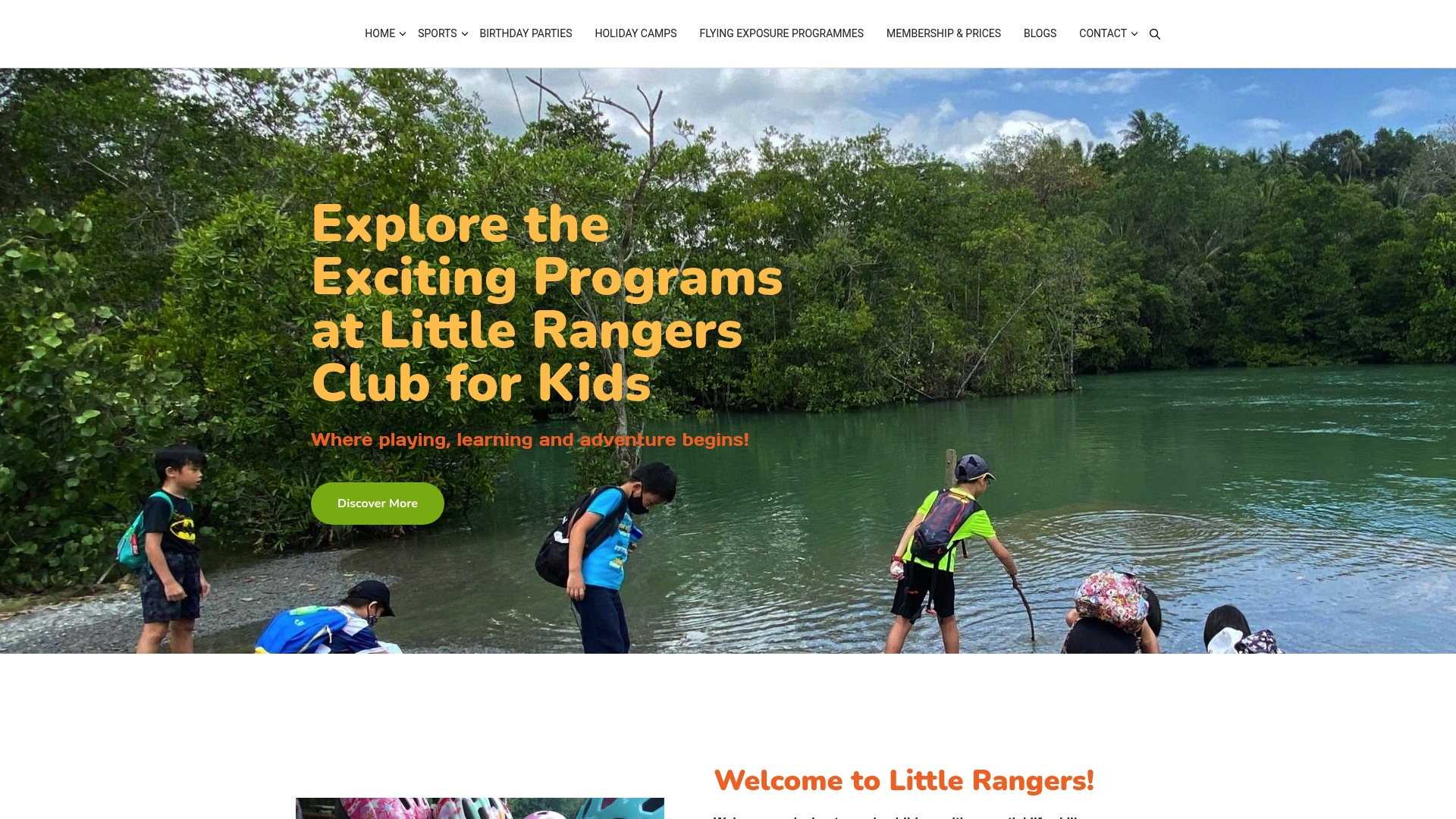
If you want to see what a camp day looks like, our holiday camp guide and our overview of outdoor adventure camps in Singapore explain the activities. For a regular routine, a weekly class package lets your child build skills across ten sessions. Schools and kindergartens can look at our school programs.
FAQ
What is the most important thing to check before sending my child to an outdoor camp?
Start with who is looking after your child and what happens in an emergency. Ask about staff certifications, the number of children per adult, first-aid training and the written emergency plan. These cover most of what can go wrong, and a well-run camp will have clear answers.
Is there a safety standard for outdoor camps in Singapore?
Yes. SS 710:2024 is the Singapore standard for outdoor adventure education, published in 2025. It covers risk and emergency management and participant information, among other areas. It is a code of practice, so ask a camp how it follows the standard.
How do camps keep children safe in Singapore’s heat?
Good camps schedule strenuous activity outside the midday hours and build in regular water breaks. They also monitor conditions such as WBGT and train staff to recognize heat illness. The OAE Council advisory sets a 30°C WBGT threshold for protective measures.
What should I do if my child has a food or insect allergy?
Tell the camp in writing before the first day, with your doctor’s instructions and any prescribed auto-injector. For a suspected severe reaction, guidelines say to call 995 even if the child seems better after treatment, because symptoms can return. Speak to your child’s doctor about the right plan for your child.
Sources
- Impractical to regulate every setting for children (AsiaOne)
- Outdoor education and activities (MOE)
- SS 710:2024 overview (Singapore OAE)
- SS 710:2024 code of practice preview (Singapore Standards eShop)
- Choosing a Summer Camp and Preparing Your Child (AAP, HealthyChildren.org)
- How to Choose a Youth Camp (Maryland Department of Health)
- Choosing Vacation and Summer Programs (ChildCare.gov)
- Camp safety: key questions for parents (ABC News)
- Five must-ask questions before enrolling your child (YMCA)
- Seasonal heat stress management advisory (Singapore OAE)
- High temperatures experienced in past few days (Ministry of Health)
- askST: Lightning strikes and safety tips (The Straits Times)
- First aid (Ministry of Manpower)
- Standard First Aid manual (Singapore Red Cross)
- Singapore First Aid Guidelines 2026