The best school field day is a rotation of short, team-based stations matched to the children’s age, run in small groups with a clear heat and lightning plan. Schools that bring in trained facilitators can spend their energy on the children rather than on logistics. We run field-day style programs for schools and kindergartens, from multi-sport stations to laser tag, bubble games and drone or aviation workshops.
Key Takeaways
- Pick 4 to 6 stations of about 20 to 25 minutes each, with pair or team challenges, so every child is moving most of the time.
- Match activities to age: guided play for P1 to P3, navigation and team tasks for P4, and challenge-based activities for P5 and P6.
- Plan for Singapore’s weather: check NEA for heat and lightning, schedule rest breaks, and keep a wet weather plan.
- Use about 1 adult to every 15 children as a baseline, with briefed helpers and a written risk assessment.
- Our school programs handle the facilitation, so teachers can supervise and enjoy the day. See our school field trip activities page.
Table of Contents
- What makes a field day work
- Activity ideas by age
- A sample 2-hour station rotation
- Safety, heat and weather planning
- Dress for teamwork
- Planning checklist for teachers
- Perspective
- Bring a facilitated field day to your school
- FAQ
- Sources
What makes a field day work
A field day is not a sports meet with winners and losers. At its best it is a set of games where children practise running, throwing, balancing, cooperating and solving small problems together.
Singapore schools already build on this idea. Ai Tong School’s L.E.A.D programme says its activities are planned progressively by age so children build toughness, resilience, teamwork and appreciation of nature. Edgefield Primary describes structured play that teaches values, reflection and goal-setting. A field day is a one-day version of the same idea.
Three design rules follow from this:
- Keep everyone active. Many small stations beat one big relay where most children wait.
- Use pairs and teams. Cooperation is where the character learning happens.
- End with a short reflection. Ask what worked, what was hard and what the team would change.
Activity ideas by age
Preschool and kindergarten (K1 to K2)
Young children need short turns, simple rules and plenty of movement. MOE says full-day preschools must include at least 30 minutes of outdoor activity daily or 45 minutes three times a week, so a field day is a good extension of what children already do.
Good choices:
- Obstacle courses with crawling, balancing and jumping
- Parachute and bubble games
- Simple scavenger hunts with picture clues
- Water play on a cool morning
Our kindergarten year-end activities page shows how these are set up for graduation season. For more on why this matters, see our guide to outdoor learning and sports in preschools.
Lower primary (P1 to P3)
Lower primary children are still building fundamental movement skills. NParks’ Kids for Nature programme, developed for MOE’s Programme for Active Learning, runs eight two-hour lessons for P1 and P2, with seven in school and the last a park excursion. Greendale Primary’s outdoor programme centres on guided nature walks and school-based experiences for these years.
Good choices:
- Run, jump and throw stations
- Bubble games and tag variations
- Minute-to-win-it style challenges in teams of four
- Nature scavenger hunts in the school compound
Middle primary (P4)
P4 children can handle navigation and team tasks. Greendale adds neighbourhood hikes to build navigation and teamwork at this level.
Good choices:
- A mini amazing race with map and clue tasks
- Orienteering around the school field
- Team building challenges with a simple build, such as a brick or drone model
- Laser tag with team objectives
Upper primary (P5 and P6)
Older children want challenge and some independence. Ai Tong’s P5 camp includes a high element obstacle course, orienteering and an outdoor cooking competition. Edgefield’s P6 students choose from Tchoukball, Floorball, Archery Tag and more.
Good choices:
- Archery-style or laser clay shooting activities
- Water sports such as sailing or pool games, with qualified supervision
- Strategy games with team roles and a debrief
- Flight simulator and drone workshops that mix technology with teamwork
A sample 2-hour station rotation
ActiveSG’s athletics school holiday programme offers a useful template. Its two-hour session has 15 minutes of warm-up, 75 minutes of stations, and a cool-down and sharing circle. Here is a version adapted for a school field day:
| Time | Activity | Purpose |
|---|---|---|
| 0:00 to 0:15 | Warm-up and team briefing | Safety rules, team names |
| 0:15 to 0:40 | Station 1 | Movement skills |
| 0:40 to 1:05 | Station 2 | Teamwork challenge |
| 1:05 to 1:30 | Station 3 | Problem solving |
| 1:30 to 1:40 | Cool-down and water | Recovery |
| 1:40 to 2:00 | Reflection circle | Learning and celebration |
With 2 age-appropriate levels at each station, mixed-ability groups can all take part. Add rest and water breaks inside each station, not only between them.
Safety, heat and weather planning
Singapore’s climate shapes every outdoor plan. Treat these as fixed parts of the schedule.
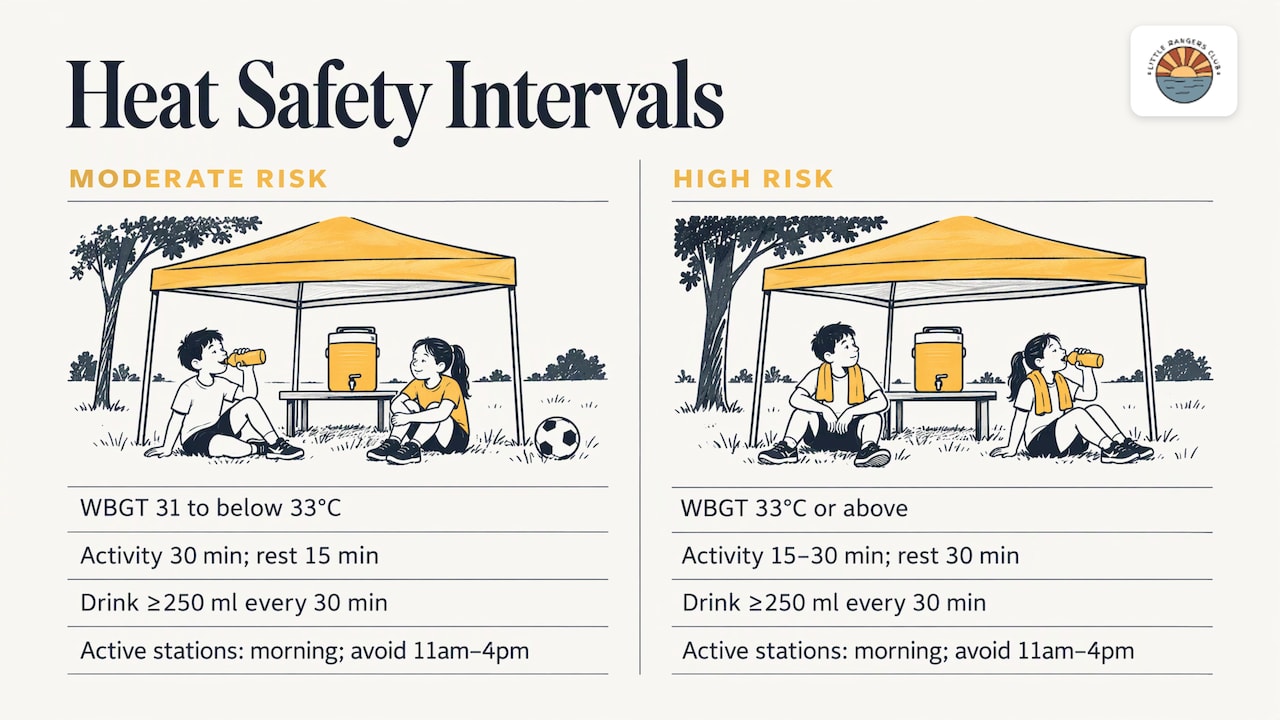
Heat. The heat stress management plan notes that the hottest part of the day is typically 11am to 4pm. At moderate risk (WBGT 31 to below 33°C) it recommends 30 minutes of activity followed by 15 minutes of rest. At high risk (WBGT 33°C or above) it recommends 15 to 30 minutes of activity and 30 minutes of rest. Participants should drink at least 250ml of water every 30 minutes. Check NEA’s website or the myENV app before you start. Schedule the most active stations in the morning.
Lightning and rain. NParks’ guide says outdoor activities are unsafe if there is a lightning risk and cannot be run well in heavy rain. PUB’s guidance is to check forecast and lightning status 1 to 2 hours before an activity and not to start under a Category 1 Lightning Alert or heavy downpour. The same guide says to postpone if the PSI reading is 100 or above during haze. Always have an indoor or sheltered backup.
Supervision. The general MOE guideline cited in NIE’s fieldwork guide is 1 teacher or helper to every 15 participants. The same guide asks for a risk assessment before fieldwork and says helpers should be briefed on stations, objectives and emergency procedures. PUB’s field study guide keeps a facilitator ratio of 1:20 and pairs students so no one wanders alone.
Providers. The Singapore Standard SS 710:2024 sets requirements for planning and managing outdoor adventure education activities, covering provider accountability, supervisor competence, risk management and equipment. Read it when you assess any provider of adventure activities.
Also pack: a first aid kit for each station, a clear emergency contact sheet, a head count at every transition, and water points near each station. For the safety practices behind our camps, see our child safety at outdoor camps guide.
Dress for teamwork
A field day looks better and runs more smoothly when teams are easy to spot. Class or house shirts help children feel part of a group, and this is covered in more detail in this piece on customised CCA T-shirts and team spirit. Combine shirts with caps, sunscreen and closed shoes.
Planning checklist for teachers
- Set the learning goal: teamwork, movement skills, resilience or celebration.
- Choose 4 to 6 stations suited to the age group.
- Complete the risk assessment and brief all helpers.
- Book transport if the venue is off campus.
- Fix a wet weather plan and a heat plan.
- Check NEA forecasts the morning of the event.
- Run a reflection circle at the end.
For off-campus outings, our school field trip activities guide adds more ideas. Larger events such as family day carnivals call for the same station approach with more helpers.
Perspective
Teachers do the hardest part of a field day: they know the children. What they rarely have is a spare week to design stations, source equipment and brief helpers.
That is why we build our programs around adventure with a purpose. Our approach combines fun and learning, so a laser tag round or a drone build becomes a lesson in teamwork, resilience and problem solving. Our experienced facilitators run the stations, and safety and quality instruction come first in everything we do.
We work with children aged 3 to 13, so one day can include activities pitched at each group. Schools can choose indoor or outdoor formats and customise the day to their cohort.
Joshua
Bring a facilitated field day to your school
We offer programs for kindergartens and schools, including multi-sports, adventure activities and aviation workshops. Our Aviation Exposure School Programme costs $105 per student, and details are on our school programs and partnerships page. For the full range of activities, visit Little Rangers Club.
Parents who want the same energy outside school can look at our weekly multi-sports classes, where a 10 Sessions Weekly Class Package costs $280, or our holiday camps.
FAQ
How long should a school field day last?
Two to two and a half hours suits primary children, according to NIE’s fieldwork guidance, who say this keeps interest high. A full day can work if you split it into a morning of active stations and an afternoon of calmer, shaded or indoor activities.
What is a good adult-to-child ratio?
The general MOE guideline is one teacher or helper to every 15 participants, and PUB’s field study guide uses 1:20 for facilitators. Choose the lower number for younger children and for higher-energy activities such as water games.
What if it rains on the day?
Heavy rain and lightning are reasons to move indoors. Check the forecast and lightning status one to two hours ahead through NEA, and keep a sheltered plan ready, such as hall-based team challenges, brick building or bubble-free games.
Can a field day include technology activities?
Yes. Drone and flight simulator workshops suit upper primary children in particular, and they work well as indoor stations when the weather turns.
Sources
- NParks: Kids for Nature programme
- NParks: Kids for Nature P2 guide book
- ActiveSG Athletics School Holiday Programme
- Ai Tong School L.E.A.D programme
- Edgefield Primary School sports programme
- Greendale Primary School Learning for Life Programme
- MOE: Outdoor learning in pre-schools and primary schools
- PUB: Marina Reservoir field study guide
- Heat stress management plan
- NIE: Primary social studies fieldwork
- Singapore Standard SS 710:2024
- Customised CCA T-shirts and team spirit