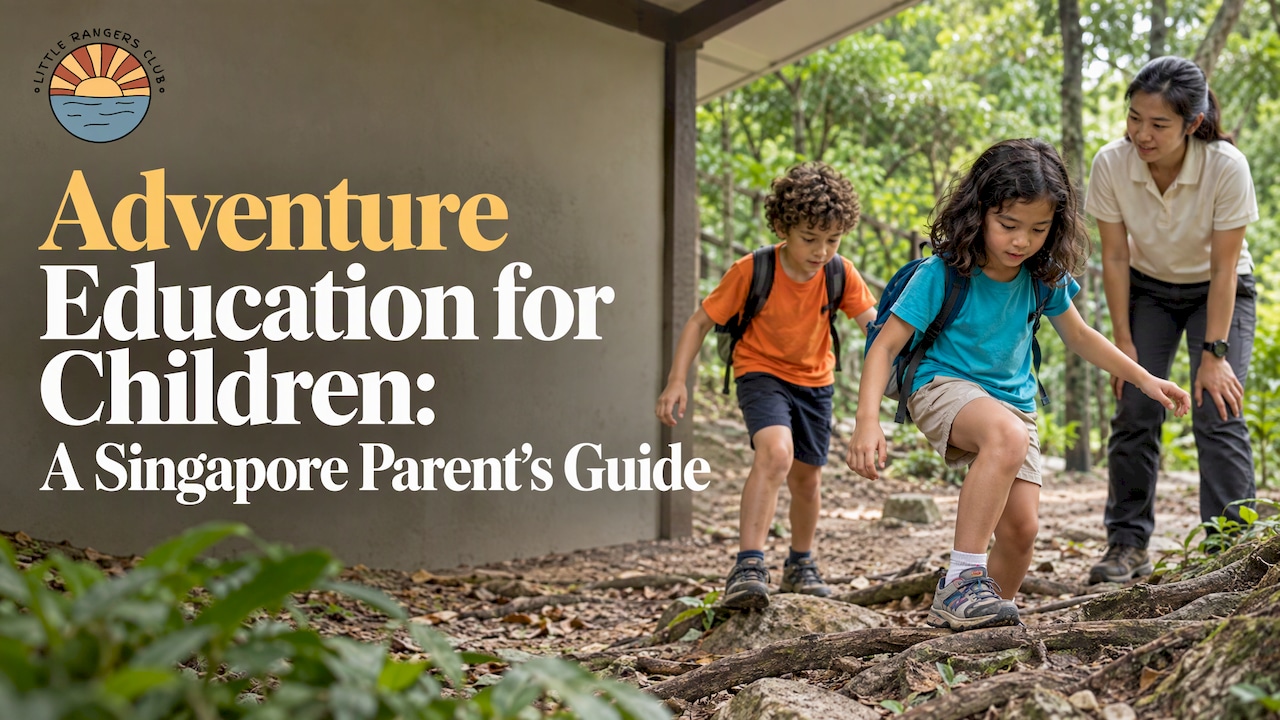
Adventure education teaches children teamwork, resilience and problem-solving by putting them in real, hands-on challenges with a trained facilitator, and the simplest way to start in Singapore is a structured programme that runs it for you. At Little Rangers Club we run weekly multi-sports classes, holiday camps and mobile birthday parties for children aged 3 to 13, so the learning happens inside activities your child actually wants to join.
Key Takeaways
- Adventure education is planned learning through challenge, not just free play: a facilitator sets a task, children work it out together, and then reflect on it.
- A 2025 review of children aged 6 to 18 linked it to better leadership, self-efficacy, peer support, independence and resilience.
- Singapore’s own guidance backs outdoor learning, from ECDA for preschools to MOE’s weekly outdoor requirements and the SS 710:2024 safety code.
- Heat and rain shape every outdoor plan here, so scheduling, shade and supervision matter as much as the activity.
- Weekly classes, holiday camps and themed birthday parties are three easy ways to bring adventure learning into family life.
Table of Contents
- What adventure education actually means
- What children gain: the evidence
- What Singapore’s own guidance says
- Matching adventure to your child’s age
- Doing it well in Singapore’s heat and rain
- What good supervision looks like
- Three ways to start with Little Rangers
- Birthday parties as adventure education
- For schools and kindergartens
- Book your child’s first adventure
- Our perspective
- Frequently asked questions
- Sources
What adventure education actually means
Most parents picture a ropes course or a camping trip. The idea is wider. Singapore’s code of practice for outdoor adventure education, SS 710:2024, describes these activities as a platform for education in a practical environment. Skills such as critical thinking, leadership, teamwork and problem-solving are taught and then applied for real.
A 2025 scoping review describes outdoor adventure education as activities and experiences that engage directly with natural settings and often include real or perceived risk. The same review notes that children’s risk-taking is driven by their own motivation, which ties to three basic psychological needs: autonomy, competence and relatedness.
In plain terms, the difference from ordinary play comes down to three things:
- A purpose. The activity is chosen to build a skill, such as cooperating on a team task or planning a route.
- A stretch. The challenge sits just beyond what the child already does comfortably.
- A guide. A trained facilitator frames the task, manages safety and helps the child make sense of what happened afterwards.
A playground visit can be wonderful. An adventure session adds structure, so the lesson sticks.
What children gain: the evidence
The research is broad, and it points in a consistent direction.
Character and social skills. A 2025 mixed-method review in PLOS One covered children aged 6 to 18. It reported that adventure education improved leadership, self-efficacy, peer support, relationship skills, independence and the ability to follow instructions. Participants also showed greater resilience and life satisfaction, and lower stress.
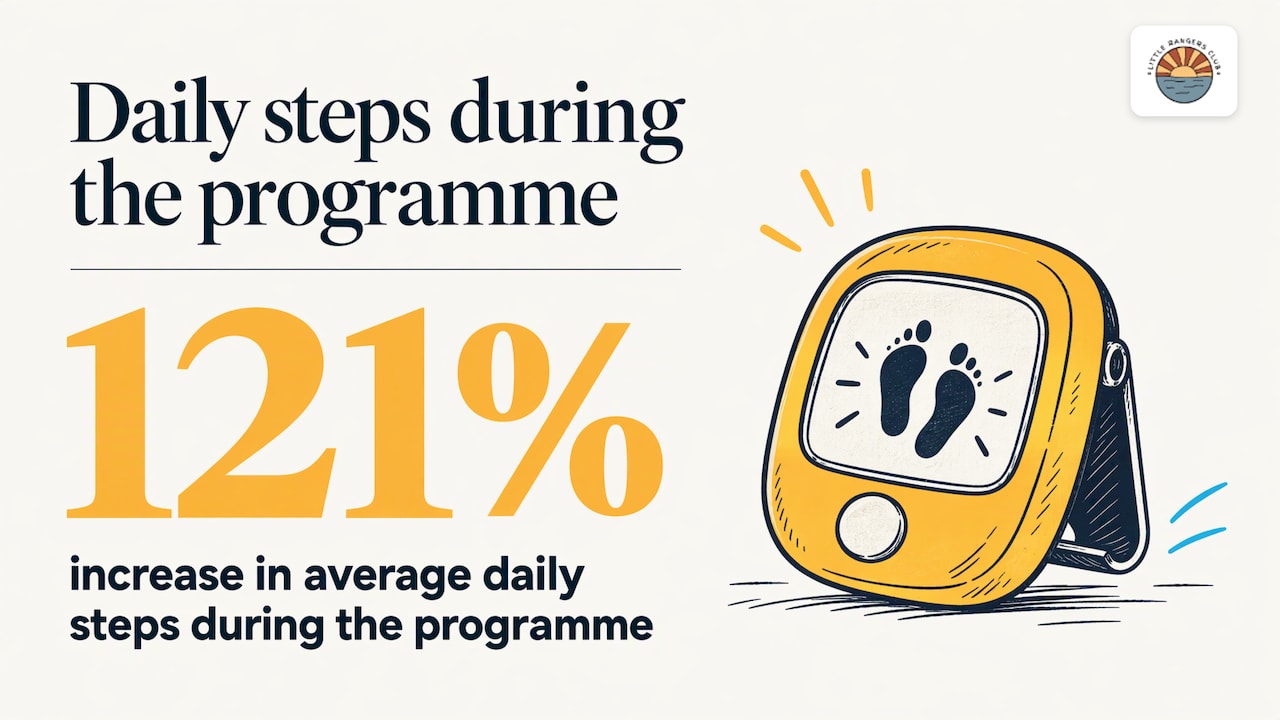
Physical activity. The same review reported one study in which average daily steps rose from 1,324 to 7,963, a 121% increase, during the programme. For a child who spends most weekdays at a desk, that is a very large change.
A wide range of developmental areas. A 2025 scoping review of 40 studies found positive associations across multiple developmental domains. Its themes included resilience and confidence, wellbeing, physical skills, autonomy, nature connectedness and the influence of the educator. That last theme matters for parents: who leads the session shapes what the child takes away.
Motor skills, focus and eyesight. Singapore’s Early Childhood Development Agency (ECDA) states that being outdoors gives children more chances to be active, improves motor skills, strengthens the immune system and lowers the risk of myopia. It also says children learn more deeply through their five senses and focus better. Myopia is a particular concern in Singapore, so the outdoor hours count.
Learning to judge risk. The US-based NAEYC explains that running, climbing and navigating uneven terrain build fitness and bone health. It adds that children also learn to assess risk, devise a plan and take action. Researchers Dodd and Lester go further and propose that age-appropriate adventurous play may help children cope better with anxiety.
The UK’s Education Endowment Foundation notes that the wider evidence base shows positive impacts on self-efficacy, motivation and teamwork. Self-efficacy simply means a child’s belief that they can do something hard. It is the quality parents usually mean when they say they want a more confident child.
What Singapore’s own guidance says
You are not swimming against the current by choosing outdoor learning. Schools are already expected to provide it.
- Preschools. MOE states that full-day preschools must include at least 30 minutes of outdoor activity daily, or 45 minutes three times a week. Half-day preschools must include at least 30 minutes of gross motor activity three times a week, with at least one session outdoors.
- Primary schools. The same MOE reply sets 2 hours of weekly PE for Primary 1 and 2, and 2.5 hours for Primary 3 to 6, much of it outdoors when the weather allows. Primary 5 pupils also attend a three-day cohort camp.
- Programme for Active Learning. NParks’ Kids for Nature programme gives Primary 1 and 2 pupils eight two-hour lessons on nature appreciation, outdoor safety skills and social-emotional learning.
- Early childhood educators. ECDA publishes a national guide with principles and practical suggestions, plus a repository of outdoor learning experiences and an activity journal.
These hours cover the basics. Many families want more variety and a stronger challenge than a school timetable can fit, and that is where weekly classes, camps and special-occasion programmes come in. If you are weighing outdoor against indoor options, our comparison of nature-based and indoor enrichment walks through the trade-offs.
Matching adventure to your child’s age
Risk is where the learning happens, and the right amount depends on age. The 2025 scoping review cites Sandseter’s well-known taxonomy of risky play. It lists six types: great heights, high speed, harmful tools, dangerous elements, rough-and-tumble play, and places where children can get lost. Seen that way, a few ordinary childhood moments count as adventure: climbing a structure, racing, wrestling playfully, exploring out of an adult’s sight.
A practical way to match this to age:
- Ages 3 to 5. Short, playful sessions with lots of movement: obstacle courses, simple team games, exploring a park. The adventure is small and close to a helper.
- Ages 6 to 9. Longer challenges with rules and teams: relay and strategy games, building tasks, first experiences with water sports or flight simulators. Children begin to plan together.
- Ages 10 to 13. Real skill-building with some independence: sailing, wing foiling, drone building and flying, outdoor survival skills, navigating a race course as a team.
A child who likes to watch first needs a different start from one who leaps in. Good facilitators let both take the next step at their own pace. That is why we group our classes by age and offer private classes for children who do better one-on-one.
Doing it well in Singapore’s heat and rain
Adventure here comes with a weather plan. Under Singapore’s National Heat Response Plan, as reported by The Straits Times in 2025, pre-schools are not to conduct outdoor activities between 11am and 4pm when the plan is activated. Outdoor activities should be modified or suspended according to the heat stress level, with a WBGT reading of 33°C or higher as the trigger. WBGT (wet-bulb globe temperature) is the heat-stress measure that combines temperature, humidity and sun.
For parents, that translates into a few habits:
- Prefer morning or late-afternoon sessions for outdoor activity.
- Send water, a hat and sun protection, and dress your child in breathable clothing.
- Choose programmes that have an indoor option or a rain and heat plan.
- Build up gradually. A Straits Times report on a preschool camping trip to St John’s Island described children who had practised cycling up to 5km over seven months to build endurance for hot weather before the three-day, two-night trip.
If your child has a medical condition such as asthma, heat sensitivity or a heart condition, speak to your child’s doctor before starting a strenuous programme.
What good supervision looks like
SS 710:2024 is published by Enterprise Singapore and sets minimum requirements and best practices for planning and delivering outdoor adventure education. It covers provider accountabilities, the competence of programme supervisors and activity leaders, risk management, location and facility readiness, equipment adequacy and the safety information given to participants before, during and after activities.
Those are the building blocks of a well-run session: trained leaders, a clear risk plan, suitable equipment and clear communication with families. Our approach rests on safety and quality instruction delivered by experienced facilitators. Our guide to child safety at outdoor camps explains what parents can expect on the day.
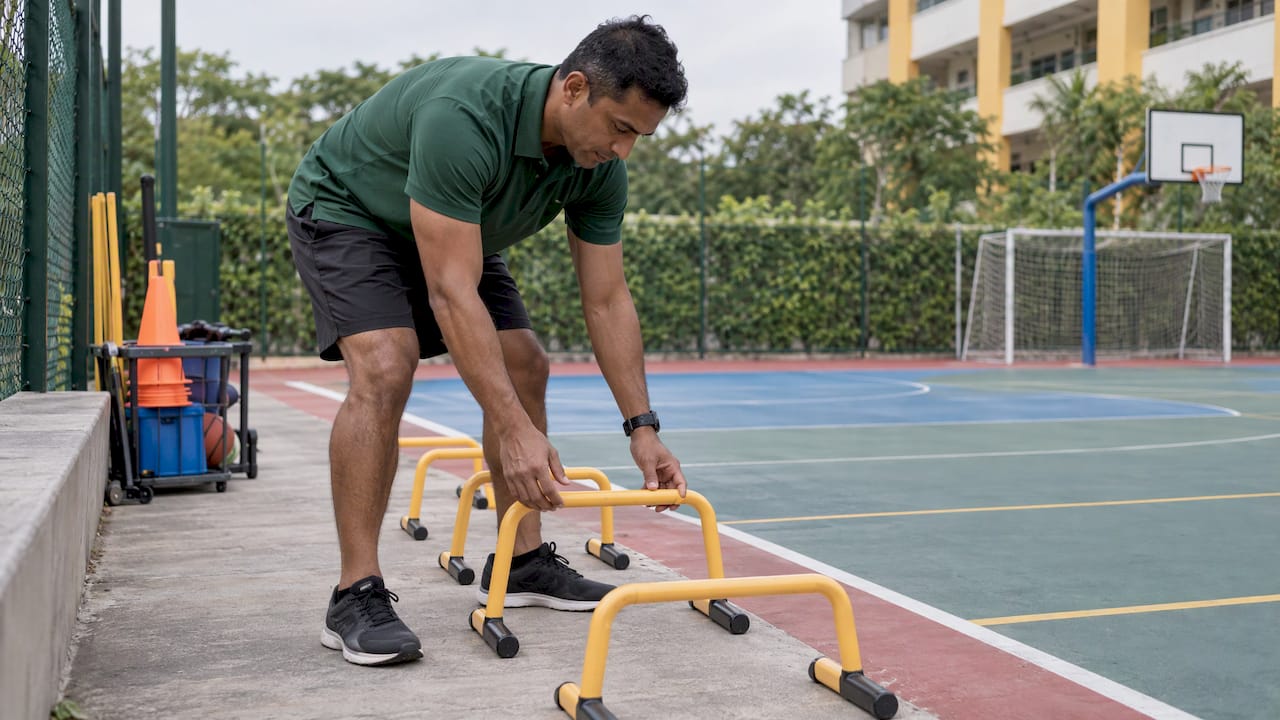
Three ways to start with Little Rangers
Weekly multi-sports classes
Regular sessions build skill because children return to them. Our 10 Sessions Weekly Class Package costs $280 and gives your child a steady rhythm of movement, teamwork and new challenges. Children aged 3 to 13 can take part. A weekly class also suits families who want adventure learning without giving up a whole holiday week.
Holiday camps
School holidays are the best window for longer adventures. The Little Rangers Holiday Camp mixes outdoor challenges, sports and hands-on workshops. See our guide to outdoor adventure camps in Singapore for how to choose one, and the camp page for current schedules and pricing.
Flight simulator and drone workshops
For children who love technology, aviation is adventure with a goal. On our pricing page you will find the 30mins Simulator Experience at $55 per person, the 60mins Simulator Experience at $95 per person, the Basic Build & Fly Course at $60 per person, the Advance Build & Fly Course at $50 per person, and Hall-of-Fame Drone Fly Sessions at $16 to $25 per person. A 10 sessions Learn-to-Fly Simulator Package is $880. Children build a drone, then fly it, which turns problem-solving into something they can see.
Birthday parties as adventure education
A party can teach as well as entertain. Our birthday packages are mobile, so we come to your home or a local venue near you, with professional facilitation. Teams strategise, cooperate and cheer each other on, which is the same skill set as in a class.
| Party | Price |
|---|---|
| Combat Skirmish Laser Tag | $360 |
| BLOOP Bubble Games | $456 |
| Water ZOVB and Water Tag Pool Party | $660 |
| Minute To Win It | $680 |
| Indoor Lego Bricks Masters | $680 |
| Laser Clay Shooting | $690 |
| Brick-A-Drone | $750 |
| Amazing Race Party Edition | $780 |
| Sailing & Wing Foil | $950 |
All are one-off prices as listed on our parties and events page. For a quick match: the Amazing Race suits mixed-age groups who like puzzles and teamwork, the Lego and Brick-A-Drone parties suit builders, and the water and sailing options suit older children who want a physical challenge. For more ideas, browse our kids birthday party ideas.
For schools and kindergartens
Schools and kindergartens can add adventure learning without building the programme from scratch. Start from the learning goal: teamwork for a year-end event, outdoor skills for a cohort, or a technology hook such as aviation.
The EEF notes that programmes range from short courses at school or a local centre, to regular sessions over a longer period, to intensive residential courses. It also says that adventure education typically involves collaborative challenge, practical problem-solving and explicit reflection. Reflection is the step where children talk about what they tried and what they would change, and it is what turns a fun day into a lesson.
Our Aviation Exposure School Programme is $105 per student, and the details are on our school programmes and partnerships page. For preschools, our article on why outdoor learning and sports matter in preschools sets out the thinking.
Book your child’s first adventure
If you want your child to build confidence, teamwork and resilience through real challenges, start with a weekly class or a holiday camp. Our facilitators plan each session around fun first, with the life skills built in. Parents get children who grow physically, emotionally and socially in a safe, nurturing environment.
See the weekly class package or the holiday camp, or get in touch through littlerangers.sg to plan a party or school programme.
Our perspective
We built Little Rangers around one belief: children learn the most important things by doing something a little bit hard, together, and having fun while they do it.
Teamwork, resilience and problem-solving cannot be handed over in a worksheet. A child learns them when the team has to cross the course, when the drone does not fly on the first attempt, or when the laser tag round needs a plan. That is why every programme we offer, from multi-sports classes to holiday camps to birthday parties, is an experience first and a lesson second.
We also think adventure should be easy for families. That is why our birthday parties come to your home or a venue near you, and why our programmes cover ages 3 to 13. Our facilitators are experienced, and we put safety and quality instruction ahead of everything else.
If you want your child to grow in confidence and love learning, an adventure with the right guide is a great place to start.
Joshua
Frequently asked questions
At what age can children start adventure education?
Our programmes are for children aged 3 to 13. Younger children begin with short, playful, close-to-adult activities such as obstacle courses and team games. As they grow, the challenges get longer and more independent, such as sailing, drone building or race-style games.
How often should my child do adventure activities?
Regularity helps more than occasional big events. Many families pair a weekly class, such as our 10-session package, with a holiday camp, so skills build up over the year. MOE’s preschool guideline of at least 30 minutes of outdoor activity daily or 45 minutes three times a week is a useful baseline for what children should get overall.
Is adventure education safe for young children?
Safe adventure means planned, age-appropriate challenge with trained leaders. Singapore’s SS 710:2024 code covers supervisor competence, risk management, equipment and safety information for outdoor adventure education. Our facilitators put safety first, and we match each activity to the child’s age. Check with your child’s doctor first if your child has a medical condition.
Can adventure education work for a birthday party?
Yes. Our mobile packages bring professionally facilitated games to your home or a local venue. Options include laser tag, an Amazing Race, bubble games, Lego building and sailing, and each one gives children a team challenge to work through.
How can a school or kindergarten add adventure learning?
Begin with the goal, whether that is teamwork, outdoor skills or a year-end celebration, and pick a format of a single workshop, a series or a camp. We work with schools and kindergartens on field activities and special events, and our school programmes page lists what is available.
Sources
- Code of practice for outdoor adventure education, SS 710:2024
- Risky Outdoor Play and Adventure Education in Nature for children, 2025 scoping review
- Scoping review of risky outdoor play and adventure education, PMC
- Investigating the impact of adventure education on children, PLOS One 2025
- ECDA: Outdoor Learning
- NAEYC: Eliminate Barriers to Risk Taking in Outdoor Play
- Adventurous Play as a Mechanism for Reducing Risk for Anxiety, PMC
- EEF: Outdoor adventure learning
- MOE: Outdoor Learning in Pre-Schools and Primary Schools
- NParks: Kids for Nature (PAL outdoor education)
- The Straits Times: Singapore’s new national heat response plan
- The Straits Times: Pre-school without walls, kids go on camping adventure