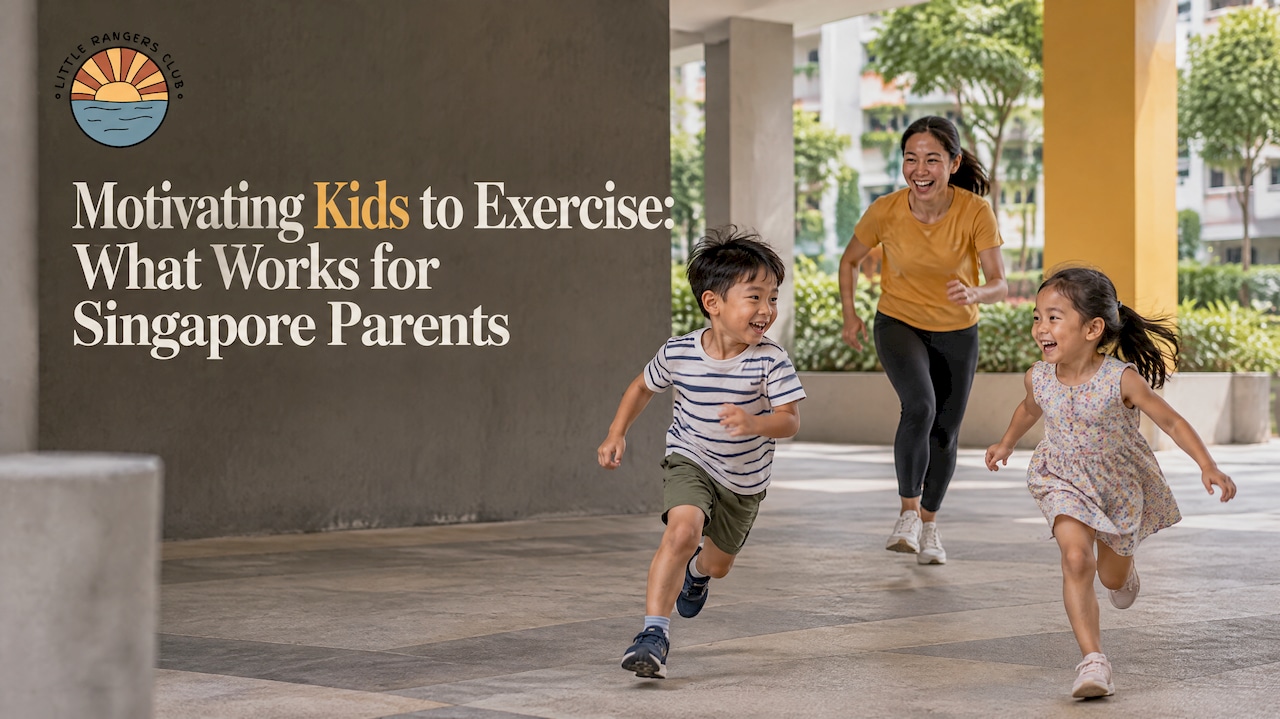
Children move more when they choose the activity, when it is social, and when a parent or friend joins in. Start with 10 to 15 minutes, build slowly, and give them a regular place where movement feels like play. For many families in Singapore, that place is a weekly multi-sports class, where friends, coaches and a changing set of games do part of the motivating for you. We run those classes at Little Rangers Club for children aged 3 to 13.
Key Takeaways
- Let your child choose the activity and the game rules. Choice and child-led play are what Singapore’s health and sports bodies recommend.
- Begin with 10 to 15 minutes and build toward the daily targets in the Singapore Physical Activity Guidelines.
- Join in. Tag, walks and obstacle courses work better with a parent playing than with a parent watching.
- Make movement social. Friends, siblings and weekly classes give a child a reason to turn up.
- Cap recreational screen time and keep balls and ropes within reach, so the active option is the easy one.
Table of Contents
- How Much Activity Children Need in Singapore
- Let Your Child Choose
- Join In Instead of Watching
- Build Movement Into the Day
- Start Small and Build
- When Screens Compete
- If Your Child Lacks Confidence
- Strength Play at Home: Keep It Safe
- Why a Weekly Class Keeps Motivation Going
- Our Perspective
- Little Rangers Programs That Get Children Moving
- FAQ
- Sources
How Much Activity Children Need in Singapore
Know the target first, so you can judge whether a push is needed at all. The Singapore Physical Activity Guidelines 2022 set these figures:
| Age | Recommendation |
|---|---|
| Under 1 | At least 30 minutes of tummy time daily |
| 1 to 2 | 180 minutes of varied activity daily |
| 3 to 6 | 180 minutes daily, including at least 60 minutes of moderate-to-vigorous activity |
| 7 to 17 | An average of 60 minutes of moderate-to-vigorous aerobic activity per day across the week, with vigorous aerobic and muscle- and bone-strengthening activity at least 3 days a week |
Two details help in practice. The school-age target is now a weekly average, so a quiet Tuesday can be balanced by a busy Saturday. The 2022 guidebook also removed minimum bout lengths, so short bursts count. That is good news if your child resists a long workout.
Moderate-to-vigorous means activity that raises the breathing and heart rate: brisk walking, cycling, running games, swimming. Muscle- and bone-strengthening means things like climbing, jumping and bodyweight play.
Let Your Child Choose
The most consistent advice from HealthHub’s Grow Well SG programme is to let children pick activities they enjoy. It suggests family cycling, badminton, dance workouts and tag as starting points. A child who picked the game owns it. A child who was assigned it negotiates.
Offer two or three options rather than an open question. “Scooter or tag at the playground?” gets an answer. “Do you want to exercise?” gets a no.
Let them run the game
Sport Singapore’s guide to creative active play recommends letting children invent games, set the rules or act as game master. Taking the lead helps sustain engagement and builds confidence. This works well for the child who says they are bad at sports: nobody is bad at a game they designed.
Match the activity to the child
The American Academy of Pediatrics advises choosing developmentally appropriate activities and never pushing a child through pain. A four-year-old needs short, silly, varied play. A ten-year-old often wants rules, scores and teammates.
Join In Instead of Watching
Sport Singapore’s Active Parents article from April 2025 advises parents to take part rather than only watch. Its ideas include tag, ball play, obstacle courses, weekend hikes, swims and post-dinner walks.
The same logic applies to teen and pre-teen athletes, where your attitude to sport shapes theirs. This piece on sports and teen mental health shows why the tone parents set around play and performance matters.
HealthHub also points to wider support: share routines with your spouse, invite grandparents for a walk, and organise playdates with neighbors’ children. Activity that includes other people is easier to keep up.
Build Movement Into the Day
You do not need a separate workout slot. HealthHub’s Being Active page suggests taking the stairs, walking to a nearby shop, detouring through a playground or making chores more active. Small moments add up and help form lasting habits.
Easy ideas for Singapore homes
- Colour hunts: turn a walk around the estate into a search for something red, then something yellow.
- Animal actions: you act out an animal and they guess, then swap. HealthHub suggests this one, with parents joining in.
- Laundry dash: a relay to carry clothes to the basket.
- Void-deck games: Sport Singapore’s active play ideas include hopscotch and relay races at the void deck.
- Rainy-day indoor play: balloon volleyball, sock bowling and yoga-freeze games come from the same source.
- Home obstacle course: the AAP suggests safe obstacle courses, dance prompts and hopping or skipping chores.
Sport Singapore also suggests keeping balls, skipping ropes or a mini goal where children can reach them, and clearing a movement-friendly space of at least 2 square meters at home. When the equipment is visible, children use it.
Start Small and Build
HealthHub suggests 10 to 15-minute sessions, gradually building toward 60 minutes a day. A first step that feels achievable removes most of the resistance. Fifteen minutes of tag after dinner is a win. Keep it cheerful, praise the effort, and add time only when your child asks for more.
When Screens Compete
If your child would rather watch a tablet, the answer is rarely a ban. Link movement to what they already love: a dinosaur hunt, a superhero training course, a dance from a favorite video. Then set clear limits.
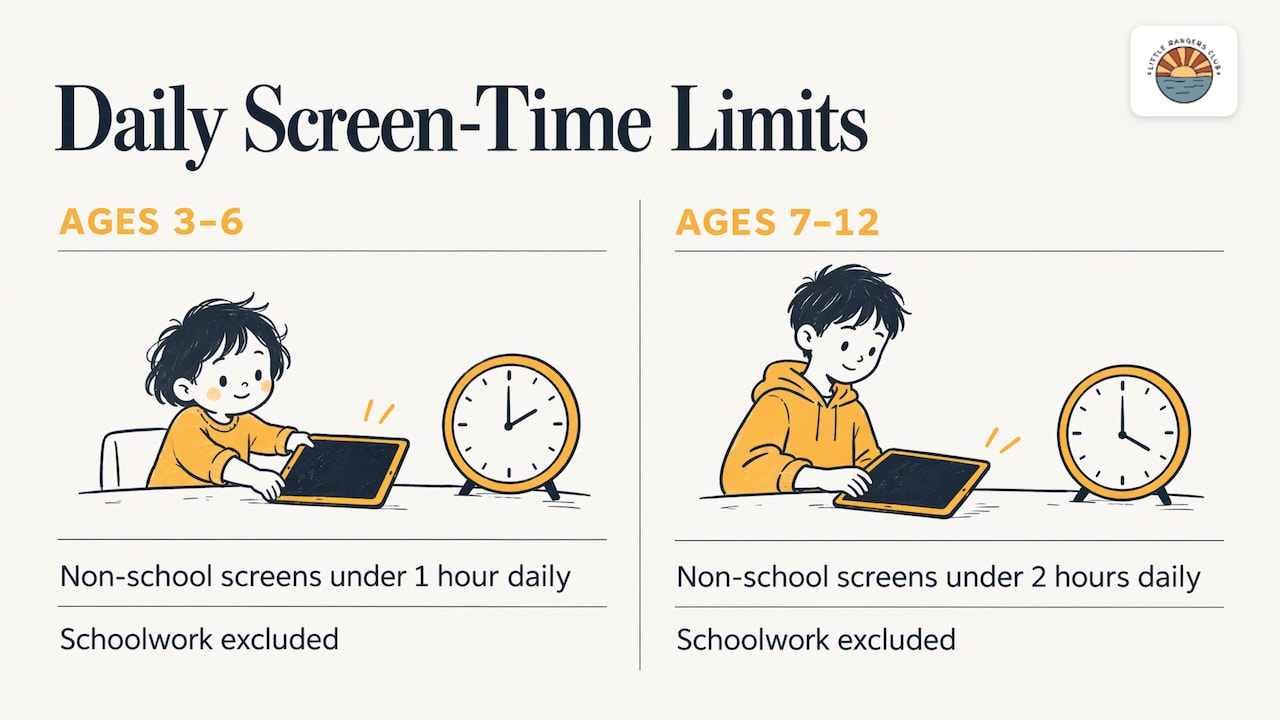
The Ministry of Education’s Grow Well SG announcement from January 2025 says non-school screen use should stay under 1 hour a day for ages 3 to 6 and under 2 hours for ages 7 to 12, unless it is for schoolwork. Making the active choice easy and the screen choice time-limited works better than arguing each afternoon.
If Your Child Lacks Confidence
Children who avoid exercise often fear being the slowest. Three habits help:
- Practice in a low-pressure setting, with just family at first.
- Pick activities where success is not about speed, such as obstacle courses or treasure hunts.
- Let them lead, as above.
Friendships also change the picture. Our guide on helping kids make friends covers how shared activity builds those bonds, and a child with a friend in class is far more willing to turn up.
Strength Play at Home: Keep It Safe
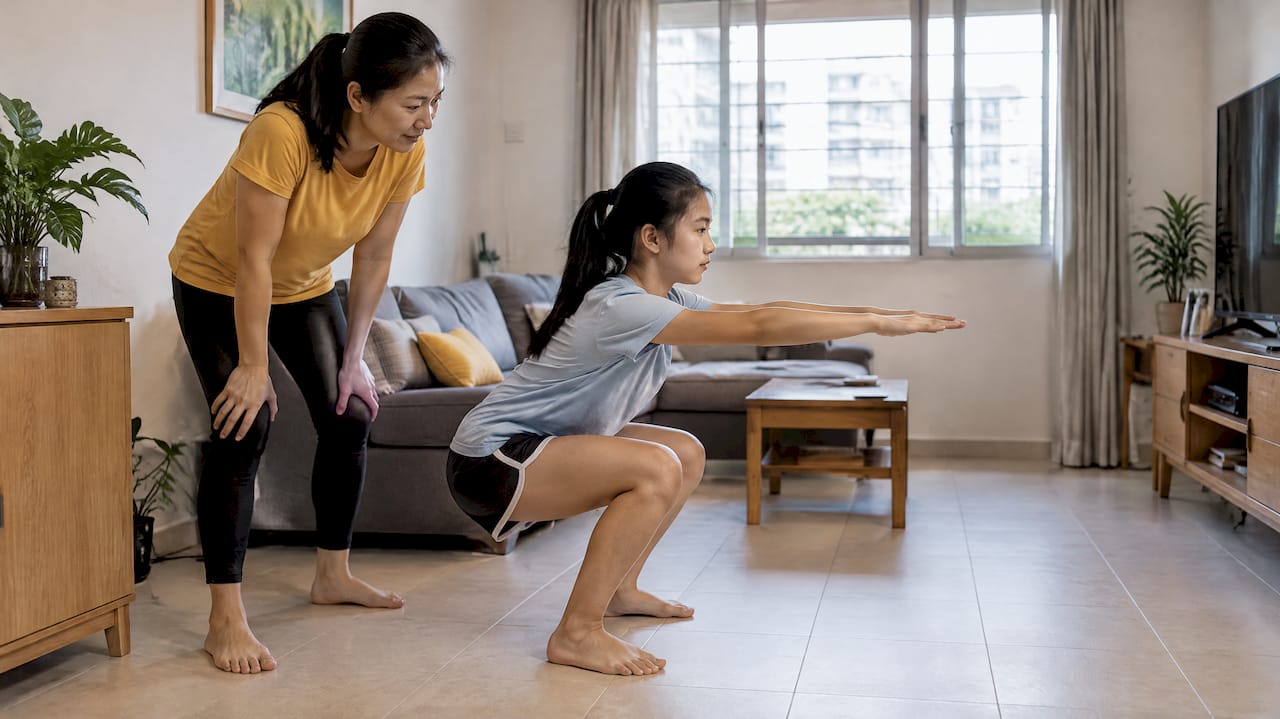
If your older child wants to “get stronger”, Singapore’s youth strength-and-conditioning consensus statement recommends starting with bodyweight exercises and learning sound technique before adding any load. It also discourages training to muscular failure, because tired muscles compromise form and raise injury risk. For younger children, Sport Singapore’s GetActive@Home pack advises checking the area and equipment, adapting activities to age and ability, and taking part alongside your child.
Why a Weekly Class Keeps Motivation Going
Home play is the foundation. A regular class adds what a parent alone cannot: a fixed day, peers, a facilitator who plans the games, and variety. When every session is different, there is always something to look forward to. Our guide to multi-sports programs for kids explains how this works, and our overview of structured activities for children shows what to look for. For the youngest, see sports for 3-year-olds.
Our Perspective
We run indoor and outdoor programs for children aged 3 to 13, and our approach is built on one idea: fun and learning belong together. A child who is laughing during a team challenge is also practicing teamwork, resilience and problem-solving.
That is why our weekly multi-sports classes, holiday camps and adventure activities mix games, sports and outdoor challenges rather than drilling one skill. Children who might never choose “exercise” will happily choose a mission, a race or a flight simulator session.
We also believe motivation grows from belonging. Safe settings, experienced facilitators and a group of friends give a child the confidence to try, and confidence keeps them coming back.
Joshua
Little Rangers Programs That Get Children Moving
If you want a regular rhythm, our 10 Sessions Weekly Class Package is $280 one-off and gives your child a weekly class of multi-sports play. During school breaks, our holiday camps fill the days with outdoor adventure, and for a more personal approach we offer private classes.
Celebrating soon? Our mobile birthday party packages bring active games to your home or a nearby venue, from a Combat Skirmish Laser Tag party at $360 to an Amazing Race Party Edition at $780. Schools and kindergartens can ask about our school programs and partnerships for year-end and outdoor activities.
FAQ
How do I get my child excited about exercise?
Offer a choice of two or three activities, join in yourself and keep sessions to 10 to 15 minutes at first. Link movement to your child’s interests, such as animals, treasure hunts or dance. Inviting a friend makes it more fun still.
How much exercise should my child get each day?
For ages 3 to 6, the Singapore guidelines recommend 180 minutes of activity daily, including at least 60 minutes of moderate-to-vigorous activity. For ages 7 to 17, the target is an average of 60 minutes of moderate-to-vigorous activity a day across the week.
What if my child prefers screens?
Set clear limits for recreational screen time, under 1 hour for ages 3 to 6 and under 2 hours for ages 7 to 12. Then offer an appealing alternative, ideally one that follows their interests. Keep balls and ropes visible so active play is the easy option.
Can small children do strength exercises?
Bodyweight play such as climbing, hopping and obstacle courses is a good start. Singapore’s youth guidance puts technique first and discourages training to muscular failure. Adapt activities to your child’s age and ability, and stop if anything hurts.
Sources
- Singapore Physical Activity Guidelines 2022
- HealthHub: Grow Well SG, Nurturing Healthy Behaviours
- HealthHub: Grow Well SG, Being Active
- Sport Singapore: How Parents Can Inspire an Active Lifestyle
- Sport Singapore: 5 Ways Your Kids Can Get Creative with Active Play
- Sport Singapore: GetActive@Home Resource Pack
- MOE: Grow Well SG announcement
- AAP HealthyChildren: 11 Ways to Encourage Your Child to Be Physically Active
- AAP HealthyChildren: 4 Play Ideas to Get Kids Moving
- SSI-NYSI Consensus Statement on Strength and Conditioning for Youth Athletes
- Sports and Teen Mental Health