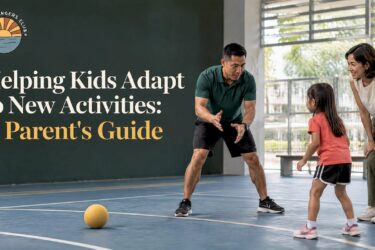
Children in Singapore need at least 60 minutes of moderate-to-vigorous activity a day from age 3, and humid afternoons, haze and school schedules often push that time indoors. Home games cover part of it. A weekly structured class with a trained facilitator gives your child a regular, varied session with other children, and that is why many parents add one. Our 10 Sessions Weekly Class Package is $280 for ten sessions. Below you will find the guidelines, home ideas that work, the safety basics and how to build a routine.
Key Takeaways
- Singapore’s guidelines call for at least 180 minutes of activity of any intensity a day for young children, and at least 60 minutes of it moderate-to-vigorous from age 3.
- Short bursts count: 15 minutes of unstructured play between other activities, or 10 minutes together as a family, add up.
- Good indoor fitness mixes running, jumping, balancing, catching and throwing, so children build a full set of movement skills.
- Warm up, drink water, and stop if your child feels giddy, breathless or in pain.
- Home play builds the habit, and a weekly class adds variety, coaching and friends to move with.
Table of Contents
- How Much Activity Does Your Child Need?
- Indoor Fitness Ideas That Work at Home
- Build the Whole Movement Toolkit
- Keep It Safe
- Make It a Habit, Not a Chore
- When a Structured Class Is the Next Step
- Little Rangers Weekly Classes
- Our Perspective
- FAQ
- Sources
How Much Activity Does Your Child Need?
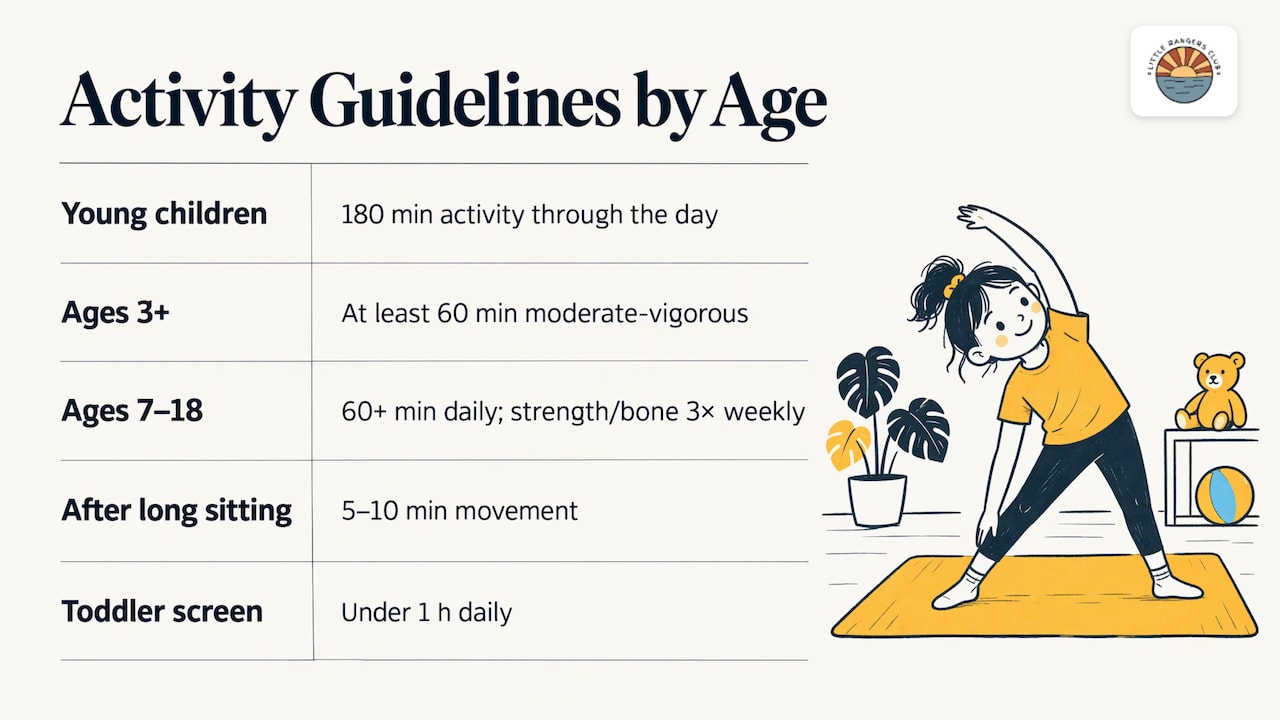
The revised 2022 Singapore Physical Activity Guidelines recommend that young children accumulate at least 180 minutes of physical activity of any intensity through the day. All children aged 3 and older should include at least 60 minutes of moderate-to-vigorous activity. Moderate-to-vigorous means your child is breathing harder and warmer than usual, like during running games, jumping or fast dancing.
For older children the Health Promotion Board’s guidance is 60 minutes or more of moderate-to-vigorous activity daily for ages 7 to 18. It also asks for muscle- and bone-strengthening activity at least three times a week, and 5 to 10 minutes of movement after long sitting spells. Screen time for toddlers should stay under an hour a day, according to HealthHub.
A worked example for a 5-year-old: 180 minutes sounds like a lot, but it is a whole day’s total. Ten minutes of dancing before breakfast, a walk to the playground, 15 minutes of hide and seek after homework, a class session and an after-dinner family game get you there without a single long workout.
Indoor Fitness Ideas That Work at Home
You do not need equipment. Singapore’s own health pages offer plenty of starting points.
Turn everyday moments into movement
HealthHub’s Grow Well SG pages suggest adding movement to everyday moments: squats during study breaks, fitness moves in TV commercial breaks, and 15-minute bursts of unstructured play such as hide and seek or catching between activities. They also suggest setting aside regular family exercise time, such as after dinner.
Games for toddlers and preschoolers
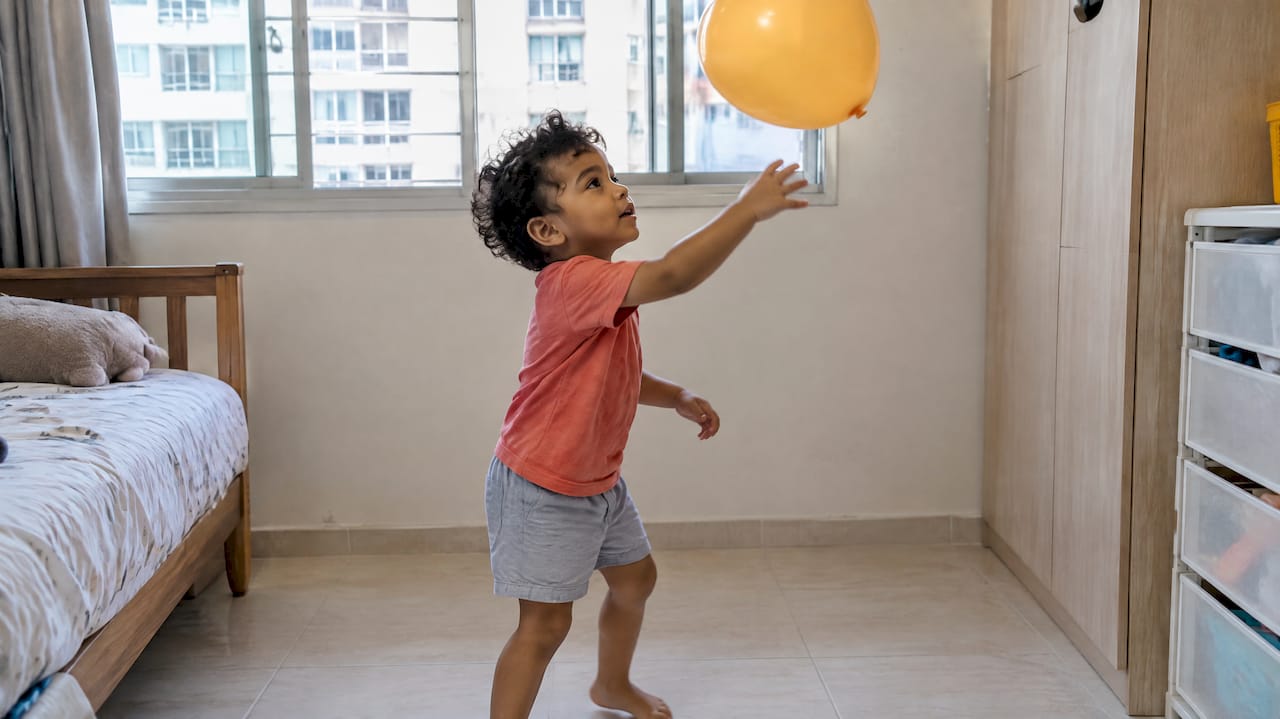
For little ones, HealthHub recommends a safe movement zone in the house, dancing to a favorite song, keeping a balloon up by hitting it with different body parts, a masking-tape hopscotch and an obstacle course made from household objects. The Being Active page adds movement cards and a Laundry Dash, where children sort clothes using silly movements.
ActiveSG’s GETACTIVE!@HOME pack gives themed warm-ups, such as crawling out of a tiger’s den, a Fruit Salad Dance and star squats, along with a daily activity chart.
Games for school-age children
Older children want challenge and a score. A timed obstacle course where they choose the order of the obstacles works well, and so does a pillow game of “the floor is lava”, according to the American Academy of Pediatrics’ parenting site. A living-room circuit with stations for squats, planks, jumping jacks and crab walks gives them a body-weight workout, as Children’s Health suggests. Rotating who picks the day’s activity keeps everyone invested.
A desktop reaction toy can also add variety to a rainy afternoon, such as a desktop speed ball for kids that rewards hand-eye coordination and quick reflexes.
Build the Whole Movement Toolkit
Good indoor fitness is more than burning energy. The GETACTIVE!@HOME pack names three groups of fundamental movement skills:
| Skill group | Examples | Home game |
|---|---|---|
| Locomotor | Walking, running, jumping | Animal walks, hopscotch |
| Object control | Catching, throwing, kicking | Sock-ball tossing, cushion catch |
| Stability | Balancing, bending, twisting | Tape tightrope, one-foot holds |
Check that a week of play touches all three. Many homes lean heavily on the first and rarely practice the second or third, because throwing and kicking need space and balance work needs a patient eye. This is where a coach adds value: a facilitator plans the session so each skill gets its turn at the right level for your child’s age.
Keep It Safe
HealthHub’s Getting Fit Through Fun advice gives clear rules:
- Dress your child in suitable clothes and shoes.
- Exercise before meals, or at least 2 hours after a heavy meal.
- Warm up and cool down.
- Skip exercise when your child is unwell.
- Stop if your child feels giddy, breathless or in pain, and offer water.
- Supervise when needed.
Clear the floor of toys, move sharp-cornered furniture and check that mats do not slide on tiles. If your child stays dizzy or short of breath after resting, see a doctor.
SPAG also offers a simple memory aid, SAFER: suitability, awareness, fitness, exercise with a buddy, and responsibility. A buddy is built in when children train in a group.
Make It a Habit, Not a Chore
Parents often ask how to get a child to keep moving. Three habits help.
- Start small. The NHS suggests starting with 10 minutes of movement together instead of aiming for long sessions.
- Join in. KK Women’s and Children’s Hospital’s early-childhood activity guidelines say caregivers should take part in toddlers’ and preschoolers’ play, and that this is associated with better developmental skills and more accumulated activity.
- Track it. A simple daily chart that your child ticks off turns movement into a goal. Our guide on motivating kids to exercise goes deeper for Singapore families.
When a Structured Class Is the Next Step
Home play is a strong base, and some children are ready for more: a regular slot, new games, children their own age and an adult who plans progression. Structured sessions answer all four. Read our parent’s guide to structured activities for children to see what a good session looks like. If your child is 3, our guide to sports for 3-year-olds is the place to begin.
If you wonder how indoor and outdoor sessions compare, see nature versus indoor enrichment.
Little Rangers Weekly Classes
Little Rangers Club runs indoor and outdoor programs for children aged 3 to 13, built around multi-sports classes that develop teamwork, resilience and problem-solving. The 10 Sessions Weekly Class Package costs $280. For one-to-one attention, ask about our Exclusive Private Classes, and during school breaks see the Little Rangers Holiday Camp.
If your child enjoys drones or aviation, our workshops include a 30-minute simulator experience at $55 per person and the Basic Build & Fly Course at $60 per person, listed on our pricing page. Schools and kindergartens can look at our school programs and partnerships, including the Aviation Exposure School Programme at $105 per student.
Our Perspective
We think children stay active when movement feels like play with a purpose. A living-room obstacle course is a great start, and we encourage every family to build that habit.
What we add is a regular slot every week, a facilitator who plans the games, and a group of children to cheer on. Teamwork, resilience and problem-solving grow when children have to solve something together, and a class gives them that every session.
Birthdays are another chance to move. Our mobile parties come to your home or a nearby venue, and the active formats, from laser tag to bubble games, keep a whole group running. See the birthday party options.
Joshua
FAQ
How can I get my child’s energy out indoors?
Short bursts work best. Try 15 minutes of hide and seek or catching between activities, a dance break, or a timed obstacle course made from cushions and tape. Finish with a cool-down so your child settles.
Can a 7-year-old run on a treadmill?
None of the Singapore guidance we reviewed recommends treadmills for children. Running and jumping games, circuits and structured classes meet the same goals, and they build catching, throwing and balance skills as well.
How long should indoor exercise last?
There is no single session length. Aim for the daily totals in the Singapore guidelines and build them from short blocks of 10 to 15 minutes. A weekly class can supply one of the longer blocks.
What if my child does not like exercise?
Join in and let them choose the game. The NHS reminds parents that having a go matters more than doing exercises correctly. Small goals on a chart help, and a class with friends can change how a child feels about moving.
Sources
- Singapore Physical Activity Guidelines (SPAG), 2022
- HPB: 60 minutes of physical activity a day
- HealthHub: Toddlers and Physical Activity
- HealthHub: Grow Well SG, Nurturing Healthy Behaviours
- HealthHub: Grow Well SG, Being Active
- HealthHub: Getting Fit Through Fun for Kids
- ActiveSG: GETACTIVE!@HOME preschool pack
- HealthyChildren.org: 4 Play Ideas to Get Kids Moving
- Children’s Health: Indoor and At-Home Exercises for Kids
- NHS Healthier Families: Let’s Move
- KKH Singapore Integrated 24-Hour Activity Guidelines for Early Childhood