
Most children adapt to a new activity when three things are in place: they know what will happen, they feel heard when they are nervous, and they get to build up one small step at a time. Structure matters as much as encouragement. That is why we run our weekly classes, holiday camps and parties with a clear routine, a familiar group and experienced facilitators, so your child spends less energy on the unknown and more on the fun.
Key Takeaways
- Talk before you go: ask how your child feels, what worries them and what they look forward to, then promise to work through it together.
- Make the unknown predictable: visit, rehearse the routine at home and tell your child what the session will look like.
- Respond to upset with understanding first, then a clear plan with a limited choice.
- Start small and let your child set the pace. Praise effort, not results.
- Most hesitation is normal and passes. Persistent distress across settings is a reason to see your doctor.
Table of Contents
- Why new activities feel hard for children
- Before the first session
- During the first sessions
- How structure helps children settle
- When your child resists or struggles to move on
- Settling into camps and parties
- Is it normal hesitation or something more?
- Our approach to a nervous first day
- Our perspective
- FAQ
- Sources
Why new activities feel hard for children
A new class means unfamiliar adults, unfamiliar children, new rules and often new sensations: noise, water, helmets, bright lights. Singapore’s Early Childhood Development Agency (ECDA) describes easing transitions as teaching children to regulate emotions and behavior when facing change or unfamiliarity, with parents and educators working as a team. So adapting is a skill, and like any skill it is learned through practice with support.
That is useful framing for you. Reluctance in week one is not a sign that the activity is wrong or that your child is difficult. It is a child doing something hard.
Before the first session
Have the feelings conversation
The Ministry of Education advises parents to talk openly about what a child feels, what makes them nervous and where their strengths lie, and to assure them you will work through new challenges together. Pick a relaxed moment, such as a car ride or bath time, and ask open questions: “What do you think will be the most fun part? Is there anything that feels a bit scary?”
Do not rush in with “There’s nothing to worry about.” PBS KIDS for Parents notes that talking children out of their feelings teaches them to hold the feelings in. Name the feeling instead: “It’s normal to feel nervous before something new.”
Make it predictable
Children cope better when they can picture what is coming. Try these:
- Walk through the day. Say where you will go, who will be there, what happens first, and when you will return. A short picture story works well for younger children. Action for Children explains that a social story can help a child feel prepared, understand what is expected and plan what to do if uncomfortable.
- Rehearse at home. ECDA suggests role-playing routines such as saying goodbye and approaching a new friend, using dolls or pretend lessons so the child links the new setting with fun. Practice asking for help too: “What would you do if you needed the toilet or felt unwell?”
- Visit first where possible. The same ECDA guide recommends a visit to meet the teachers and see the drop-off and pick-up points. PBS suggests similar practice, such as visiting the pool before swim class.
- Build the routine early. A consistent sleep time, a packed bag and a snack plan lower the load on the day. The MOH-MOE 2026 Parent-Child Activity Book says simple routines such as waking on time and packing one’s own bag help children adjust.
Prepare for the sensory side
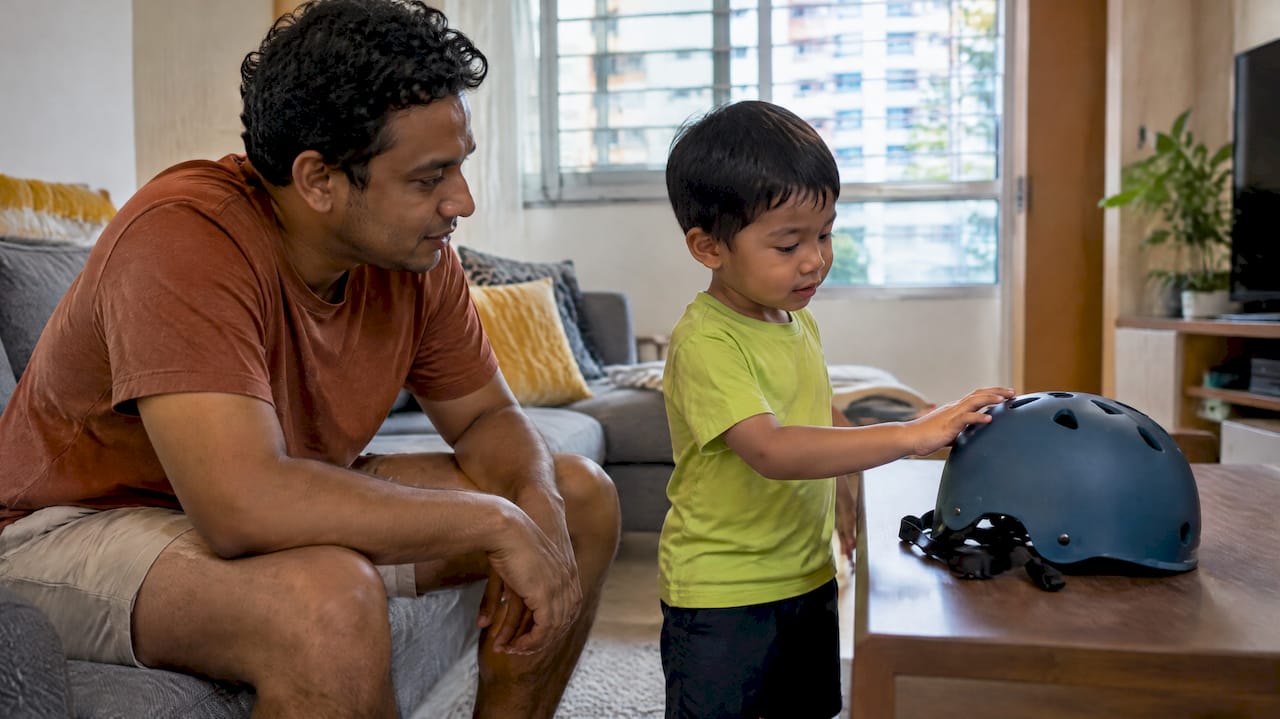
Active programs bring sensations: splashing water, loud whistles, gear on the head. KKH advises telling the child ahead about sensory experiences and introducing them gradually, starting with familiar objects and adding one element at a time, without forcing an input the child is not ready for. Let your child touch the helmet or bib at home before the day.
During the first sessions
Break it into steps
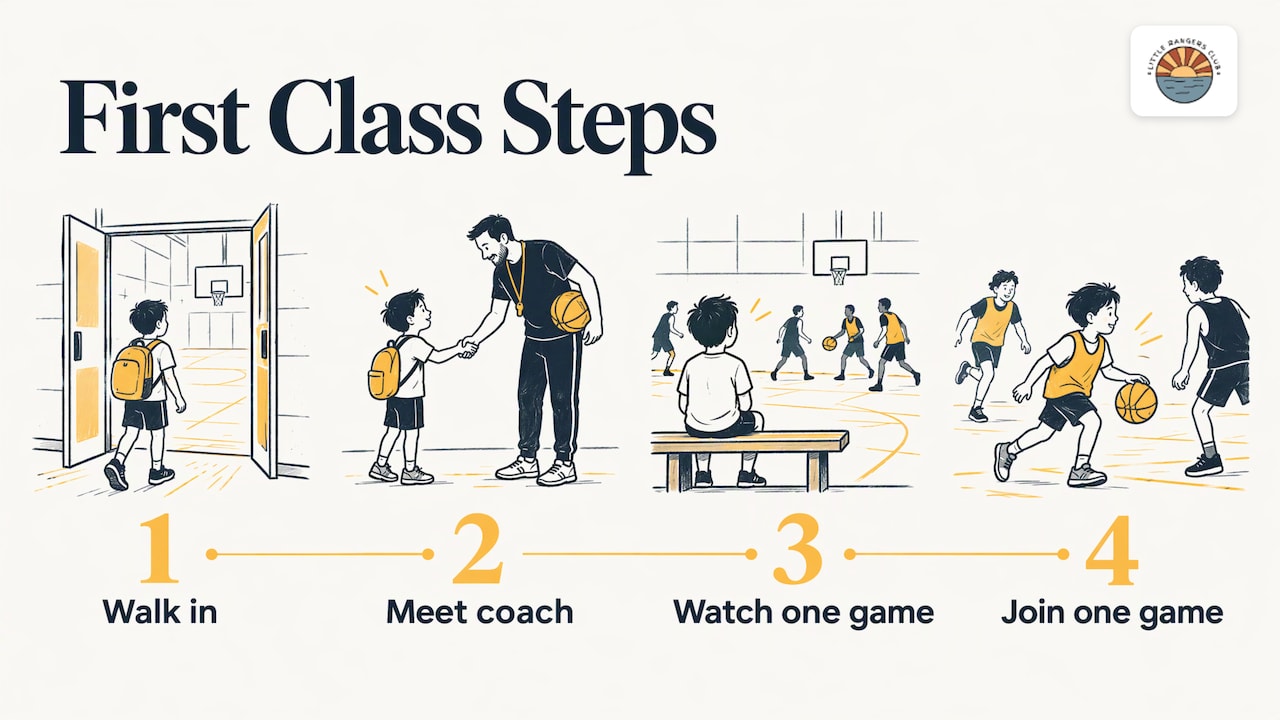
The Health Promotion Board’s Parenting for Wellness module suggests breaking an anxiety-provoking situation into parts, because avoidance tends to make anxiety worse. It also recommends trying one step at a time, praising effort whatever the result, and reminding the child that mistakes are okay.
For a first class, the steps might be: walk in, meet the coach, watch one game, join one game. If your child only watches in week one, that counts as a step forward.
Stay calm yourself
If your child gets anxious, the same HPB module suggests guiding slow deep breathing, for example tracing the outline of a hand: in up one finger, out down the other side. It also suggests acknowledging how hard the moment is and inviting your child to talk, draw or write about worries once calmer.
Set up a goodbye ritual
A short, consistent farewell, such as a high five or a special phrase, is easier than a long one. ECDA lists a drop-off ritual like a special song or a favorite soft toy as a helpful habit. Say you will be back, and be back when you said.
Expect a settling-in period
NTUC First Campus notes that separation anxiety at the start of preschool is normal and temporary, and that tantrums or moodiness during adjustment call for patience. The same applies to a new weekly class: judge it over several sessions, not one.
How structure helps children settle
The more consistent a program is, the faster children relax. In our weekly multi-sports classes, children come back to the same routine and the same group each week, so the format becomes familiar quickly. Our 10 Sessions Weekly Class Package is priced at $280 and gives a child a run of sessions to build that familiarity, rather than a single trial that may fall on a bad day. You can see how we think about this in our guide to structured activities for children.
For younger children, our guide to sports for 3-year-olds covers what a first class looks like. If friendships are the worry, see helping kids make friends. And if your child tends to give up when something is hard, our ideas for resilience building activities show how small challenges build staying power.
When your child resists or struggles to move on
Adapting is not only about starting. Some children love an activity so much that leaving it is the hard part.
Psychologist Claire Lerner says that at transition time, less is more: validate the feeling and offer a limited choice, such as getting into the car alone or with your help. She explains that a child’s discomfort can take over their thinking, so reasoning with them mid-meltdown tends to feed defiance. Validation plus a clear plan works better.
A Lurie Children’s Hospital psychologist, quoted by Care.com, recommends stating expectations before leaving, giving a five-minute warning, empathizing and using a timer. A line such as “It is hard to leave because it is fun” shows you understand without changing the plan.
A simple routine you can use:
- Tell your child before the session how it will end.
- Give a five-minute warning, then a one-minute warning.
- Name the feeling: “You’re sad it’s over.”
- Offer a choice that does not change the outcome: “Do you want to walk to the car or hop?”
- Mention the next session, so there is something to look forward to.
Settling into camps and parties
Holiday camps and birthday parties are one-off or short experiences, so preparation counts even more.
- Holiday camps. Talk through the daily schedule, practice the packing list together and let your child choose a water bottle or bag. Our holiday camps bring together multi-sport, outdoor and drone activities, so children try several things and often find one they enjoy.
- Birthday parties. Guests may be unsure of games they have never played. Explain the game beforehand and let the birthday child help choose. Our mobile parties can be held at home or a nearby venue, so the setting is already familiar. Our party packages include the Combat Skirmish Laser Tag Birthday Party at $360 and the Amazing Race Party Edition at $780.
- Workshops. If your child is curious but cautious about flying, a single flight simulator session is a low-pressure start: the 30mins Simulator Experience is $55 per person. Prices are as listed on our pricing page.
Is it normal hesitation or something more?
Most children warm up within a few sessions. These signs suggest your child is finding the transition hard: irritability, crying easily, poor sleep, nightmares and not wanting to talk about the activity. Ask about worries at a calm moment, using open-ended questions.
Speak to your child’s doctor if difficulties persist. KKH advises seeking professional help when behaviors show up consistently across settings, significantly affect daily life, or intense emotional responses continue despite support. NUH’s developmental resource also advises speaking to your child’s doctor right away if you notice a developmental red flag or have any concern about development. In Singapore, a doctor can refer children under 7 to early intervention services if needed.
Our approach to a nervous first day
If you are choosing between a group class and something more gradual, we offer Exclusive Private Classes for children who benefit from one-to-one attention at the start, and the group sessions can follow. Our weekly classes, camps and parties are designed around adventure, safety and quality instruction, with experienced facilitators who guide children through each step. Take a look at our weekly class package to see how a term is set up.

Schools and kindergartens planning year-end or outdoor activities can find our school programs and partnerships here, including the Aviation Exposure School Programme at $105 per student.
Our perspective
Children do not need to be fearless. They need to feel that the adults around them are steady, and that a hard thing can be done in small pieces.
That is how we plan every session. A new child watches first if they want to. A game is explained before it starts. Each activity has a clear start and end, and the same routines return week after week. Adventure is where children learn that nerves and excitement can sit side by side, and that trying again is part of the fun.
We would rather a child take three weeks to join in happily than be pushed in on day one. Confidence built that way lasts well beyond the class, into school, friendships and the next new thing.
Joshua
FAQ
How long does it take a child to adjust to a new activity?
It varies. Many children settle within a few sessions, and NTUC First Campus notes that adjusting to new situations takes time and patience. Judge progress across several weeks, looking for small signs such as staying longer, joining one game or talking about the class at home.
Should I stay and watch the first session?
It depends on the child and the setting. Staying nearby can help a very nervous child begin, then you can step back gradually as they gain confidence. Use a short, consistent goodbye once they are ready, and always return when you promised.
What if my child says they do not want to go back?
Ask what exactly felt hard, and acknowledge the feeling without arguing with it. Break the worry into parts and plan one small step for next time, such as meeting the coach first. If the reluctance continues alongside poor sleep or distress at other times, speak with your child’s doctor.
What if my child is upset when the activity ends?
This is common and usually comes from loving the activity. Give a warning before the end, name the feeling, and offer a limited choice about how to leave. Staying calm and consistent helps more than explaining.
Sources
- MOE: Supporting my child to transition smoothly to Primary 1
- ECDA: Laying strong foundations for positive transitions
- ECDA: Ready, Set, Preschool
- MOE: Parent-Child Activity Book 2026
- HPB: Supporting your child when they are feeling anxious
- KKH: Understanding sensory processing
- NUH: Developmental milestones
- NTUC First Campus: Preparing your child for preschool
- Action for Children: Social stories and scripts
- PBS KIDS for Parents: Build your child’s confidence
- Psychology Today: The trouble with transitions
- Care.com: Leaving when having fun
- WhichSchoolAdvisor: Transition tips