Children build resilience by doing hard, manageable things and having a warm adult help them make sense of what happened. The best activities are the ones where a child faces a small challenge, tries more than once, and feels supported along the way: active play outdoors, simple problem-solving tasks at home, team games, and calm conversations after a setback. Below you will find ideas for ages 3 to 13, what Singapore health and education bodies say about them, and how to adapt them for a shy, cautious or reluctant child.
Key Takeaways
- Resilience grows through small, repeated challenges, not one big lesson. Start with tasks your child can almost do, then raise the difficulty gradually.
- Active, outdoor and team-based play gives children safe practice at falling, trying again and working with others.
- What you say after a mistake or a loss matters. Praise effort, and ask what the child learned rather than why it went wrong.
- A warm, steady relationship with a caregiver is the base everything else sits on.
- Shy or cautious children do better when you build up step by step, from one-on-one to pairs to small groups.
Table of Contents
- What resilience looks like in a child
- Everyday resilience activities at home
- Outdoor and active activities that build grit and teamwork
- Confidence and self-esteem activities
- Team sports and adventure activities
- Helping your child cope with setbacks
- Adapting activities for age, temperament and ability
- Why we believe in adventure for resilience
- Put resilience into a weekly routine
- FAQ
- Sources
What resilience looks like in a child
Resilience is not toughness or never being upset. It is the ability to feel disappointment, calm down, think about what to do next and try again. A child who cries after losing a game, takes a breath, and asks to play another round is showing resilience.
The NUHS-NUS guide Raising a Resilient Child, written by Kelly Lee and Danielle Seah of Mind Science Centre Singapore, breaks resilience into factors identified in Singapore adolescents. They include emotional regulation, personal control, confidence and responsibility, flexibility, perseverance, optimism, positive coping, humor, and relationships and social support. That list is useful for parents because each factor can be practiced separately. A child can work on flexibility through a changed routine and on perseverance through a puzzle that takes several attempts.
The same guide quotes researcher Philip Fisher, who says the relationship a child has with a primary caregiver makes the biggest difference beyond genes. It also notes that parental warmth, responsiveness and sensitivity support self-regulation and can cushion the effect of other stressors. So the activities below work best when you do them with your child, not just to them.
Everyday resilience activities at home
You do not need special equipment. Ordinary routines are full of chances for a child to take on a small challenge.
1. Get active together
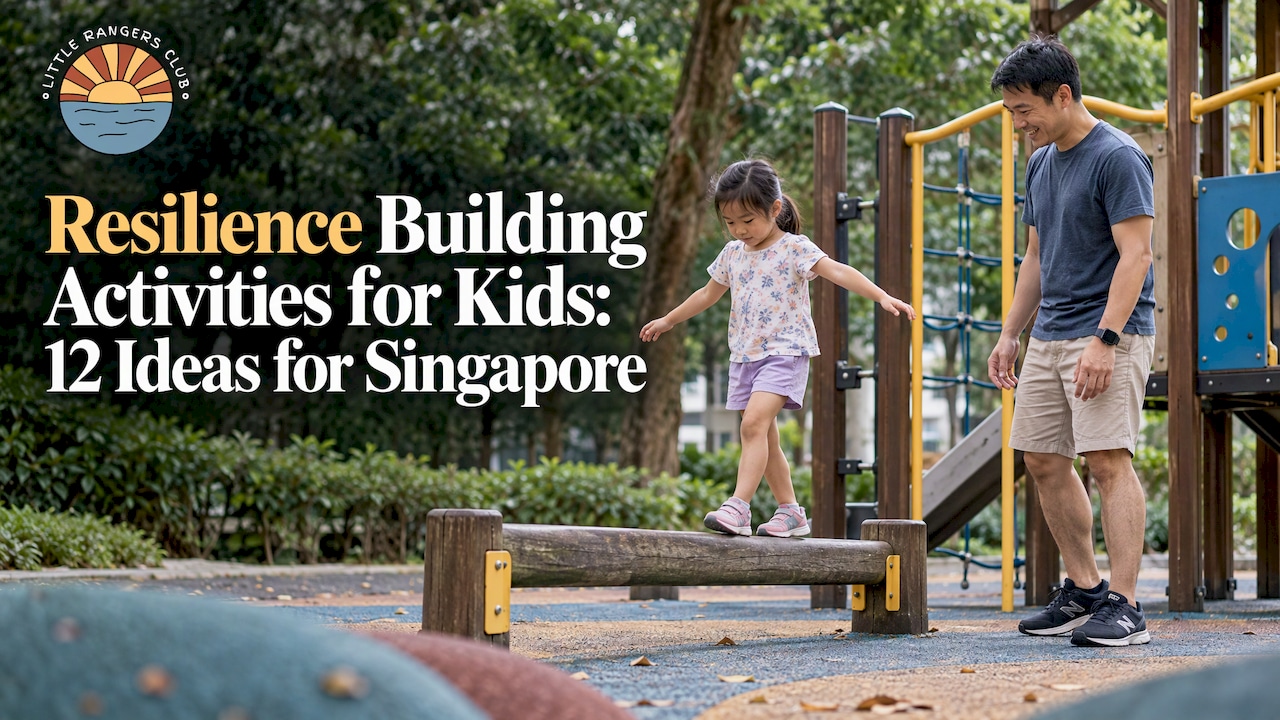
The Health Promotion Board’s advice on building resilience in your child on HealthHub suggests being active as a family, for example jogging, cycling or playing at the playground. Shared movement gives you natural moments to say “keep going” or “let’s rest, then try again.”
2. Give them a job in the kitchen
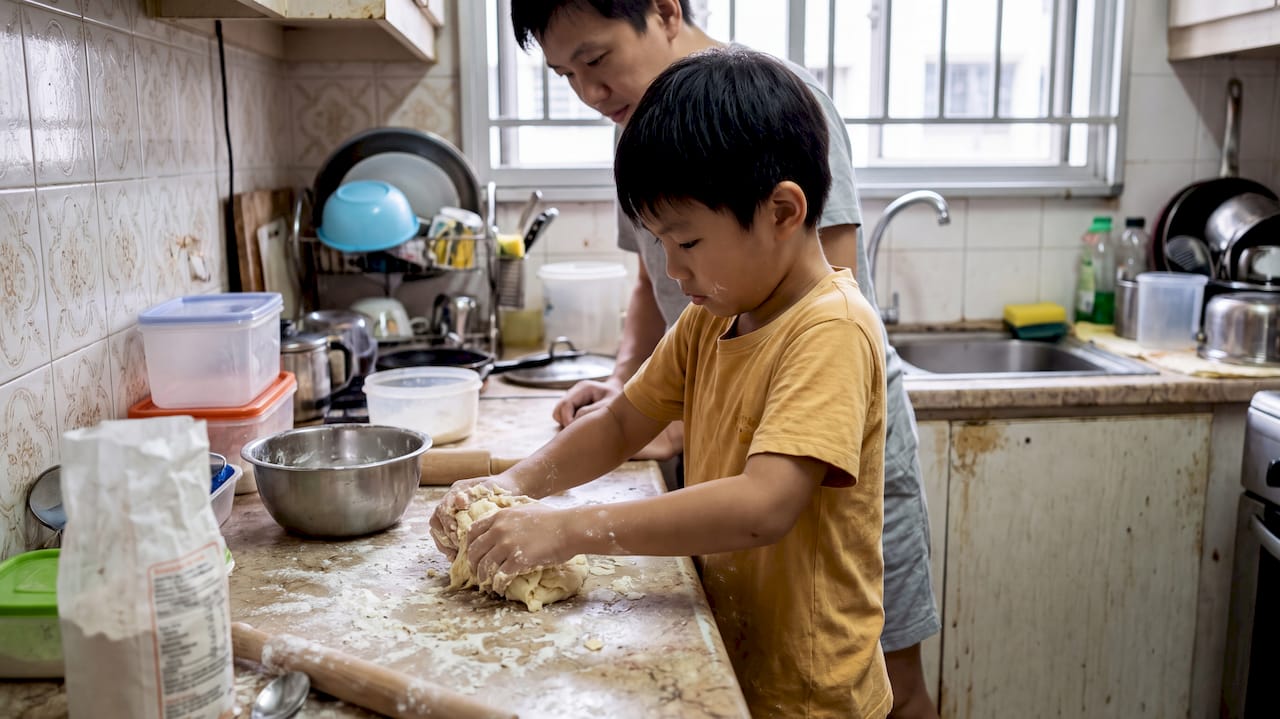
The same HealthHub page recommends kitchen-helper tasks such as kneading dough. Dough that sticks, eggs that crack and measuring that goes wrong are all low-stakes problems. Let your child fix the mess before you step in.
3. Offer real choices
HealthHub also encourages involving children in decisions. For very young children, start with two options, such as which shirt to wear or which park to visit. Older children can help plan a weekend outing or choose which activity to try next term. Making a choice and living with the result builds a sense of personal control, one of the factors in the NUHS-NUS guide.
4. Change a routine on purpose
For flexibility, the NUHS-NUS guide suggests introducing a change to a normal routine and talking your child through it, trying new rules or different ways of doing a familiar activity. Take a different route to school, play a favorite board game with a twist, or have dinner in a different order. Explain what is changing and why, then let your child say how it felt.
5. Set a small challenge and ask for solutions
The guide also recommends setting small challenges and asking your child to think of possible solutions and try them to see what works. A practical example: the bookshelf is too crowded. Ask how your child would fix it, then let them try their plan, even if it is not the one you would choose.
6. Teach “Stop, Think, Do”
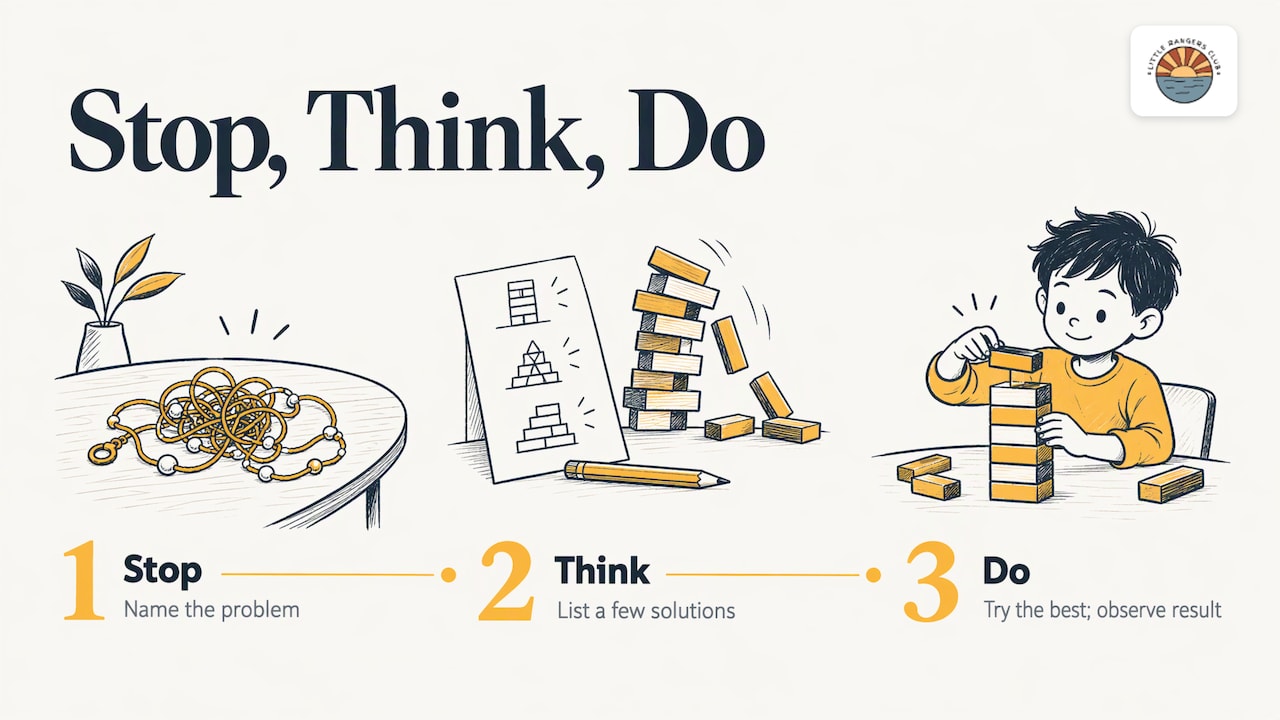
The NUHS-NUS guide describes a three-step approach: stop and think about what the problem is, come up with a few solutions, then carry out the best one. Practice on small things like a tangled necklace or a tower that keeps falling. You can also share your own experiences of coping with a problem, which shows your child what positive coping sounds like.
7. Use the word “yet”
When your child says “I can’t do it,” add “yet.” The guide recommends this because it gives hope that practice and perseverance will lead to success. It costs nothing and works for a 4-year-old tying shoelaces or a 12-year-old learning to swim laps.
Outdoor and active activities that build grit and teamwork
Outdoor play gives children something indoor activities struggle to copy: unpredictable terrain, real physical risk at a safe level, and other children to negotiate with.
The National Institute of Early Childhood Development’s article on outdoor activities that build confidence and skills says running, climbing and balancing build motor skills, and that children playing together outdoors learn to negotiate, take turns and build empathy. It also cites research linking experiential outdoor learning to better focus, stronger memory and healthier emotional growth.
Tanglin Trust School’s write-up on outdoor education makes a point worth remembering: as children fall in natural settings, they learn to pick themselves up, and that makes them more willing to take risks. It lists group tasks such as building a den together or making potions in a mud kitchen as ways to practice teamwork, negotiation and conflict resolution.
8. Take a nature trail together
HealthHub’s outdoor activity ideas for children name several Singapore options: sandcastle-building at Castle Beach in East Coast Park, the Chemperai Trail at MacRitchie Reservoir, the 600m Rain Forest Walking Trail at Singapore Botanic Gardens, the Treetop Trail, and the Wallace Trail at Dairy Farm Nature Park. Turn the walk into a small mission: find five different leaves, reach the next marker, or lead the family for the last stretch.
The same page cites a 2018 study finding that children in Singapore spend only 3.1 hours a week outdoors, compared with 13.8 hours for children in Sydney. Even one regular outdoor outing a week moves your child closer to that gap.
9. Try hands-on exploration
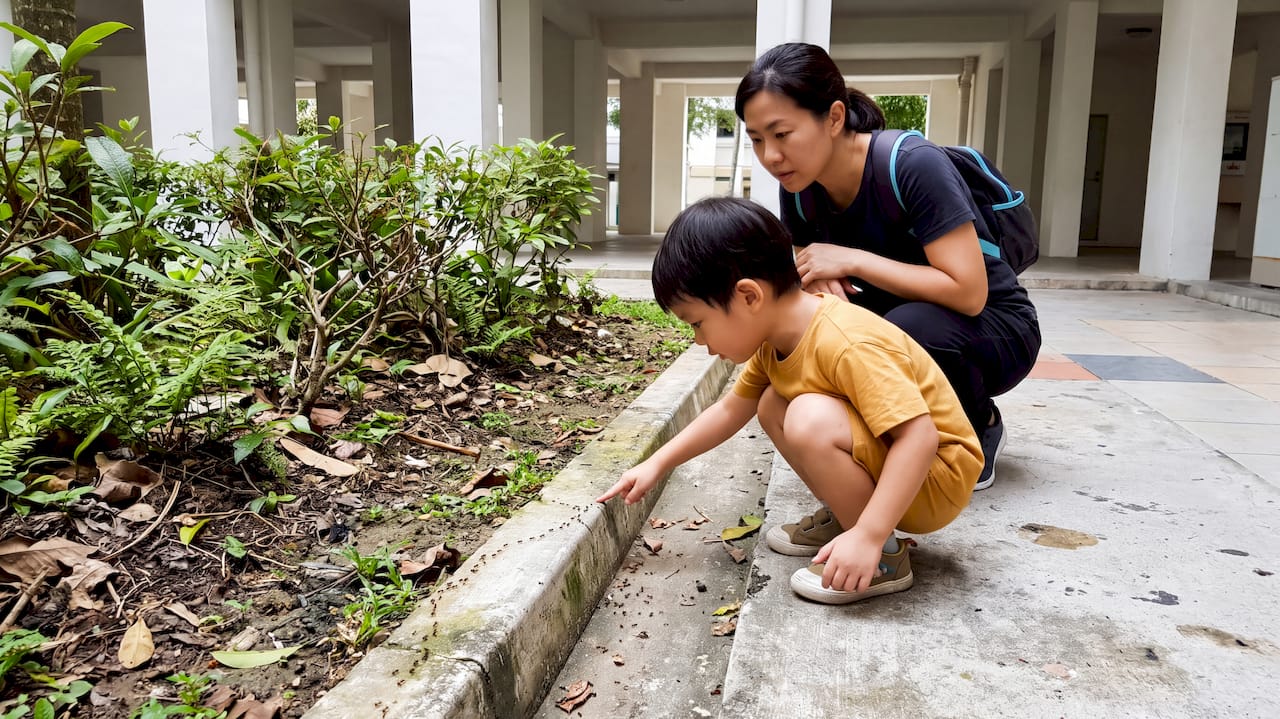
NIEC reports that activities like following ant trails and counting legs help quieter children find the confidence to speak up. A park, a school field or even a HDB void-deck garden will do. Ask open questions, then let your child be the expert for a few minutes.
10. Build up physical activity slowly
HealthHub’s Grow Well SG parent hub says being active increases self-confidence and self-esteem, reduces stress and anxiety, and fosters mental resilience. If your child resists exercise, its advice is to start with 10 to 15 minute sessions to build confidence, working toward the goal of 60 minutes of daily activity. It also encourages team sports such as football or netball to build teamwork.
This is the practical answer for a parent trying to motivate a child to exercise: make the first step so small that success is nearly guaranteed, then add a few minutes at a time. Choose something the child enjoys, join in, and talk about effort afterward rather than speed or scores.
Confidence and self-esteem activities
Confidence and resilience feed each other. A child who believes they can improve is more likely to try again, and each recovery adds to that belief.
HealthHub’s guidance for parents is simple and specific:
- Acknowledge positive choices your child makes.
- Avoid negative labels such as “lazy” or “stupid.”
- Encourage your child to try different activities to find out what they are good at.
- Praise effort, however small, to reinforce positive behavior and build self-esteem.
- Explain that different people excel at different things, and that your child can be proud of what they achieve.
The NUHS-NUS guide adds two ideas for family time. Pay special attention when your child has learned something new on their own, and invite them to talk about their strengths. A dinner-table habit works well: each person names one thing they tried this week and one thing they got better at.
11. Run a “strengths and yets” chat
Once a week, ask your child for one thing they are good at and one thing they cannot do yet. Write both on a sheet and revisit it a month later. Seeing a “yet” move across to the strengths column is more convincing than any compliment.
12. Let your child teach you
Ask your child to teach you a game, a skill or a school topic. They have to organize their thinking, handle your mistakes patiently and see themselves as capable. Younger children enjoy showing a parent a sports move; older children can teach a younger sibling.
Team sports and adventure activities
Group activity adds something a parent cannot supply alone: peers. The International Resilience Project, as reported by CNA, recommends the “I Have, I Am, I Can” technique for children, and CNA also describes team sports at recreational or competitive level as a possible win-win for mental and physical resilience.
Research on outdoor adventure supports this. A scoping review in MDPI reports that outdoor adventure education significantly enhanced participants’ grit, mastery and emotional regulation, and that participants most valued chances to build relationships, self-efficacy and resilience. It also cites work showing that when adventurous activities are scaffolded so challenge grows in steps, children’s independence, risk-taking and emotional regulation improved.
That word “scaffolded” matters when choosing a class or camp. Look for a program where challenges increase gradually, where coaches let children solve problems before stepping in, and where every child has a role. Recognition also shapes how kids experience sport; this list of team award ideas for youth sports shows how celebrating effort, teamwork and attitude, not just stats, helps children keep trying and believe in themselves.
If you are comparing options, our guides on kids sports clubs for confidence and social skills and multi-sports programs for children explain what to look for. For a wider view of local options, see our list of outdoor activities for kids in Singapore.
Helping your child cope with setbacks
Resilience is built in the moments after something goes wrong. What you say then can turn a loss into learning or into shame.
The NUHS-NUS guide advises helping children see setbacks as temporary and as chances to learn how to improve next time, and recognizing their effort even when they do not reach the end goal.
SportSG’s Active Parents Circle offers concrete scripts for sport and play:
- Wait five minutes. After a game, wait before discussing it so emotions cool, and let your child lead the conversation. The article on stepping back to raise resilient young athletes calls this the 5-Minute Rule.
- Reframe the question. Replace “Why did you lose?” with “What did you learn?”
- Name the recovery. Another SportSG article, The Right Words Matter, suggests saying “Mistakes help you learn” and following up with “What would you do differently next time?” It advises avoiding “Why did you do that?” because it can sound like blame.
NTU’s National Institute of Education adds a point about reflection. In its piece on when adults step back, Dr Caleon says children develop resilience both by hearing stories of others who overcame hardship and through their own experiences, and that guided reflection after moderate adversity helps them get the most from it. In practice: let the struggle happen, then talk it through. Do not rescue first and debrief never.
Adapting activities for age, temperament and ability
The same activity looks different at 4, 9 and 13.
Ages 3 to 5. Keep choices to two options, tasks short and the adult close. Kinderland’s screen-free coding, reported by The Straits Times, has children guide a toy “robot mouse” from one point to another. When it goes the wrong way, they adjust and try again. You can copy the idea at home with a treasure map or a floor-based obstacle path.
Ages 6 to 9. Children can handle “Stop, Think, Do” and simple reflection. Team games, trail missions and cooking projects work well. Let them own a small responsibility, such as packing their own bag for an outing.
Ages 10 to 13. Offer more independence and more say in what they try. Preteens often resist advice but respond to being asked for their own plan. Challenges can include longer outdoor adventures, learning a technical skill, or helping run something for younger children.
Shy or cautious children. A Kinderland teacher quoted in the same Straits Times report starts by chatting one-on-one, then pairs the child with a supportive peer for small tasks, and over time the child gains the courage to speak in small groups and then share ideas with the whole class. Parents can use the same ladder before a new class: meet the coach, visit once without joining, then try a first session with a friend.
Children who say “I hate sports.” Go back to the 10 to 15 minute rule, change the activity rather than the goal, and avoid comparing them with siblings.
Why we believe in adventure for resilience
We run children’s programs for ages 3 to 13, and what we see every week is that resilience shows up in small moments: a child who slips on the obstacle course and decides to go again, or a group that argues about a plan and then makes it work.
That is why our programs are built around adventure, multi-sports, outdoor learning and hands-on challenges. Children practice teamwork, resilience and problem-solving by doing, with experienced facilitators who step in when needed and step back when a child is close to solving it alone.
NIE’s research summary notes that experiential learning is linked to better physical, cognitive and social-emotional outcomes. We design for exactly that: fun and learning together, in a safe and nurturing setting, so children can stretch a little further each session.
Home habits and group programs complement each other. At home you give the warmth and the words. With us, your child gets peers, new challenges and a coach who is not their parent.
Joshua
Put resilience into a weekly routine
If you would like structured practice alongside what you do at home, our weekly multi-sports classes give children the same challenge-and-recovery rhythm with a group. The 10 Sessions Weekly Class Package is $280 one-off. Children aged 3 to 13 can also join our outdoor holiday camps; see the Little Rangers Holiday Camp page for details and current schedules.

For a child who needs a gentler start, we also offer Exclusive Private Classes. If you would rather build resilience through a celebration, our birthday party packages bring team challenges to your home or a local venue, with professional facilitation. You can also read how our approach compares in nature-based and indoor enrichment.
FAQ
What is the simplest resilience activity for a young child?
Offer a small task they can almost do, such as pouring their own water or kneading dough, and let them finish it even if it is messy. Give two choices rather than open-ended ones, as HealthHub suggests for very young children. Afterward, praise the effort rather than the result.
How do I build my child’s confidence without overpraising?
Praise specific effort, not general talent, and avoid negative labels. HealthHub advises acknowledging positive choices and praising effort however small. Pair that with chances to try different activities so your child finds real strengths.
How can I motivate my child to exercise?
Start with 10 to 15 minute sessions and build up, as the HealthHub Grow Well SG hub recommends. Pick an activity your child enjoys, join in, and keep the focus on effort and fun. A team activity such as football or netball can add a social reason to turn up.
What should I say when my child loses or fails?
Wait a few minutes, then let your child talk first. Ask what they learned or what they would do differently next time instead of asking why they failed. If your child is very upset, comfort them first and reflect later.
Are outdoor activities really better for resilience than indoor ones?
Both help, but outdoor play offers uneven ground, physical challenge and unscripted teamwork. NIEC notes that running, climbing and balancing build motor skills in ways a classroom cannot fully replicate. A mix of both gives children the widest range of challenges.
Sources
- Building Resilience In Your Child, HealthHub
- Outdoor Activities to Build Confidence and Skills Beyond the Classroom, NIEC
- The Transformative Power of Outdoor Education, Tanglin Trust School
- Outdoor Activities for Your Children, HealthHub
- Parent Hub: Grow Well SG, HealthHub
- Building resilience in Singapore’s youth, CNA
- Risky Outdoor Play and Adventure Education in Nature, MDPI
- The Art of Stepping Back, Active Parents Circle
- The Right Words Matter, Active Parents Circle
- When adults step back, kids learn to bounce back, NTU NIE
- Want children to learn better? Get them to do active learning, NTU NIE
- Raising children for life, The Straits Times