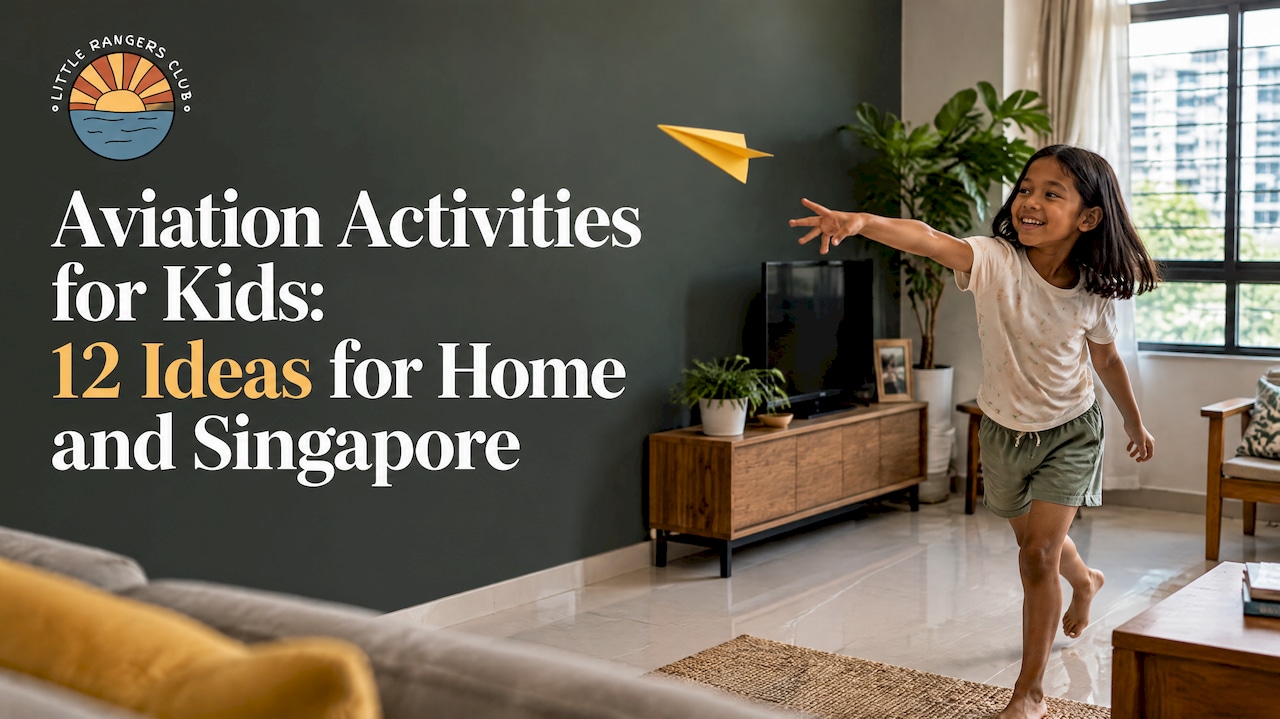
The best aviation activities for kids mix making, testing and a taste of the real thing. At home that means paper planes, balloon rockets and pretend flight school. Outside the home in Singapore it means a flight simulator session, a drone build or a school aviation program. Below you will find ideas by age, the science each one teaches, safety points and the next step when your child wants more than a living-room experiment.
Key Takeaways
- Paper airplanes are the cheapest starting point. Changing one thing at a time (folds, wing angles, paperclips) turns play into a real experiment on lift, drag and stability.
- Younger children (about 3 to 6) learn best through movement and role play, such as flight school games. Older children can handle measuring, logging and design.
- Keep home flying safe: never throw planes toward people, and watch for paper cuts.
- For hands-on flying beyond the home, simulator sessions and Build & Fly drone courses at Little Rangers start at $50 per person.
Table of Contents
- Why aviation works so well for children
- Aviation activities at home (ages 3 to 8)
- Aviation activities that link to the real world (ages 7 to 12)
- Safety, materials and time
- Quick guide: which activity for which age
- Going further in Singapore
- What children do in our aviation programs
- Aviation for a birthday party
- Our perspective
- Ready for the next step?
- FAQ
- Sources
Why aviation works so well for children
Flight is one of the few science topics a child can see, hold and change within a minute. A folded sheet of paper either glides or dives, and the child can usually tell why after two or three tries. That quick loop of try, observe, adjust is the core of engineering, and it builds patience and resilience at the same time.
Aviation also reaches into many subjects: weather, geography, mathematics, design and teamwork. A child who starts with a paper plane can end up asking how a jet crosses an ocean or why the airport tells pilots about the wind. Singapore is a good place for this, because most children here have already watched aircraft at Changi and often travel by air.
Aviation activities at home (ages 3 to 8)
These need almost no equipment. Most of them can be adapted to your child’s age simply by changing the questions you ask.
1. Fly a paper airplane and change one thing
Let your child draw a plan, fold it, fly it and mark where it lands. Engineering Explorers describes this sequence: draw plans, build, test, mark the distance, then discuss which design features worked best. The talking at the end is where most of the learning happens, so do not skip it.
A useful house rule: change only one thing between flights. If your child changes the wings and the nose at the same time, nobody can tell which change mattered.
2. Tune the plane
Small adjustments make big differences. The Australian National University science team suggests folding elevators or bending wing angles so children can investigate stability, lift and control. Ask: “What happens if the back edge of the wing bends up? What if it bends down?”
3. Tight folds versus loose folds
The Academy of Model Aeronautics shares lesson ideas in which students compare tightly folded planes with looser ones to see how drag changes the flight. It also suggests adding paperclips as payloads and watching how distance, stability and flight path change. This covers the four forces of flight (lift, weight, thrust and drag) without a single textbook page.
4. Balloon rocket race
Tape a straw to an inflated balloon, thread it on a string stretched across the room and let go. The race shows thrust very clearly. A Singapore-made Fly High activity pack includes a balloon rocket race at home, along with paper aeroplane activities in an open space or outdoors, and suggests parents adapt the questions to their own children.
5. Flight school with movement
For children aged 3 to 6, pretend play beats worksheets. The same activity pack suggests playing pilots in a flight school, and using body movements to invent and fly machines at different speeds and in different directions. Try this: you call out “slow take-off”, “fast turn left” or “gentle landing”, and your child moves like the aircraft.
If your child loves story-driven games, the same imaginative muscles are used in starter tabletop RPGs for kids, where children invent a character and act out a mission. A pilot crew with a flight plan makes a great story.
Aviation activities that link to the real world (ages 7 to 12)
Older children start asking how things work in real life. These projects connect a home activity to actual aviation.
6. Keep a weather and flight log
Pilots care about weather before anything else. The Singapore Scouts’ Young Aviator Badge has requirements across six tiers, including explaining how weather affects air activities and getting a local forecast. You can copy that idea at home: before each paper plane session, check the forecast, note the wind, and record how it affected the flights.
Meteorological Service Singapore notes that aviation is one of the main users of weather services. Its free Changi Airport weather-office visits are currently suspended till further notice, so check that page before planning anything around them.
7. Design an airport on paper
The same badge asks scouts to visit an airport and draw a diagram, map or model of its areas. After your next trip through Changi, ask your child to draw what they remember: check-in, security, gates, runways, control tower. Then compare it with the airport map. Children are usually surprised by how much they missed.
8. Identify aircraft and parts
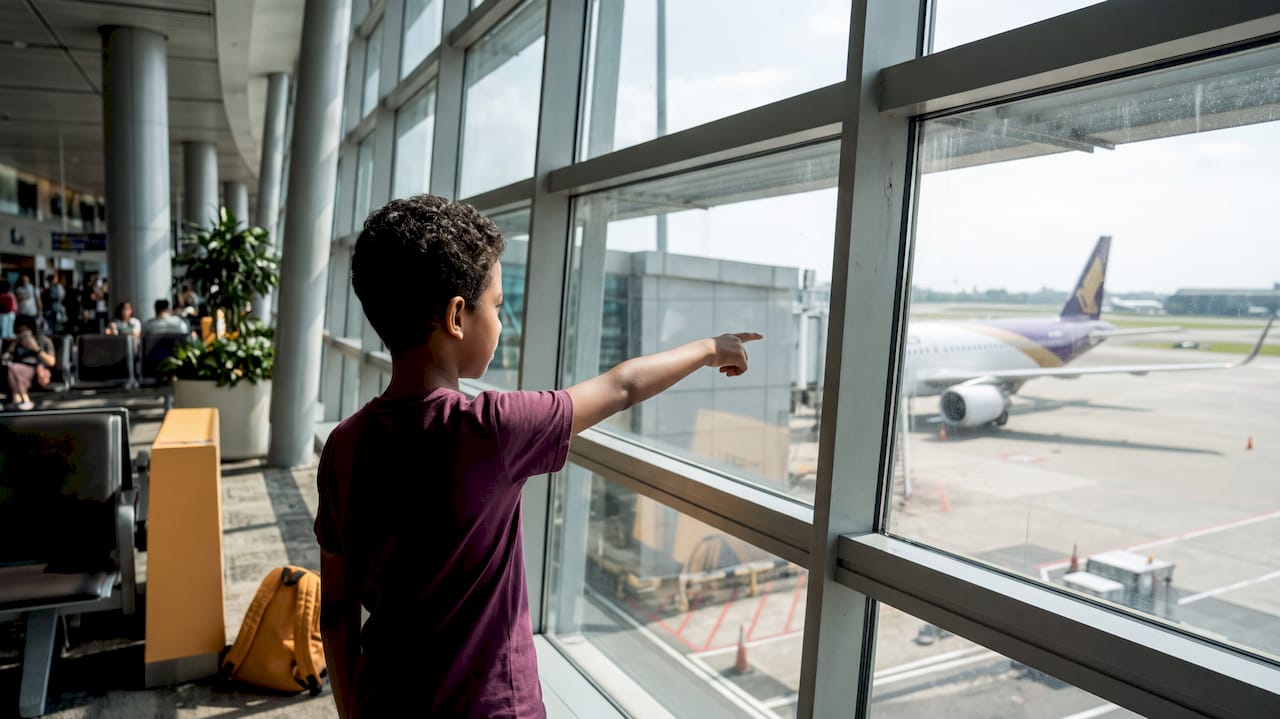
Another Young Aviator Badge requirement is identifying aircraft and aircraft parts. Print a simple diagram of a plane, label the wings, tail, rudder and flaps, then watch departures from a viewing spot and see how many parts your child can name on a real aircraft.
9. Present one discovery
End each project with a two-minute talk to the family: “Here is what I changed, here is what happened, here is what I would try next.” It teaches communication and makes the learning stick.
Safety, materials and time
Aviation activities at home need very little, but a few habits matter.
- Materials: printer paper, paperclips, tape, a ruler or tape measure, a notebook. For balloon rockets add balloons, straws and string.
- Flying direction: NUSTEM advises that planes are never flown toward people. Set a clear launch line and keep everyone behind it.
- Paper cuts: the same source warns about paper cuts when folding. Younger children can use softer craft paper, and you can fold the first creases for them.
- Time: 15 to 30 minutes suits ages 3 to 6, and 45 to 60 minutes works for older children who are logging results.
- Space: outdoors or in a large open room, away from balconies, windows and fans.
Balloons are a choking hazard for very young children, so keep broken pieces away from under-fives and supervise closely.
Quick guide: which activity for which age
| Age | Best activity | What it teaches |
|---|---|---|
| 3 to 4 | Flight school movement game, simple paper plane | Direction, speed, following instructions |
| 5 to 6 | Balloon rocket race, paperclip payload test | Thrust, weight, cause and effect |
| 7 to 9 | Tune-the-plane experiments, aircraft part labeling | Lift, drag, stability, careful observation |
| 10 to 13 | Weather log, airport design, simulator and drone programs | Systems thinking, navigation, design and control |
Going further in Singapore
Once your child has outgrown the living-room runway, there are several routes in Singapore.
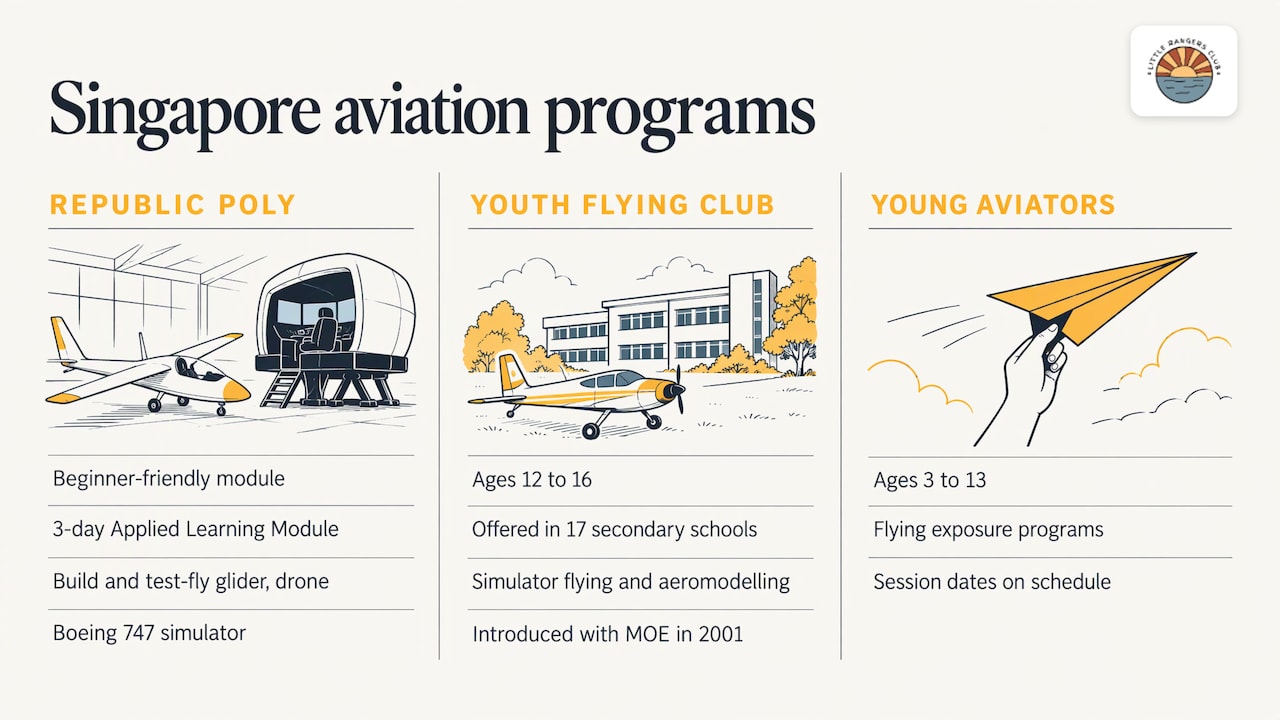
School and youth programs. Republic Polytechnic runs a beginner-friendly 3-day Applied Learning Module in which students explore aerodynamics and aircraft systems, build and test-fly a glider and a drone, and try piloting a Boeing 747 in a simulator. For secondary students aged 12 to 16, the Singapore Youth Flying Club CCA, introduced with MOE in 2001, covers aviation knowledge, simulator flying and aeromodelling, and is offered in seventeen secondary schools. Both are aimed at older students, so for younger children you need something else.
Programs for ages 3 to 13. This is where we come in. Our approach is to make flight something children do, not just hear about. Our Young Aviators flying exposure programs are designed to give children a first taste of aviation, and you can see session dates on the flying exposure schedule.
What children do in our aviation programs
Flight simulator sessions
A simulator lets a child sit in a pilot’s seat and handle take-off, turns and landing without leaving the ground. We offer a 30-minute experience at $55 per person and a 60-minute experience at $95 per person. For children who want to keep progressing, the 10-session Learn-to-Fly Simulator Package is $880. Our guides explain what to look for in a kids’ flight simulator, including safety and curriculum and the advantages of flight simulator training for young minds. For a general overview, see our flight simulator experiences in Singapore.
Build & Fly drone courses
Children who enjoyed tuning paper planes often love building a drone and then flying it. The Basic Build & Fly Course is $60 per person and the Advance Build & Fly Course is $50 per person. For casual flying, Hall-of-Fame Drone Fly Sessions are $16 to $25 per person.
Aviation Exposure School Programme
Schools and kindergartens can bring aviation to their students through our Aviation Exposure School Programme at $105 per student. It suits year-end activities and enrichment days, and works well for classes that have already tried paper plane projects.
All prices above are one-off prices as published on our site; check the pricing page for the current list.
Aviation for a birthday party
If your child is the kind who reads about planes at bedtime, a themed party can be a great way to celebrate. Our Brick-A-Drone Kids Birthday Party is $750, and it combines building with flying. Parties are mobile, so we can run them at your home or a local venue with professional facilitation. At a smaller scale, you can also borrow the paper plane distance challenge: give each guest the same sheet, ten minutes to tune and three throws to score.
Our perspective
We have watched hundreds of children go from “I can’t do it” to “let me try again” within one session. Aviation is a great teacher of that shift, because the result of a change is immediate and visible.
Our view is that the best aviation activities for kids move through three stages. First, play: fold, throw and laugh. Second, test: change one thing and compare. Third, experience: sit in a simulator seat or build a drone and fly it. Each stage makes the one before it more meaningful, and each develops the teamwork, resilience and problem-solving that we care about at Little Rangers.
That is why we combine indoor aviation sessions with outdoor, multi-sport and adventure programs. Children who run, climb and compete tend to bring that energy and confidence back to the more focused work of building a drone or handling a simulator. We design our programs, with experienced facilitators and a strong emphasis on safety, so that fun and learning stay together.
Joshua
Ready for the next step?
If your child has flown every paper plane in the house, a guided session is the natural next step. Our facilitators handle the setup, the safety briefing and the instruction, so you can simply watch your child fly. Start with a 30-minute simulator experience at $55, or look at the Build & Fly courses on our pricing page.
For school-wide or kindergarten events, see our school programs and partnerships page. For longer stretches, our holiday camps combine outdoor adventure and drone building across school breaks. If your child likes to be outside as much as in the air, our guide to outdoor activities for kids in Singapore has more ideas.
FAQ
What age can children start aviation activities?
Children as young as 3 can enjoy simple flight school role play, folding a paper aeroplane with help and balloon rocket races. From about 7, they can handle measuring, logging results and changing one design feature at a time. Our programs serve ages 3 to 13, so there is usually a level that suits your child.
What is the easiest aviation experiment to do at home?
A paper airplane test is the easiest. Fold one plane, fly it three times and mark the landing spot. Then add a paperclip to the nose and repeat, and compare the distance and the path.
Are paper airplanes safe for young children?
Yes, with a few rules. Never fly planes toward people, and be careful of paper cuts while folding. Set a launch line, and keep flights away from balconies and windows.
Can a child try a flight simulator in Singapore?
Yes. We offer a 30-minute simulator experience at $55 per person and a 60-minute session at $95 per person. Our guide on kids’ flight simulator safety and curriculum explains what a session involves.
Are there aviation programs for school groups?
Yes. Our Aviation Exposure School Programme is $105 per student. Older students can also look at programs run by polytechnics and the Singapore Youth Flying Club.
Sources
- Designing Paper Airplanes, Engineering Explorers
- How to be a Paper Plane Master, ANU
- Fold to Flight, Academy of Model Aeronautics
- Fly High Activity Pack
- Young Aviator Badge, Singapore Scouts
- Visit Us, Meteorological Service Singapore
- Make Paper Aeroplanes, NUSTEM
- Building and Controlling Flying Machines, Republic Polytechnic
- CCA, Singapore Youth Flying Club
- Starter Tabletop RPGs for Kids, D20 Collective