
The best school adventure activities in Singapore give children a real challenge they can only solve as a group, at a level that suits their age, led by trained facilitators. For schools and kindergartens, that means choosing a programme that scales from a gentle first step to a stretch task. For parents, it means finding weekly classes, camps and parties that carry the same idea outside school hours. Little Rangers Club runs indoor and outdoor programmes for children aged 3 to 13, including an Aviation Exposure School Programme at $105 per student, so you can start from a concrete option rather than a blank page.
Key Takeaways
- Adventure activities build teamwork, resilience and problem-solving best when the challenge rises step by step and the group reflects afterwards.
- Match the activity to the age: guided exploration for ages 3 to 6, team challenges for ages 7 to 9, and longer, more independent tasks for ages 10 to 13.
- Singapore has a national standard, SS 710:2024, for outdoor adventure education providers. Ask any provider how it handles supervision, risk management and equipment.
- Schools can book a ready-made programme, while parents can continue the same skills through weekly classes, holiday camps and active birthday parties.
Table of Contents
- What counts as an adventure activity for school children?
- Why schools and parents choose adventure learning
- Matching adventure activities to age
- What Little Rangers offers schools and kindergartens
- A planning checklist for school leaders
- Safety and supervision: what to check
- Extending adventure beyond the school day
- Perspective: why we build adventure around teams
- Plan your school or family adventure with Little Rangers
- FAQ
- Sources
What counts as an adventure activity for school children?
An adventure activity puts children in an unfamiliar, slightly uncomfortable situation where the answer is not obvious, and where they need each other to get through it. That could be a ropes course, a navigation task, a kayak, a build-and-fly challenge or a team race. What makes it “adventure” is the challenge and the group, not the scenery.
Singapore schools already use this idea at every level. Three examples show the range.
Secondary school. Secondary 3 students can take the five-day residential MOE-OBS Challenge, which pairs school lessons with expedition trekking, kayaking and ropes courses. Around 18,000 students took part in 2025, close to half the cohort, and the new Coney Island campus, opened on 11 September 2026, is expected to take all Secondary 3 students by 2030. The campus is built so that challenges are progressive: students start with easier tasks and work up.
Lower primary. NParks’ Kids for Nature gives Primary 1 and 2 students eight two-hour lessons, seven in the school compound and a final park excursion: a picnic for Primary 1, and a guided walk at Jacob Ballas Children’s Garden or HortPark for Primary 2.
A whole-school ladder. One primary school’s outdoor education programme moves from guided nature walks in P1 to P3, to neighbourhood hikes in P4, a three-day, two-night camp in P5 and outdoor adventure learning with reflection in P6.
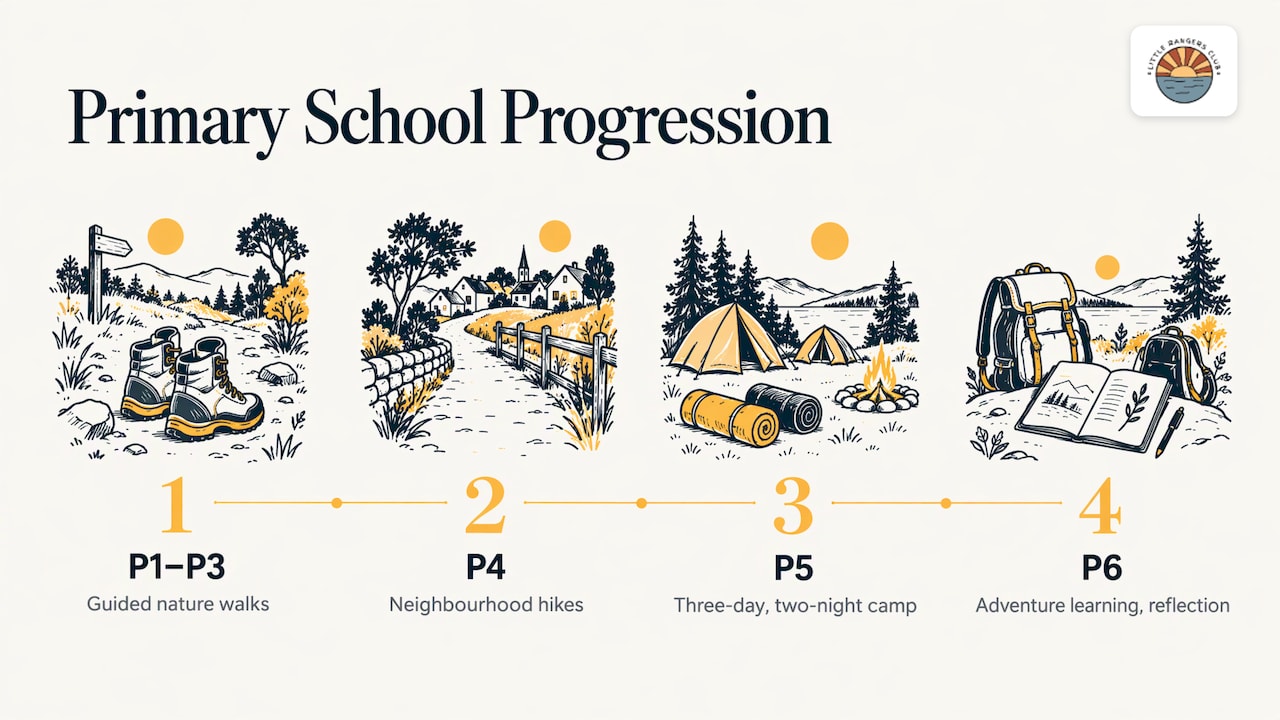
The pattern is the same each time: begin close to home, make the task a little harder each year, and give children time to talk about what happened.
Why schools and parents choose adventure learning
The case rests on more than a feeling that children enjoy being outdoors.
A 2025 systematic review in PLOS One found that adventure education significantly improved critical thinking, group belonging, resilience and pro-social behaviour in children, with higher self-esteem and better well-being reported among participants. The authors explain why: direct experience teaches children about themselves and others, and they have to respond to difficulty in an unpredictable setting that invites exploration.
A December 2025 scoping review of risky outdoor play and adventure education found that when children choose their own level of challenge, they build autonomy, competence and a sense of shared risk-taking that supports problem-solving and self-efficacy. That matters for your planning: the child should be able to pick how far to push.
The UK’s Education Endowment Foundation says outdoor adventure learning may positively affect self-efficacy, motivation and teamwork. Its suggestions are practical: challenging activities, collaborative problem-solving with reflection, support to overcome difficulties, and building on the adult-pupil relationships afterwards.
Research from the North American Association for Environmental Education community points to three mechanisms behind social-emotional learning in outdoor adventure. Children learn by struggling with physical, emotional and social challenges. Peers give practical and emotional support. And a group culture of commitment encourages members to help anyone who is stuck.
The same idea is applied well beyond schools. Some clinical teams use adventure therapy for teens because challenging group tasks can open up conversations that are hard to start in a classroom.
What this means when you choose an activity:
- The challenge must be real but reachable.
- It must need more than one child to solve.
- A facilitator should help the group talk through what happened.
A day out that is purely sightseeing misses two of those three.
Matching adventure activities to age
Age matters more than almost any other factor. A task that thrills a ten-year-old can overwhelm a four-year-old, and a gentle nature walk bores a twelve-year-old within minutes. The table below is a planning guide built from how the Singapore school programmes above progress and from the activities Little Rangers runs. It is a starting point, not a rulebook.
| Age group | What suits them | What the challenge looks like | Examples at Little Rangers |
|---|---|---|---|
| 3 to 6 (kindergarten, N1 to K2) | Short, guided, sensory activities with lots of adult support | Exploring, following simple instructions, taking turns | Nature exploration, indoor and outdoor games, bubble games party |
| 7 to 9 (P1 to P3) | Team games with clear rules and quick feedback | Working in pairs or small teams, simple navigation | Weekly multi-sports classes, relay-style and race-style parties |
| 10 to 12 (P4 to P6) | Longer tasks, building and problem-solving, some independence | Planning a route, building then testing something, leading a team | Build and fly drone courses, simulator sessions, survival training |
| 13 (lower secondary) | Skill-based activities with real responsibility | Mastering a technique, coaching others | Water sports, sailing, outdoor survival skills |
A few rules of thumb sit behind the table.
Keep the step small for younger children. Kindergarten groups do best when the adventure is a story or a mission: find the hidden items, cross the “river”, build a shelter for a toy. Success should come within minutes.
Add structure and teamwork in the early primary years. At this age children love rules and fairness. Team relays, obstacle tasks and challenges with a clear finish line work well, and it is a good time to introduce simple reflection: what worked, what would you change?
Give older children responsibility. By upper primary, children want to feel trusted. Let them plan, build, test and present rather than only follow instructions.
Check for different abilities. The new OBS campus includes wheelchair-accessible elements, and one OBS instructor described how a team with four deaf students led other students to learn sign language. Whatever you book, ask how the activity can be adapted so that every child contributes.
What Little Rangers offers schools and kindergartens
Little Rangers Club delivers structured indoor and outdoor enrichment for children aged 3 to 13, with experienced facilitators and a focus on safety, quality instruction and character development through experiential learning. For schools, the main listed option is the Aviation Exposure School Programme, priced at $105 per student. It builds on the club’s flight simulator and drone work, and you can read more about the format on the flying exposure programmes page.
Schools and kindergartens looking for special year-end activities can also use the club’s wider range of adventure-based activities, nature exploration, water sports and outdoor survival training. Our school field trip ideas go through formats that work for different class sizes, and our guide to outdoor learning for preschools is written for kindergarten teachers and principals.
Because the club’s positioning is customisable programmes for different ages, the practical first step for a school is to share the year level, group size and the skills you want to emphasise, such as teamwork, resilience or problem-solving, and build the programme around those.
A planning checklist for school leaders
Before you commit to any outdoor or adventure activity for a class, run through these questions.
- What is the learning goal? Name one or two: teamwork, perseverance, leadership, navigation. This guides the choice of activity and the reflection afterwards.
- Is the difficulty progressive? Look for an activity that starts easy and builds, as the OBS campus does, rather than a single high-pressure event.
- Is there time to reflect? The EEF’s guidance on collaborative problem-solving with reflection applies to a two-hour session as much as a five-day camp.
- How will you follow up? A short class discussion the next day helps the learning stick.
- What is the cost per student, and what does it include? Compare on a per-student basis so parents can see what they pay for.
- Are the safety arrangements clear? See the next section.
Safety and supervision: what to check
Singapore has a national code of practice for this field. SS 710:2024 sets requirements and best practices for outdoor adventure education providers. These cover:
- provider accountabilities
- supervisor and activity-leader competence
- risk management
- readiness of the location and facilities
- adequacy of equipment
- safety information for participants before, during and after activities
The standard covers abseiling and climbing, low and high challenge courses, paddling and rowing, improvised rafting, hiking and navigation, camping and experiential learning games.
In practice, a school or parent can ask any provider these questions:
- Who leads the session, and how many facilitators are there per group of children?
- How is risk assessed for the specific location and weather?
- What equipment is used, and how is it kept in good condition?
- What do children hear in the safety briefing before they start?
A public example shows what a good briefing and ratio look like. PUB’s ABC Waters Learning Trail at MacRitchie Reservoir, designed for lower secondary students, uses a facilitator-to-student ratio of 1:10 to 1:20 and a maximum group of 80. Its safety briefing covers reporting illness or animal bites, moving away from snakes, scorpions and centipedes, not entering the reservoir, and returning to the Amenities Centre on a lightning warning. Those figures belong to that trail, so use them as an example of the level of detail to expect rather than a universal ratio.
SportSG also advises matching activities to a child’s age and ability and checking the operator’s requirements, weather and safety guidance before going out. For a parent’s view of the same questions, see our child safety at outdoor camps guide.
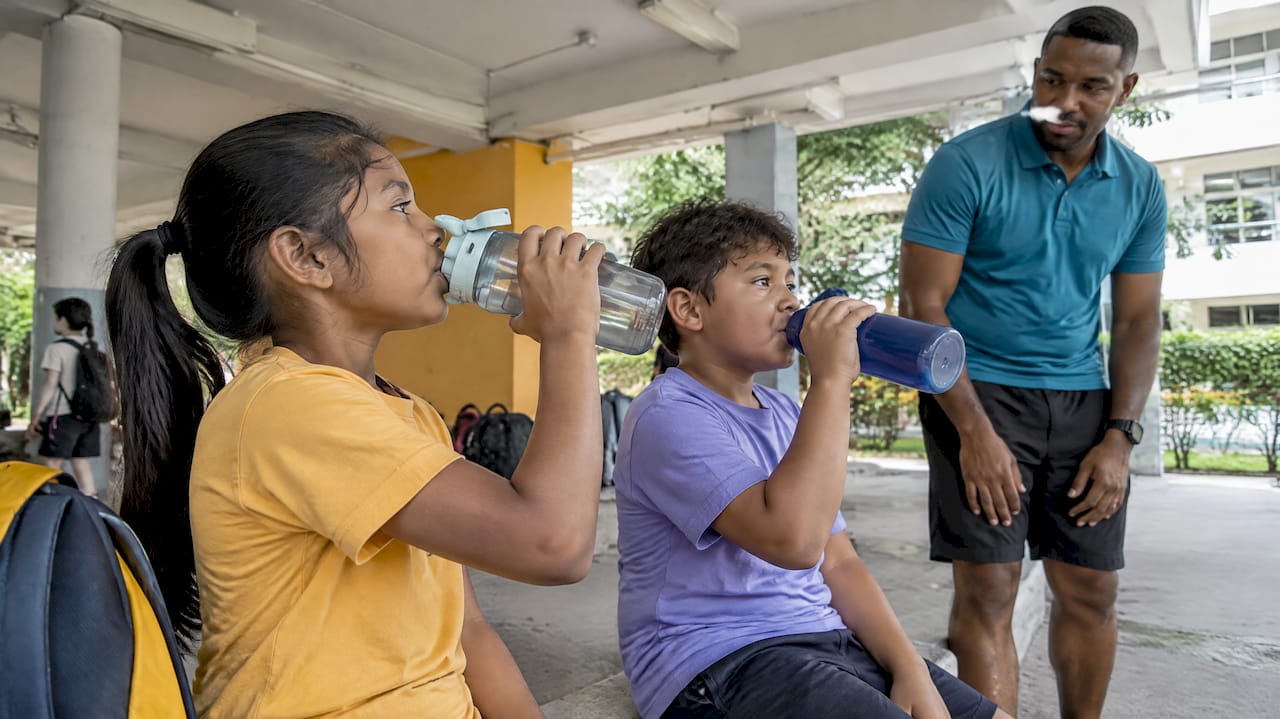
Singapore’s weather adds one more practical point: afternoon thunderstorms, heat and humidity. Plan shaded rest breaks, water, sun protection and a clear wet-weather plan for every outdoor session.
Extending adventure beyond the school day
A single school event is a good introduction. Skills grow when children get regular practice, which is where parents come in.
Weekly multi-sports classes. The 10 Sessions Weekly Class Package costs $280 and gives children a regular rhythm of physical activity, teamwork and skill building across ten sessions.
Holiday camps. SportSG’s school-holiday guide suggests hiking, canoeing, kayaking and mountain biking, plus survival skills such as map reading, knot tying and tent building. The Little Rangers Holiday Camp brings this kind of outdoor, hands-on learning into the school breaks. For a comparison of what is on offer, see our guide to the best holiday camps in Singapore.
Flight and drone workshops. For children who love gadgets and building, the club offers a 30-minute simulator experience at $55 per person, a 60-minute simulator experience at $95 per person, a Basic Build & Fly Course at $60 per person and an Advance Build & Fly Course at $50 per person. Hall-of-Fame Drone Fly Sessions range from $16 to $25 per person, and the 10 sessions Learn-to-Fly Simulator Package is $880. Everything is listed on the pricing page, and our drone skills guide explains what children learn.
Private classes. For a child who needs a more tailored pace, the Exclusive Private Classes are an option; the price is not published, so enquire with the club.
Adventure birthday parties. A party can be a team challenge rather than a sit-down event. Little Rangers parties are mobile, run at home or at a local venue with professional facilitation. The published packages are:
| Party | Price |
|---|---|
| BLOOP Bubble Games Birthday Party | $456 |
| Combat Skirmish Laser Tag Birthday Party | $360 |
| Water ZOVB and Water Tag Pool Party | $660 |
| Minute To Win It Birthday Party | $680 |
| Indoor Lego Bricks Masters Birthday Party | $680 |
| Laser Clay Shooting Birthday Party | $690 |
| Brick-A-Drone Kids Birthday Party | $750 |
| Amazing Race Party Edition | $780 |
| Sailing & Wing Foil Birthday Party | $950 |
You can see all of them on the parties and events page, and our school-age birthday activities guide helps you match a theme to your child’s age.
Perspective: why we build adventure around teams
We started Little Rangers because we kept seeing the same thing: children light up when fun and learning are the same activity. A child who is trying to land a drone on a target, or crossing an obstacle with a teammate, is practising patience, communication and problem-solving without being told to.
That is why we design our programmes around challenge, teamwork and reflection. Our facilitators set a task that is within reach, let the group work out how to approach it, and help children think about what they did well. Confidence builds because children earn it.
We also believe adventure should be close to home. Our mobile birthday parties come to your home or a nearby venue, and our school programmes are designed to adapt to different ages and group sizes. Safety and quality instruction come first in everything we run, because parents and teachers can only enjoy the day when they trust the people leading it.
If you are a school leader, start with the skill you want your students to gain, and choose an activity that practises it. If you are a parent, start with what your child already loves, and look for a programme that stretches it a little further.
Joshua
Plan your school or family adventure with Little Rangers
If you are planning a school programme, a year-end activity for a kindergarten, a holiday camp or a party, Little Rangers can help you build it around your group’s age and goals. Schools can start with the Aviation Exposure School Programme at $105 per student, and parents can explore weekly classes, camps and parties from the Little Rangers Club homepage.
Tell us the age group, the number of children and the skills you want them to build, and we will suggest the right format.
FAQ
What are good adventure activities for primary school children in Singapore?
Team-based tasks with clear goals work well: obstacle challenges, navigation games, nature exploration, build-and-fly workshops and water activities with trained instructors. Many Singapore primary schools progress from guided nature walks in the early years to hikes and camps in upper primary. Choose activities that start easy and build in difficulty.
How can kindergartens run a safe adventure day?
Keep tasks short and story-led, use a high adult-to-child ratio, and plan around heat and rain. Ask the provider about leader competence, risk management and equipment, which are the areas covered by Singapore’s SS 710:2024 code for outdoor adventure education. Little Rangers works with children from age 3 and can adapt activities for kindergarten groups.
Do adventure activities really help children develop life skills?
Research suggests they can. A 2025 systematic review reported gains in critical thinking, resilience, group belonging and pro-social behaviour. The benefits are strongest when the challenge is progressive, the group works together and there is time to reflect afterwards.
How much do school adventure programmes cost?
It depends on the activity and group size. Little Rangers’ Aviation Exposure School Programme is $105 per student, and its other published prices are on the pricing and parties pages. For custom school programmes, contact the club with your group’s age and size.
Can adventure activities continue outside school hours?
Yes. Weekly multi-sports classes, holiday camps, drone and simulator workshops and adventure birthday parties all give children regular practice. The 10 Sessions Weekly Class Package costs $280, and the holiday camp page has the latest camp details.
Sources
- Largest OBS campus opens on Coney Island (The Straits Times)
- New OBS Coney Campus officially opens (CNA)
- Kids for Nature (NParks)
- Learning for Life Programme in Outdoor Education (Greendale Primary School)
- Investigating the impact of adventure education (PLOS One, 2025)
- Risky Outdoor Play and Adventure Education in Nature (PMC, 2025)
- Outdoor adventure learning (Education Endowment Foundation)
- How challenges and peers contribute to social-emotional learning (eePRO)
- SS 710:2024 Code of practice for outdoor adventure education
- ABC Waters Learning Trail trainer’s guide (PUB)
- School Holiday Activities in Singapore: Outdoor Ideas (SportSG)