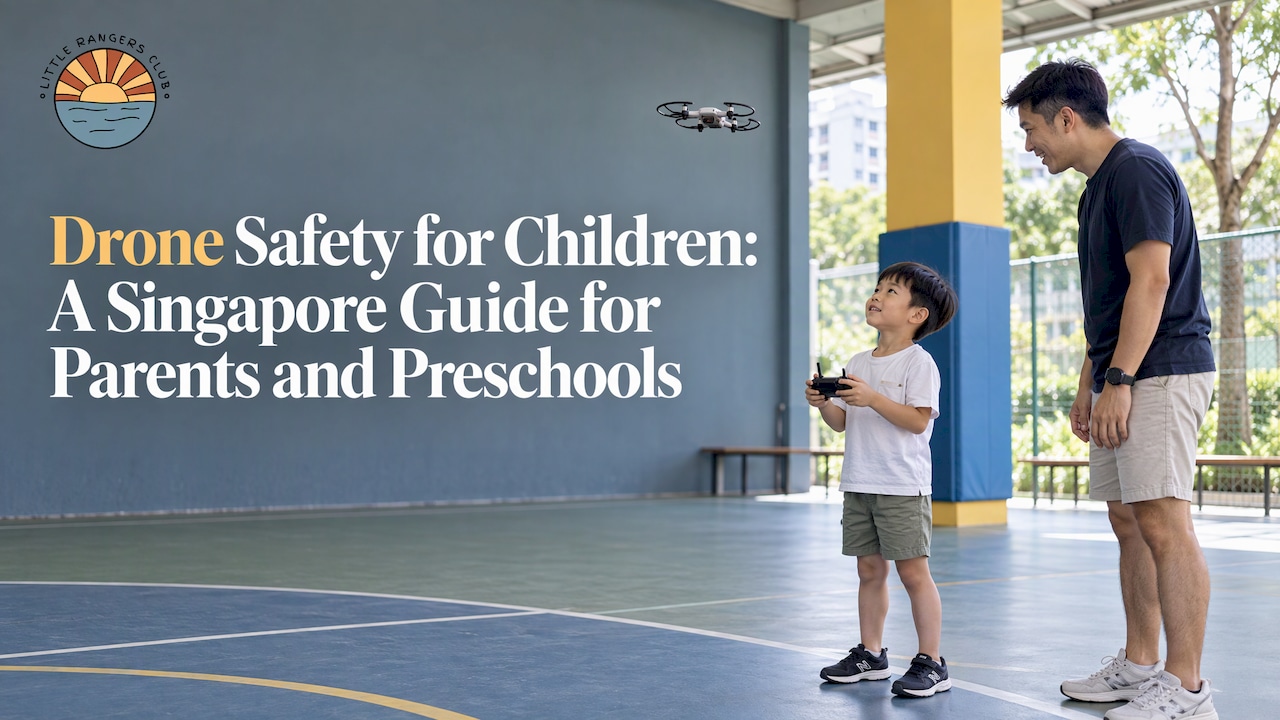
Children can fly drones safely when three things are in place: a small, guarded drone, a clear and legal flying area, and an adult who stays beside them. In Singapore the rules add a fourth: registration and permissions that depend on the drone’s weight and where it is flown. This guide covers what injuries actually happen, what the Civil Aviation Authority of Singapore (CAAS) requires, how to handle batteries and crashes, and how preschools can bring drones into a lesson. If you would rather your child learn the basics in a supervised setting first, our drone skills for children page explains what they learn and where to start.
Key Takeaways
- Most drone injuries to children are cuts to the face, head and fingers from spinning propellers, so propeller guards, eye protection and distance matter more than anything else.
- In Singapore there is no age limit for recreational flying of a drone up to 1.5kg, but CAAS recommends adult supervision for operators under 16.
- A drone above 250g must be registered. Under-16s cannot register one themselves, so a parent or guardian must.
- Batteries are the hidden hazard: check them for swelling before every flight and charge only with the right charger.
- For preschools, a supervised indoor or structured programme removes most of the legal and safety guesswork.
Table of Contents
- What actually goes wrong when children fly drones
- Singapore’s rules in plain language
- Choosing a drone that suits a child
- Before every flight: a short routine
- Batteries: the part parents overlook
- Supervision at different ages
- For preschools: bringing drones in safely
- What we do at Little Rangers
- Why a guided session is the easier first step
- Our perspective
- Frequently asked questions
- Sources
What actually goes wrong when children fly drones
The typical drone injury is not dramatic, but it is painful and often on the face. A review of US emergency department data covering 26 children aged 0 to 18 between 2010 and 2019 found that the head and face were the most affected body parts (58%). Lacerations were the most common diagnosis (42%), and 65% of injuries came from direct impact with the drone. Some 92% of the children were treated and sent home from the emergency department.
A wider US study of 2015 to 2020 drone injury records counted around 4,250 injuries. About 21% involved people under 18, and lacerations made up 72% of diagnoses. Among injuries to the arm and hand, fingers were hit most often (56%). The authors recommend propeller guards, keeping at least 16 feet (about 5 metres) away from people, and extra care around young children.
The same children’s review recorded two battery incidents: one child swallowed a drone battery, and one infant was exposed to smoke from an exploding battery. These are rare, but they explain why battery handling gets its own section below.
The pattern is useful for parents. Almost every injury comes from one of three situations:
- A child, or a bystander, is too close when the propellers spin up.
- A child reaches for the drone before the propellers have fully stopped.
- A battery is damaged, overheated or left within a small child’s reach.
Each one is preventable with a habit, not with expensive kit.
Singapore’s rules in plain language
The rules depend on the weight of the drone, which CAAS calls an unmanned aircraft (UA), and on what the flight is for. These points come from CAAS and Singapore Statutes Online.
Registration and labels
A UA weighing more than 250g must be registered, and CAAS also requires Broadcast Remote Identification for outdoor flights above that weight. You must be at least 16 to register a UA. If your child is younger, a parent or legal guardian registers it, and the child needs their permission to use it. Registration involves a S$25 label and an online application through the UA Portal. Flying an unregistered UA above 250g is an offence that can bring a fine of up to S$10,000 and/or up to six months’ jail, according to CAAS registration guidance.
Most toy drones for young children weigh well under 250g, but weigh yours with its battery fitted rather than trusting the box.
Age and supervision
CAAS states that there is no age restriction for recreational flying of a UA not exceeding 1.5kg, but it recommends adult supervision for operators below 16. For heavier aircraft, between 1.5kg and 7kg, the rules tighten. Under the Air Navigation (101 — Unmanned Aircraft Operations) Regulations, the minimum age is 16, and someone under 16 may fly such an aircraft for recreation or education only under a supervising pilot who is at least 16 and holds a UA Basic Training Certificate or UA Pilot Licence.
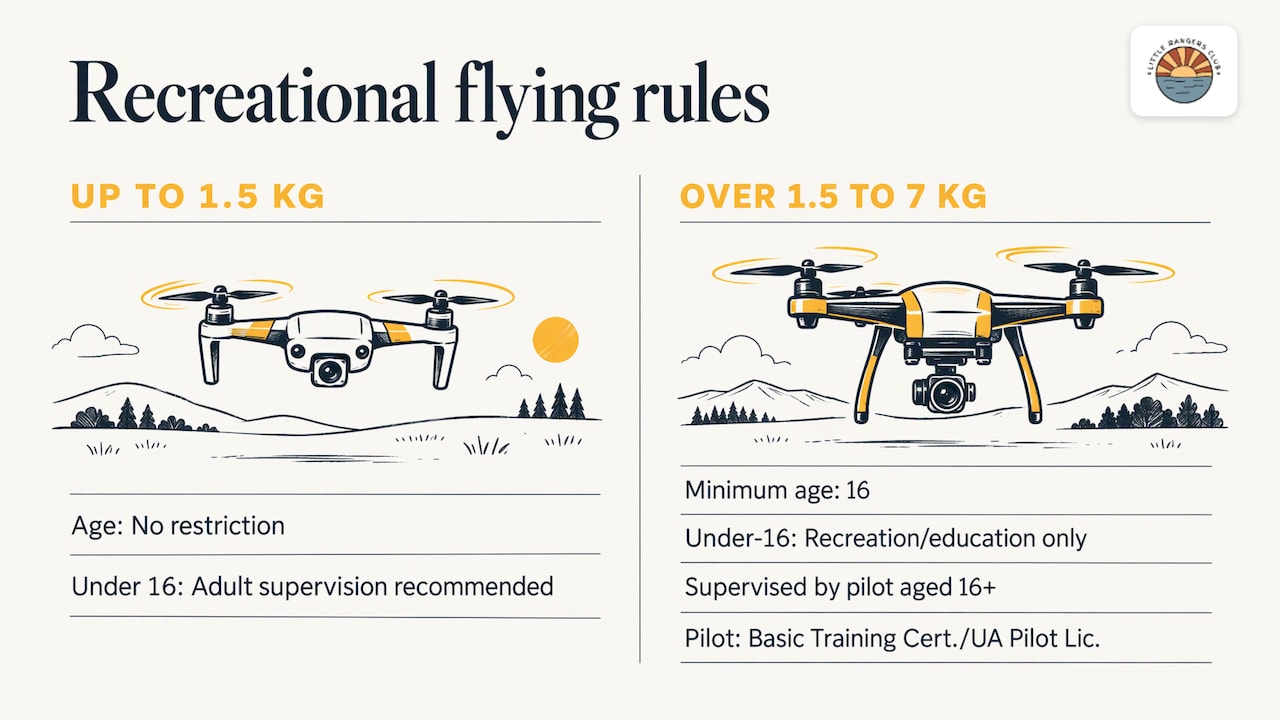
That training is a one-time course of about two hours, as set out on the CAAS basic training page. It is not needed for flying indoors in an area that the public cannot access, unless the event has more than 50 people.
Where you may not fly
No-fly zones include a 5km radius around airports and airbases, restricted areas such as military training grounds and government buildings, and crowds. A 2026 summary of the CAAS rules notes that most recreational flights under 60m above ground, outside those zones, need no permit, and that you should check OneMap’s drone no-fly layer or the CAAS map before every flight. Singapore is small and dense, so many HDB estates, parks and beaches sit close to one of these zones. Check first, every time.
What changed recently
The regulations were amended in the last two years. According to the consolidated regulations, an amendment effective 6 July 2024 took organised group sporting activities and competitions, recreational activities provided in the course of a business, flying displays and light shows out of the definition of recreational flying. A further amendment effective 29 December 2025 changed Class 2 activity permit conditions. If a school, club or business is organising flights for a group, confirm with CAAS which permissions apply before the day, rather than assuming the family rules cover it.
Choosing a drone that suits a child
Australia’s eSafety Commissioner notes that most drones are recommended for children over 12, although some are designed for children from about 8. It suggests judging the child’s patience and maturity rather than only their age, and learning to fly alongside them. That fits Singapore’s own approach, where the law sets no floor for light drones but CAAS recommends supervision under 16.
When you compare models, look for these features:
- Full propeller guards or an enclosed frame. Guards protect the face and fingers, and the injury figures above show why that matters. Guidance for parents from the UK’s The Card Project also recommends guarded or enclosed designs for children.
- Light weight. Staying under 250g avoids the registration requirement and means a collision does less harm.
- A return-to-home function you have tested on the ground first, where the model has one.
- A battery in a protected compartment, not a loose pack a toddler can pick up.
Also remember that a drone with a camera is a data device. eSafety points out that it can store personal and location information, so talk to your child about privacy and about not filming neighbours or other children without permission.
Before every flight: a short routine
School and university drone programmes use checklists because they work. Adapt this one for a living room, a void deck or a field.
- Check the space. The University Corporation for Atmospheric Research’s flight school guidance suggests an indoor space such as a gymnasium for students and checking for hazards like sprinkler nozzles and fire-detection equipment. Outdoors, confirm you are outside the no-fly zones above.
- Appoint a spotter. The same guidance describes a Range Safety Officer who confirms the launch area is clear and warns the pilot of hazards. At home, that is the adult standing next to the child.
- Put on eye protection. Safety goggles are recommended for students in that guidance, and the injury data show why: the face takes most of the damage.
- Inspect the propellers. Educators are advised to look for nicks, cracks or bends before every flight, never to fly or repair a damaged propeller, and to avoid carbon-fibre propellers with students. Replace, do not patch.
- Check the battery. It should be fully charged, not swollen and not hot.
- Set a bystander distance. Keep other children and adults well back. The injury study’s guideline of 16 feet is a sensible minimum.
- Land with charge in hand. The Card Project suggests landing with at least 20 to 30% battery left.
- Wait for the propellers to stop before anyone touches the drone. Teach this as a rule, because small hands reach early.
- Avoid rain, strong wind and fog, which the same guide lists as conditions to skip.
Batteries: the part parents overlook
Most toy drones use lithium batteries. Electrical Safety First, a UK charity, advises using only the supplied or manufacturer-recommended charger, buying replacement batteries only from the original manufacturer, and storing the drone and batteries in a dry place away from temperature extremes. If you notice odd smells, sparking, smoke, swelling, cracks or damage while charging, unplug immediately.
In Singapore’s heat, keep batteries out of parked cars and direct sun, and do not charge them overnight on a bed or sofa. Keep spare batteries in a closed container high up, because a child swallowing a battery is the most serious event recorded in the children’s injury review.
If the drone crashes
A crash is the moment most likely to damage a battery without showing it. A sensible sequence:
- Switch off the drone and controller, and let everyone step back.
- Wait for the propellers to stop before approaching.
- Remove the battery if it comes out easily, and put it on a hard, non-flammable surface such as tile, away from fabric and paper.
- Let it cool. Look for swelling, dents, heat, or a chemical smell.
- Do not charge a battery that has been hit hard or looks swollen. Replace it with one from the original manufacturer.
- Replace any chipped or bent propeller before the next flight.
If a battery is smoking or very hot, move everyone away and call 995 if it ignites. If a child is cut near the eye or has a deep wound, go to the nearest A&E rather than treating it at home.
Taking a drone on a flight
Parents often ask whether a drone can go through airport security. The CAAS packing guidance for passengers covers devices containing lithium batteries, including limits on battery size in watt-hours. Check the battery’s rating, which is printed on the pack, against that page, and confirm with your airline and the destination country before you travel, since drone import rules differ by country.
Supervision at different ages
The level of help a child needs changes as they grow:
| Age | What the child can do | What the adult does |
|---|---|---|
| 3 to 6 | Watch, press a button on a guarded toy, build and decorate | Controls the launch, keeps the drone away from faces, holds the battery |
| 7 to 9 | Fly a light guarded drone in a cleared space | Stands beside the child, runs the checks, sets distances |
| 10 to 12 | Fly with checks they have learned, plan short flights | Supervises, handles battery swaps and charging |
| 13 to 15 | Fly independently within the rules, with a guardian’s permission and registration if needed | Stays responsible for registration, no-fly checks and battery care |
This is a practical guide drawn from the research above, not a legal threshold. The legal position is the one set by CAAS earlier in this article.
For preschools: bringing drones in safely
Preschool teachers have a specific problem. You may have 20 or more four- to six-year-olds, a limited space, and parents who will ask about safety. A few principles help.
Keep young children as observers and builders, not pilots. At ages 3 to 6, the learning value lies in how a drone works, why it flies, and what teamwork looks like when one child launches and another watches. Building simple aircraft, sorting parts and learning the vocabulary all work without a spinning propeller in reach.
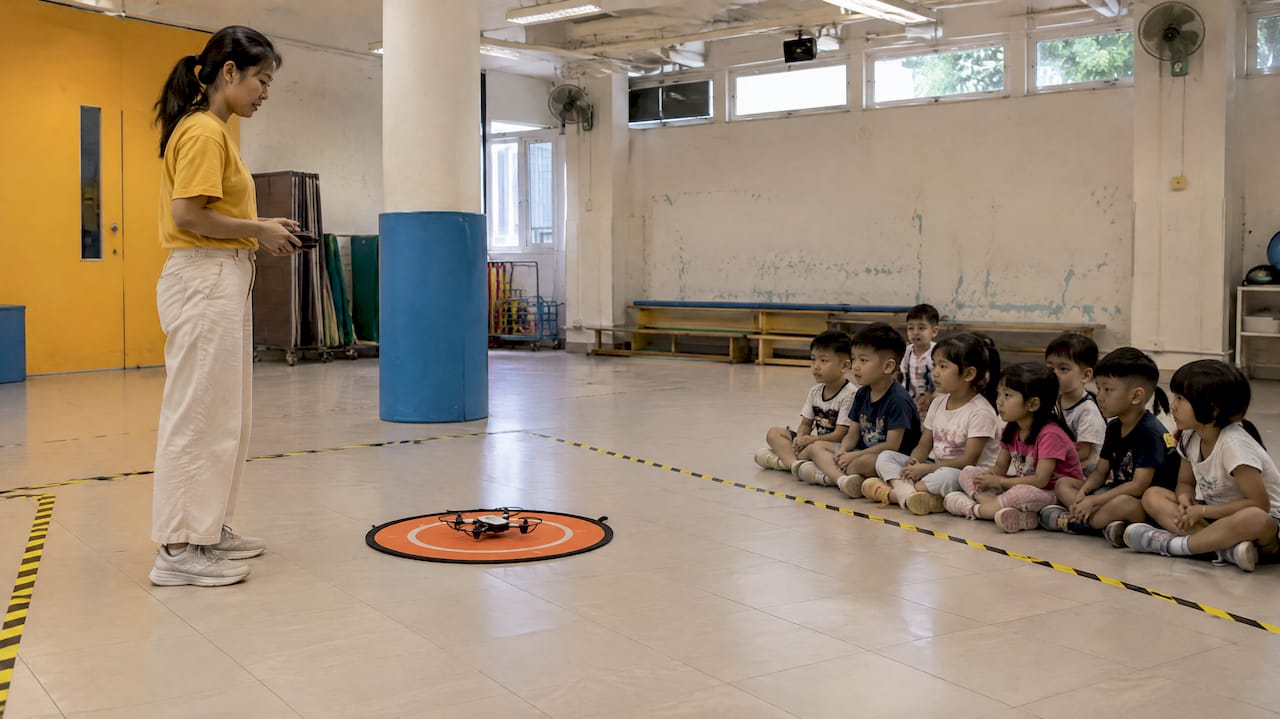
Use an indoor, non-public space. Under CAAS rules, basic training is not needed for indoor flying in an area the public cannot access, unless there are more than 50 people. A hall or covered court within the school fits that description well, but confirm your own case with CAAS.
Keep ratios tight and zones clear. Mark a launch area and a spectator area with tape. Children stay seated behind the line until the pilot lands and the propellers stop.
Check what organised group activities mean for you. Since July 2024 the regulations treat recreational activities provided in the course of a business separately from ordinary recreational flying, so ask the CAAS or your provider which permissions apply to a school event.
Plan transport properly. If the programme involves an outing, our guide to school trip transport checks in Singapore covers licences and seat belts worth checking before you book.
Year-end events are a natural moment for this. Many kindergartens run special activities for graduating classes, and a flying or aviation exposure session gives children something new to talk about at home.
What we do at Little Rangers
Little Rangers Club runs structured indoor and outdoor programmes for children aged 3 to 13 in Singapore, with an emphasis on safety and quality instruction. For schools, our Aviation Exposure School Programme is priced at S$105 per student, and the details are on our school programmes and partnerships page. For families, the pricing page lists our drone and flying options, including the Basic Build & Fly Course at S$60 per person and Hall-of-Fame Drone Fly Sessions at S$16 to S$25 per person. Our flying exposure programmes page explains how children are introduced to aviation, and our kids flight simulator guide covers safety and curriculum for the simulator side.
Why a guided session is the easier first step
Everything above is manageable, but it is a lot for one parent to hold in their head: weights, labels, no-fly maps, battery care, bystander distances. A guided session puts those habits in front of the child from the first minute, with a facilitator who runs the space.
That is the idea behind our programmes. Children learn teamwork, resilience and problem-solving through hands-on activity, and the adult does not have to be the safety officer, the instructor and the photographer at once.

If you want your child to try drones or flight in a supervised setting, start with the Little Rangers pricing page for the current drone and simulator options. If you are planning a celebration, the Brick-A-Drone Kids Birthday Party is S$750 and can be arranged through our parties and events page. Preschools can contact us about the Aviation Exposure School Programme through the schools page.
Our perspective
We think of drone safety as a set of habits, and habits are best learned young, in a setting where someone else has set up the space.
The injury data is clear that most harm comes from propellers meeting faces and fingers. That is why we teach children to wait, to look, and to keep their distance before they ever think about speed or tricks. A child who learns to ask whether the area is clear is learning something that carries into sport, cycling and the playground.
For preschoolers in particular, we would rather they build and understand than rush to fly. Curiosity about how a machine lifts off, and pride in a model they made themselves, give them confidence and a love of learning. The piloting can follow when they are older.
For parents who do fly at home, our advice is simple: guarded drone, cleared space, eyes protected, battery checked, adult beside the child.
Joshua
Frequently asked questions
Is it legal for a child to fly a drone in Singapore?
Yes, for drones up to 1.5kg there is no age limit for recreational flying, according to CAAS, which recommends adult supervision for operators under 16. Heavier drones from 1.5kg to 7kg need a supervising pilot aged 16 or above who holds the CAAS basic training certificate. Registration is needed above 250g and a parent must do it for a child under 16.
What age is right for a first drone?
Many drones are recommended for children over 12, while some are designed from about 8. Maturity and patience matter as much as age. A younger child can enjoy building and watching a drone with an adult in control.
What kind of drone is appropriate for a 7-year-old?
Choose a light drone with full propeller guards or an enclosed frame, ideally under 250g so no registration is needed. Fly it in a cleared space with an adult beside the child and safety goggles on. Check the battery and propellers before each flight.
Can a drone survive a crash, and is it safe to keep using?
The frame often survives, but the battery and propellers may not. After a crash, switch off, remove the battery, let it cool and look for swelling or heat. Replace chipped propellers and any battery that is swollen or damaged.
Sources
- Recreational Drone-Related Injuries in Children: A Review
- Drone Injuries and Safety Recommendations
- CAAS: Requirements for flying unmanned aircraft
- CAAS: Registration / Deregistration
- CAAS: Are there any age restrictions for flying UAs?
- Air Navigation (101 — Unmanned Aircraft Operations) Regulations, Singapore Statutes Online (historical version)
- Air Navigation (101 — Unmanned Aircraft Operations) Regulations, Singapore Statutes Online (amendments)
- CAAS: Unmanned aircraft basic training
- Singapore CAAS Drone Rules 2026 summary
- eSafety Commissioner: Drones gift guide
- Kids, Drones, and Safety: A Parent’s 2026 Guide
- UCAR: Learn to Fly! UAV Flight School
- Drone Safety: Preflight to Postflight
- Electrical Safety First: Drones
- CAAS: Pack for your flight